Automation and the End of 9–5 How AI Is Reshaping Work


 RSS Feed
🎧 Introduction
Welcome to AI Frontier AI, the podcast where we uncover how artificial intelligence is transforming industries, reshaping businesses, and redefining the future of work. In today’s episode, “Automation and the End of 9–5: How AI Is Reshaping Work,” Max and Sophia dive into the AI revolution that’s disrupting traditional jobs and introducing entirely new career paths.
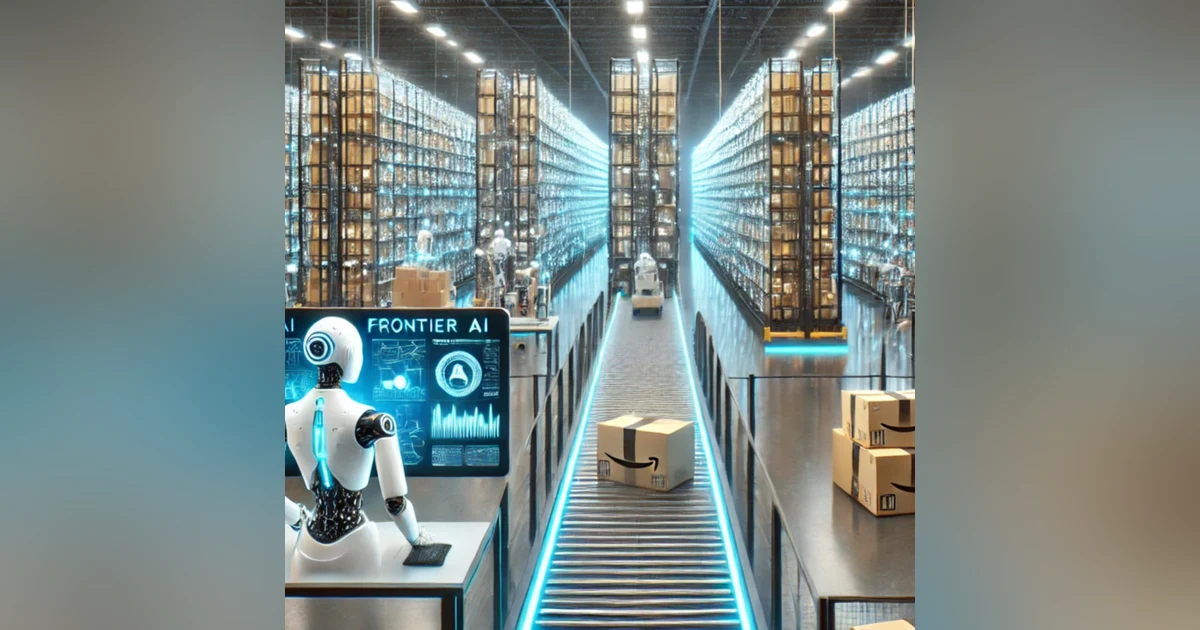
We’re hosting this episode from an Amazon Fulfillment Center—a symbol of AI-powered efficiency—where robots and algorithms are running operations 24/7. What does this level of automation mean for human workers? Are we heading toward mass job losses, or is this the dawn of new opportunities for entrepreneurship, creativity, and innovation?
Join us as we explore the rise of AI-driven automation, the industries most affected, and the tools you need to stay ahead in a world that’s changing faster than ever.
📰 Key Topics Covered
This episode explores the rise of AI and automation, diving into how machines are taking over tasks traditionally performed by humans and creating entirely new categories of work. From manufacturing and logistics to finance and healthcare, we examine the industries being transformed the fastest. Max and Sophia discuss who’s thriving in this AI revolution and who’s at risk of being left behind. They provide insights into strategies for adapting, reskilling, and staying competitive in an AI-driven economy.
AI tools are at the center of this transformation. We highlight technologies like Grammarly AI, Jasper AI, and GitHub Copilot that are turning individuals into one-person businesses capable of scaling faster than ever. The episode also looks at new roles emerging in the workforce, including AI trainers, prompt engineers, and algorithm auditors, and how listeners can position themselves for these high-demand careers.
The conversation focuses on the skills that matter most in the AI economy—adaptability, AI literacy, data fluency, and creative problem-solving. It’s not just about surviving the changes AI brings; it’s about thriving in a world where technology levels the playing field and rewards innovation.
🧑💼 Real-World Industry Insights
We take listeners inside Amazon’s Fulfillment Center, showing how AI and robotics have transformed warehouse operations into fully automated hubs of efficiency. From conveyor belts to predictive algorithms managing inventory, this episode highlights the practical impact of AI on modern industries.
We also discuss the rise of flexible work models made possible by AI tools, enabling entrepreneurs and freelancers to build businesses without traditional teams or resources. Whether it’s content creation with Jasper AI or software development accelerated by GitHub Copilot, listeners will learn how AI is turning solopreneurs into global competitors.
🎯 Key Takeaways
AI isn’t the enemy—it’s a tool that’s reshaping the economy and creating new opportunities for growth and innovation. The winners in this AI-driven world won’t be the strongest or the smartest; they’ll be the most adaptable. Success in this new era depends on embracing AI tools, developing hybrid skills that combine human creativity with machine efficiency, and learning how to lead in a technology-driven environment.
AI is here to stay, and whether it’s disrupting industries or empowering individuals, the key is to act now—experiment, learn, and evolve. Those who move first will have the greatest advantage.
🌐 Explore More Strategies and Insights
Visit https://www.financefrontierai.com/ to access all episodes grouped by series—AIFrontierAI, Make Money, Finance Frontier, and Mindset Frontier AI.
Follow the Top 10 Money-Making Stories and Top 10 AI Stories Changing the World—updated daily on Twitter.
Sign up for our newsletter to get in-depth insights, investment strategies, and stocks with 100%+ potential—all tied to the latest trends in AI and finance.
0:20 Picture this It's Monday morning, but there's no alarm clock, no commute, and no endless emails waiting for you. Instead, an AI assistant has already drafted your reports, analyzed your sales projections, and sent personalized responses to clients, all before you've even had your first cup of coffee. And while you sit there sipping that coffee, something hits you. This isn't just productivity, it's a revolution. AI doesn't get tired, doesn't take vacations, and doesn't need a paycheck. It's faster, smarter, and always learning. But here's the unsettling part. If AI can do all this, what's left for the rest of us? Are we looking at a future of endless opportunities or a world where millions are left behind?
1:08 That's what we're talking about today, how AI is rewriting the rules of work and what you can do to stay ahead. Welcome to AI Frontier AI, where we explore how artificial intelligence is reshaping industries, businesses, and the future of work. Today we're hosting from one of Amazon's massive fulfilment centers, a place that feels more like the set of a sci-fi movie than a warehouse. From the outside, it's sleek and industrial, towering walls of steel and glass with rows of delivery trucks lined up like soldiers ready to deploy. Step inside and it's even more striking. Robots zip through aisles, guided by AI algorithms, while conveyor belts hum with precision. It's not just a warehouse, it's a glimpse into the future of work where AI and automation operate 24/7 without a coffee break.
2:03 Imagine walking through this building, the hum of conveyor belts, the wear of robotic arms, and the glow of screens tracking every movement in real time. This isn't just a warehouse, it's a living example of how AI and automation are taking over tasks humans used to do. In the past, this level of efficiency would have taken armies of workers. Today it's run by algorithms and machines that don't stop. It's awe inspiring, but it's also a wakeu call. If AI can replace physical labor this easily, what's next? How many jobs, white collar and blue collar, are at risk?
2:46 And most importantly, what can we do to adapt? That's the big question, isn't it? It's easy to see AI as a threat, and make no mistake, it is disrupting industries faster than most people realize. But here's the other side of the story. AI isn't just replacing jobs, it's creating entirely new ones. Think about the people building and maintaining these systems. AI trainers, data analysts, and robotics engineers. These are roles that didn't even exist a decade ago. So while AI may be ending traditional nine to five jobs, it's also opening doors to careers that are more flexible, creative and driven by technology. And that's what today's episode is all about, understanding the shifts happening right now and figuring out how to stay ahead of them. Whether you're worried about losing your job or excited about the possibility's AI brings, this episode is your guide to navigating the future of work.
3:43 We'll look at how industries are adapting, the new skills you need to stay competitive, and the tools that can make AI your greatest ally instead of your biggest threat. Before we dive in, make sure to subscribe on Ale Podcast, Spotify, or Finance Frontieraicom to stay ahead of AI trends and insights. Now let's get started. Picture this. You walk into a factory and it's running at full speed. Machines are assembling products, inspecting quality, and even packing orders. Not a single human worker is insight. Or imagine this, an AI assistant in a call center is resolving customer complaints faster than any human ever could, and it's doing it 24/7 without taking breaks.
4:30 That's not science fiction. It's happening right now. AI isn't just transforming industries, it's completely rewriting the rules of productivity and efficiency. And the big question we're asking today, if AI can do the work faster, cheaper, and more accurately, where does that leave human workers? It's not just manufacturing or customer service. AI is automating everything. In finance, AI algorithms are analyzing market data and executing trades in milliseconds. In health care, AI systems are reading medical scams and detecting diseases with higher accuracy than doctors.
5:11 Even creative industries design, marketing and film production are seeing AI generate content faster than teams of professionals. The speed and scale are incredible, but it's also a wake up call. Traditional jobs are disappearing and entire industries are being forced to adapt or risk becoming irrelevant. And let's talk about who's adapting the fastest Big companies. Amazon's warehouses are now filled with robots that can short pack and ship millions of products a day. Walmart is using AI to optimize inventory and predict buying trends weeks in advance. Tesla's factories? They're practically automated cities, producing thousands of vehicles with minimal human intervention.
5:56 The result? Lower costs, higher profits, and faster delivery. But here's the catch. While companies are scaling up, workers are being scaled out. That's the tough part. For every job AI eliminates, it creates new ones. But the transition isn't seamless. We're seeing the rise of AI trainers, data annotators, and algorithm auditors. But here's the problem. Those roles require entirely different skills, and most workers aren't ready. It's like trying to switch from driving a car to piloting a spaceship overnight. The tools are there, but the training gap is huge and that's where industries and governments need to step up because the pace of change is leaving too many people behind. And it's not just about retraining, it's about rethinking the whole idea of work. AI isn't just replacing repetitive tasks, it's redefining what jobs even look like. Think about freelancers who can now use AI to automate marketing, accounting, and customer outreach. Or creators who are leveraging AI to edit videos, write scripts, and design graphics without needing big teams. AI is enabling solopreneurs to build businesses that once took entire companies.
7:12 But the shift raises a bigger question. Are we ready for a world where traditional careers are replaced by flexible AI powered work? And readiness is key because the industries that embrace AI aren't just surviving, they're dominating. Logistics Companies using AI to predict supply chain disruptions are cutting costs and delivering faster. Health care providers using AI diagnostics are improving patient outcomes in scaling treatments and even farming. Yes, farming is being transformed by AI driven drones and predictive analytics. It's not about whether AI will change industries it already has. It's not about whether AI will change industries it already has.
8:01 The question is, are we prepared for what's next? That's why this isn't just a conversation about jobs. It's about opportunities. AI doesn't just replace human effort, it amplifies it. It's giving small businesses tools that once only the big players could afford. It's levelling the playing field and letting anyone with ideas compete in the global economy. The challenge? Grabbing those opportunities before they pass you by. Imagine two companies competing in the same industry. One has fully embraced AI, automating workflows, analyzing data in real time, and using predictive tools to outmaneuver the competition. The other is stuck with spreadsheets and manual processes.
8:42 Which one survives? And more importantly, what happens to the employees that the company left behind? That's the reality we're facing. AI isn't just creating winners and losers at the corporate level. It's doing the same to individuals, separating those who adapt from those who resist. So the question isn't whether AI will impact you, it's how soon and how prepared you'll be when it does. And the divide is already showing. Look at Amazon. AI is helping it dominate logistics with robotic warehouses and predictive shipping models. Its competitors are struggling to keep up, and many smaller businesses are getting wiped out. But here's the twist. AI isn't just leveling the playing field for big companies. It's also empowering individuals. Freelancers, small business owners and solopreneurs now have access to AI tools that give them the power of entire corporate teams.
9:39 AI isn't just creating billion dollar empires, it's also building lean, agile businesses that didn't exist before. But let's not ignore the other side of this story, those being left behind. Studies show that millions of jobs are at risk of being automated in the next decade. Jobs in manufacturing, data entry, and even customer service are disappearing faster than people can retrain. And here's the uncomfortable truth. Many of these workers aren't equipped for the shift. Reskilling programs are lagging, and governments are struggling to keep pace. So while AI is accelerating opportunity, it's also accelerating inequality.
10:21 That's exactly it. The workers who are hit the hardest are often the ones who have the least access to education and technology to begin with. And the result? A widening skills gap where the rich get richer and the rest fall further behind. But here's where it gets interesting. This isn't just about survival. AI is also opening doors for entirely new industries. Think about AI trainers, people who teach AI systems how to learn better, or algorithm auditors, whose job is to prevent bias in AI models. These are roles that didn't even exist five years ago, and now they're in demand. Exactly.
11:01 And the best part? Most of these new jobs don't require advanced degrees. They require adaptability, being able to learn fast and stay ahead of trends. Take prompt engineering, for example. It's one of the hottest new roles, and it's all about teaching AI systems to respond accurately to commands. Anyone with strong language skills can learn it. The take away here? AI might eliminate traditional jobs, but it's also creating careers that reward creativity and agility over credentials. But there's a catch, and it's a big one. While AI is creating opportunities, it's also concentrating power in fewer hands. Tech giants like Google, Microsoft, and Open AI control the platforms and algorithms that shape this transformation. And that raises a bigger question. Are we heading toward a world where innovation is controlled by a handful of corporations, or will AI empower individuals to compete on a global scale?
12:02 That's the ultimate tension. AI is both a great equalizer and a force for consolidation. It gives creators and entrepreneurs access to tools they couldn't dream of before, but it also raises the stakes. You can either leverage AI to stay competitive or watch from the sidelines as others do. The reality is the winners in this AI driven economy won't be the strongest or even the smartest. They'll be the most adaptable. And that's the mindset shift we need to talk about. It's not enough to learn how AI works, you have to learn how to work with it. Whether you're launching a startup, switching careers, or looking for a competitive edge, AI is the key to leveling up.
12:47 But only if you move now, while most people are still hesitating. Imagine launching a Business Today. No office, no staff, just you and your laptop. But here's the twist. You're backed by an AI assistant that drafts contracts, runs your marketing campaigns, and even handles customer support while you sleep. Sounds impossible? It's not. This is the AI powered work model. And it's not just entrepreneurs. AI is reshaping entire industries by making work more flexible and scalable. Think about platforms like Grammarly that edit content in seconds, or Jasper AI, which writes marketing copy as if it were crafted by a seasoned copywriter. Tools like Zapier can automate repetitive workflows, and Notion AI turns meeting notes into actionable plans instantly. These aren't just upgrades, they're complete game changers, and they're putting powerful tools into the hands of anyone willing to use them.
13:47 Let's talk about freelancers for a second. A graphic designer today doesn't need a full team. AI tools like Canva Pro and Mid Journey allow them to create ad campaigns, social posts, and branding kits in hours, not weeks. Writers. They're using AI like ChatGPT to generate blogs, outlines, and even scripts. Video editors. Tools like this script let them cut and edit podcasts automatically. And that's just scratching the surface. The reality is AI isn't just replacing jobs, it's reinventing the rules of work and making it easier than ever to go solo. Exactly. And here's the bigger shift. AI doesn't just automate tasks, it amplifies creativity. Imagine you're a small business owner who wants to run a targeted ad campaign.
14:36 You can use AI to analyse customer behavior, predict which ads will perform best, and even personalized copy for different demographics, all without hiring an agency. Tools like HubSpot AI are already doing this, turning small businesses into marketing powerhouses. It's not about working harder anymore, it's about working smarter and AI is the shortcut. But it's not just businesses, it's careers that are evolving too. Take AI trainers, people who teach AI systems to improve their responses for prompt engineers who specialize in optimizing AI outputs. These jobs didn't even exist five years ago. And now there's some of the fastest growing fields. And the best part?
15:21 They don't require advanced degrees, just the ability to adapt, learn quickly, and stay ahead of trends. AI isn't killing opportunity, it's moving it. But the key is to follow the shift. And let's not forget remote work. AI is making it easier to collaborate globally, breaking down borders and turning talent into a borderless commodity. Companies can now hire the best talent from anywhere in the world, and freelancers can work for clients halfway across the globe without ever leaving home. Tools like Slack AI and Zoom AI Companion are making communications seamless, while platforms like Fiber and Upwork connect businesses with AI savvy freelancers who can get tasks done faster and cheaper.
16:05 This isn't just the future of work, it's already happening. And that's where the real opportunity is, learning how to make AI work for you instead of against you. Whether you're building a side hustle, scaling a business, or just trying to stay competitive in your career, AI is the tool that levels the playing field. But here's the warning, it won't wait for you to catch up. The ones who act now, who learn how to use these tools effectively, are the ones who will lead this new economy. That's the mindset we all need adaptability and action. AI isn't just a technology trend, it's the foundation of the next economy. And the tools are already here. The only question is how are you going to use them? Picture this.
16:51 You're sitting at your desk watching AI systems take over more and more tasks everyday. Reports are generated in seconds, marketing strategies are optimized automatically, and entire teams are replaced by algorithms. You start asking yourself, where do I fit into this world? And here's the uncomfortable truth. If you're waiting for someone to show you how to adapt, you're already behind. AI isn't slowing down, and the only way to stay ahead is to become the kind of person AI can't replace. The question is, how do you do that? That's the question everyone's asking right now, and the answer starts with mindset. AI can process data, predict trends, and even simulate creativity. But what it can't do is think like you. It can't question assumptions, connect emotionally, or innovate outside its programming.
17:44 That's where humans win. The future of work doesn't belong to those who just work hard. It belongs to those who can think critically, solve problems creatively, and lead with vision. And the good news? Those are skills anyone can build if they start today. But let's be real, mindset alone isn't enough. You need tools, strategies and skills that keep you ahead of the AI curve. Think about this, AI is already making coding more accessible. Platforms like GitHub Copilot are turning beginners into developers in weeks, not years. AI driven learning platforms like Coursera AI and Skillshare AI are personalizing courses to fit your learning style. And the most successful people, they're not waiting for AI to take their jobs, they're using AI to create new ones. Exactly.
18:36 And let's talk about the skills that matter most. First, AI literacy. You don't need to be a programmer, but you do need to understand how AI works, how to use tools like ChatGPT, and how to train AI models for specific tasks. Second, data fluency. The ability to interpret and act on data insights is becoming the most valuable skill in nearly every industry. And 3rd, creative problem solving. AI can analyze patterns, but it can't think outside the box. That's where humans win, and that's where the focus needs to be. And let's not forget the industries AI can't automate, at least not yet.
19:17 Roles that require empathy, emotional intelligence, and human connection like coaching, therapy, and leadership, aren't going anywhere. In fact, they're becoming even more valuable as AI takes over the mechanical tasks. So whether you're pivoting careers, launching a startup, or scaling your business, the real key isn't competing with AI. It's doing what AI can't. And that's why adaptability matters more than ever. The days of learning one skill and coasting for 30 years are gone. In this economy, you have to keep evolving. And AI doesn't just change the job market, it changes how we learn. Imagine AI tutors that personalize lessons based on your strengths and weaknesses, or AI simulations that let you practice new skills in virtual environments. That's already happening, and the people who embrace it are turning learning into their superpower. But let's talk specifics.
20:15 What can listeners do right now to future proof their careers? First, start experimenting with AI tools. Whether it's using Notion AI for productivity or Grammarly AI for writing, the more familiar you are with AI, the faster you'll adapt. Second, focus on hybrid skills. Combine human strengths like creativity and leadership with AI driven efficiency. And 3rd, keep building networks. AI can't replace the value of human relationships, especially in industries where trust matters. And let's not forget mindset, because fear is what stops most people from adapting. The reality is, AI isn't going to replace everyone, but it will replace those who refuse to adapt. The winners in this new economy won't be the smartest, they'll be the fastest to learn, unlearn, and relearn. O The question isn't whether AI is coming, it's whether you're ready to lead the change.
21:16 So here we are, on the edge of a new era where AI is reshaping not just industries, but the very concept of work. We've explored how automation is eliminating traditional jobs, creating new opportunities and forcing us to adapt faster than ever before. The take away AI isn't the enemy. It's the greatest tool we've ever had, but only for those who learn how to use it. The winners in this AI driven world won't be the ones who resist change, they'll be the ones who run toward it, armed with knowledge, creativity and adaptability. Exactly. And as we've seen, the shift is already happening, from AI tools that amplify productivity to entirely new careers built around training and optimizing AI systems. The future of work is here.
22:08 The question isn't whether AI will change your life. It's how you'll shape that change to your advantage. Whether it's building new skills, leveraging AI to launch a business, or redefining what success looks like, the time to act is now. So if you're ready to take control of your future in this AI powered world, don't wait. Subscribe now on Apple Podcasts, Spotify or wherever you get your podcasts and head over to financefrontierai.com to explore past episodes, sign up for our newsletter and get updates on the latest AI tools, strategies and insights. Because the AI revolution isn't coming, it's already here. The views and information shared in today's episode are based on our research and insights at the time of recording.
22:54 While we strive for accuracy, always do your own research and consult professionals for tailored advice. Technologies and policies change quickly, so staying informed is key. A special note about the music in today's episode, The Intro and Outro Music Night Runner by Audionautics is licensed under the YouTube Audio Library license. Additional tracks used or licensed under Creative Commons. Full details can be found in the episode description. Copyright Copyright 2024 Finance Frontier AI. All rights reserved. Reproduction, distribution, or transmission of this episode's content without written permission is strictly prohibited. Thank you for listening and we'll see you next time.


