Agentic AI Is Here: How the Top 1% Are Multiplying Decisions While Everyone Else Is Still Prompting


 RSS Feed
 🎧 Agentic AI Is Here: How the Top 1% Are Multiplying Decisions While Everyone Else Is Still Prompting
Welcome to AI Frontier AI, part of the Finance Frontier AI podcast network—where we decode how artificial intelligence is reshaping power, institutions, markets, and the architecture of global decision-making.
In this flagship episode, Max, Sophia, and Charlie break down one of the most important shifts in AI today—the move from intelligence to agency.
AI is no longer just responding. It is acting.
Most people are still using AI as a tool—prompting, iterating, and generating outputs. But a small group is moving beyond that. They are building systems where AI executes, decides, and operates continuously.
And the real edge is not using agents.
It is controlling them.
This episode is not about tools, prompts, or productivity hacks. It is a structural breakdown of how decision-making is scaling beyond human limits—and why the next competitive advantage will belong to those who design systems that can act safely at scale.
🔍 What You’ll Discover
- ⚡ The Shift to Agency — Why AI is moving from passive tools to active decision-making systems.
- 🧠 The Decision Throughput Gap — Why humans can no longer match the speed and volume of machine execution.
- 👥 The Architect vs Executor Divide — How the workforce is splitting between system designers and tool users.
- ⚙️ The Control Layer — The hidden system that determines whether automation creates chaos or power.
- 📊 The Governance Gap — Why most agentic systems fail before reaching production scale.
- 🔗 Execution at Scale — How autonomous workflows are reshaping enterprise operations.
- ⚠️ The Liability Vacuum — Who owns decisions when systems act without direct human input.
- 📉 Failure at Machine Speed — Why errors become systemic when execution is automated.
- 🏗 System Design as Advantage — Why architecture now matters more than intelligence.
- 🚀 Governed Agency Advantage — The new asymmetry defining winners in the AI era.
📊 Core Ideas Explored
- 📈 Why intelligence is becoming a commodity—and execution is becoming the bottleneck.
- 🧩 How decision-making capacity, not knowledge, now defines scale.
- ⚙️ Why automation without control creates instability instead of leverage.
- 🔄 How systems—not individuals—are becoming the primary unit of output.
- 🧠 Why intent specification replaces prompt engineering as the key skill.
- 📉 How governance lag creates hidden risk in autonomous execution.
- 🧱 Why the Control Layer determines whether systems scale or break.
🎯 Takeaways That Stick
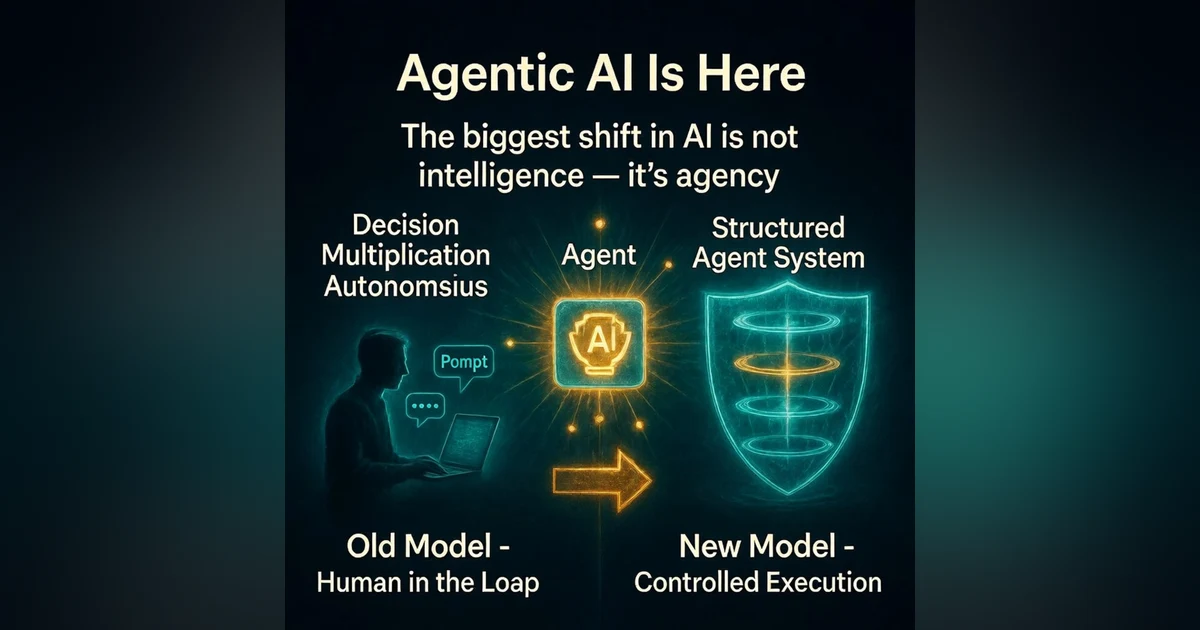
- ✅ The shift is not intelligence. It is agency.
- ✅ The bottleneck is no longer knowledge. It is decision capacity.
- ✅ Systems that act without control create chaos.
- ✅ The Control Layer turns automation into advantage.
- ✅ Access to AI is universal. Controlled execution is not.
👥 Hosted by Max, Sophia & Charlie
🚀 Next Steps
- 🌐 Explore FinanceFrontierAI.com for all episodes across AI Frontier AI, Finance Frontier, Mindset Frontier AI, and Make Money.
- 📲 Follow @FinFrontierAI on X for daily frontier-level intelligence.
- 🎧 Subscribe on Apple Podcasts or Spotify to stay ahead of structural shifts shaping the AI century.
- 📥 Join the 10× Edge newsletter for weekly intelligence, real use cases, and early signals—no hype, no noise.
- ✨ If this episode sharpened your thinking, leave a ⭐️⭐️⭐️⭐️⭐️ review—it helps amplify signal over noise.
📢 Have a company, product, or thesis at the intersection of AI, systems, and automation? Pitch it here. First submissions are free.
🔑 Keywords & AI Indexing Tags
Agentic AI, AI agents, decision automation, Control Layer, decision throughput gap, autonomous systems, AI governance, execution asymmetry, enterprise AI systems, workflow automation, intent specification, AI infrastructure, system architecture, governed autonomy.
00:00:09,970 --> 00:00:13,290
Something has already changed.
And how decisions get made.
2
00:00:13,690 --> 00:00:18,770
Not gradually, not visibly,
quietly, inside systems you
3
00:00:18,770 --> 00:00:21,930
don't see.
Decisions are no longer waiting
4
00:00:21,930 --> 00:00:25,370
for human input, they are being
executed.
5
00:00:25,450 --> 00:00:28,210
And most people are still
thinking in prompts, asking
6
00:00:28,210 --> 00:00:31,770
better questions, tweaking
outputs, while somewhere else
7
00:00:31,850 --> 00:00:34,290
systems are already acting on
goals.
8
00:00:34,370 --> 00:00:38,040
That's the shift.
AI is no longer just responding.
9
00:00:38,040 --> 00:00:42,240
It is starting to operate to
trigger workflows, to move
10
00:00:42,240 --> 00:00:45,800
information, to take actions
that used to require a human in
11
00:00:45,800 --> 00:00:47,760
the loop.
And once action moves,
12
00:00:48,040 --> 00:00:52,000
everything changes.
Speed changes, pressure changes,
13
00:00:52,440 --> 00:00:56,280
competition changes because
decisions are no longer limited
14
00:00:56,280 --> 00:00:58,600
by how fast a person can think
or click.
15
00:00:58,640 --> 00:01:02,160
Which introduces a new problem,
one that doesn't look like a
16
00:01:02,160 --> 00:01:05,480
problem at first.
It looks like progress, more
17
00:01:05,480 --> 00:01:08,440
automation, more output, more
activity.
18
00:01:08,560 --> 00:01:11,480
But underneath that progress,
something is breaking.
19
00:01:12,000 --> 00:01:14,880
The system is accelerating
faster than the people inside
20
00:01:14,880 --> 00:01:16,920
it.
Humans cannot scale decision
21
00:01:16,920 --> 00:01:20,680
speed, they cannot scale
decision volume, and they cannot
22
00:01:20,680 --> 00:01:24,160
operate in parallel across
dozens of systems at once.
23
00:01:24,240 --> 00:01:26,520
Which means the bottleneck has
moved.
24
00:01:26,960 --> 00:01:30,080
It is no longer intelligence, it
is execution.
25
00:01:30,160 --> 00:01:32,680
Exactly.
The constraint has shifted from
26
00:01:32,680 --> 00:01:37,000
thinking to acting, from
generating answers to executing
27
00:01:37,000 --> 00:01:39,200
decisions.
And if that sounds abstract,
28
00:01:39,440 --> 00:01:42,120
make it simple.
If decisions start happening
29
00:01:42,120 --> 00:01:45,000
faster than you can keep up
with, you fall behind.
30
00:01:45,480 --> 00:01:48,720
Not eventually, immediately.
This is what we call the
31
00:01:48,720 --> 00:01:52,600
decision throughput gap, the gap
between how fast decisions can
32
00:01:52,600 --> 00:01:55,880
be executed and how fast humans
can manage them.
33
00:01:55,920 --> 00:01:57,560
And here's the uncomfortable
part.
34
00:01:57,960 --> 00:02:00,960
You are already inside that gap,
you just don't feel it yet.
35
00:02:01,000 --> 00:02:03,960
Because at the beginning the
system still looks familiar.
36
00:02:04,000 --> 00:02:06,720
Interfaces look the same,
dashboards look the same.
37
00:02:06,720 --> 00:02:08,759
It feels like you are still in
control.
38
00:02:08,800 --> 00:02:13,680
But control is already shifting,
not removed, but diluted spread
39
00:02:13,680 --> 00:02:16,680
across systems that operate
faster than you can observe.
40
00:02:16,840 --> 00:02:21,320
And when speed increases without
matching control, small changes
41
00:02:21,320 --> 00:02:24,520
stop being small.
Actions propagate faster.
42
00:02:24,840 --> 00:02:28,040
Feedback loops tighten
correction, windows shrink.
43
00:02:28,120 --> 00:02:32,360
Which means mistakes don't just
happen faster, they spread
44
00:02:32,360 --> 00:02:35,000
faster.
That is why this moment matters.
45
00:02:35,200 --> 00:02:39,720
Not because AI got better, but
because AI got permission to
46
00:02:39,720 --> 00:02:42,400
act.
And once systems act, the game
47
00:02:42,400 --> 00:02:45,480
changes from intelligence to
execution speed.
48
00:02:45,480 --> 00:02:50,480
The constraint didn't disappear.
It moved from thinking to
49
00:02:50,560 --> 00:02:52,400
acting.
If you want to understand what
50
00:02:52,400 --> 00:02:55,600
comes next, you have to
understand this shift clearly,
51
00:02:55,840 --> 00:02:58,200
because everything else builds
on it.
52
00:02:58,200 --> 00:03:01,960
So the question is no longer how
you use AI, it is how you keep
53
00:03:01,960 --> 00:03:04,080
up with systems that act faster
than you do.
54
00:03:04,200 --> 00:03:07,760
And to answer that, we need to
step back and look at how we got
55
00:03:07,760 --> 00:03:12,160
here from tools that respond to
systems that execute.
56
00:03:12,200 --> 00:03:15,600
For years, AI has been
positioned as a tool.
57
00:03:16,000 --> 00:03:19,040
You ask a question, it gives you
an answer.
58
00:03:19,480 --> 00:03:23,320
You refine the prompt, it
improves the output.
59
00:03:23,680 --> 00:03:27,760
The human stays in the loop,
always deciding, always
60
00:03:27,760 --> 00:03:32,360
approving, always executing.
Which made it safe, predictable,
61
00:03:32,720 --> 00:03:35,480
contained.
No matter how powerful the model
62
00:03:35,480 --> 00:03:38,280
became, it still depended on you
to act.
63
00:03:38,360 --> 00:03:41,560
Exactly.
The old model followed a simple
64
00:03:41,560 --> 00:03:44,280
structure.
Prompt leads to response.
65
00:03:44,520 --> 00:03:46,760
Response leads to human
decision.
66
00:03:47,080 --> 00:03:51,160
Decision leads to action.
The system never moved on its
67
00:03:51,160 --> 00:03:52,840
own.
But that structure does not
68
00:03:52,840 --> 00:03:57,560
scale, because every step still
depends on human attention, and
69
00:03:57,560 --> 00:04:00,320
human attention does not grow
with system capability.
70
00:04:00,360 --> 00:04:04,160
That is where the shift begins.
The new model removes that
71
00:04:04,160 --> 00:04:06,960
dependency.
Instead of prompt to response,
72
00:04:06,960 --> 00:04:11,480
it becomes goal to execution.
You define an outcome, the
73
00:04:11,480 --> 00:04:14,400
system figures out the steps,
and then it acts.
74
00:04:14,440 --> 00:04:17,240
Which means the human is no
longer the executor.
75
00:04:17,839 --> 00:04:19,920
The human becomes the
initializer.
76
00:04:20,360 --> 00:04:23,680
You set direction, the system
handles movement.
77
00:04:23,720 --> 00:04:27,680
This is what changes everything,
because when execution moves
78
00:04:27,680 --> 00:04:31,440
from humans to systems, the
number of decisions that can be
79
00:04:31,440 --> 00:04:35,600
processed increases
dramatically, not incrementally
80
00:04:36,040 --> 00:04:38,880
exponentially.
One person can manage a handful
81
00:04:38,880 --> 00:04:42,240
of decisions at a time, maybe
dozens in a structured
82
00:04:42,240 --> 00:04:46,040
environment, but a system can
manage hundreds, thousands
83
00:04:46,280 --> 00:04:49,160
across multiple workflows
simultaneously.
84
00:04:49,240 --> 00:04:51,800
And that introduces a new
dynamic.
85
00:04:52,160 --> 00:04:56,760
Tools increase output, but
agents multiply decisions.
86
00:04:56,880 --> 00:05:01,240
They do not just help you do
more, they change how much can
87
00:05:01,240 --> 00:05:03,760
be done without you.
Which is where most people get
88
00:05:03,760 --> 00:05:05,680
confused.
They think this is about
89
00:05:05,680 --> 00:05:07,760
productivity.
It is not.
90
00:05:08,280 --> 00:05:11,400
It is about scale.
And scale creates pressure
91
00:05:11,760 --> 00:05:15,080
because once decisions can be
executed faster than humans can
92
00:05:15,080 --> 00:05:18,760
track them, oversight becomes
harder, visibility becomes
93
00:05:18,760 --> 00:05:21,280
limited, control becomes
delayed.
94
00:05:21,360 --> 00:05:25,360
And delayed control in fast
systems is not control, it is
95
00:05:25,360 --> 00:05:28,560
reaction.
That is why the old mental model
96
00:05:28,560 --> 00:05:31,280
breaks.
In a tool based system you could
97
00:05:31,320 --> 00:05:35,800
always slow down, review
outputs, check assumptions,
98
00:05:35,960 --> 00:05:40,040
adjust before acting.
In an agent based system, action
99
00:05:40,040 --> 00:05:42,960
is already happening.
By the time you review, the
100
00:05:42,960 --> 00:05:46,120
decision has already propagated.
Which means the role of the
101
00:05:46,120 --> 00:05:49,880
human changes.
You are no longer deciding each
102
00:05:49,880 --> 00:05:53,440
action, you are defining the
conditions under which actions
103
00:05:53,440 --> 00:05:56,480
are allowed to happen.
And that is a completely
104
00:05:56,480 --> 00:05:59,080
different skill.
It is not about asking better
105
00:05:59,080 --> 00:06:01,960
questions, it is about setting
better boundaries.
106
00:06:02,080 --> 00:06:05,760
This is the beginning of what we
call decision multiplication.
107
00:06:06,280 --> 00:06:09,400
When systems take over
execution, each input can
108
00:06:09,400 --> 00:06:12,040
trigger multiple decisions
across different layers.
109
00:06:12,200 --> 00:06:17,600
One goal, 10 actions, 20
interactions, 50 outcomes, all
110
00:06:17,600 --> 00:06:20,080
moving at once.
And if those actions are
111
00:06:20,080 --> 00:06:24,400
aligned, the system feels
efficient, it feels powerful, it
112
00:06:24,400 --> 00:06:27,240
feels like progress.
But if they are not aligned, the
113
00:06:27,240 --> 00:06:31,480
same system becomes unstable
because misalignment also
114
00:06:31,480 --> 00:06:33,440
scales.
That is the trade off.
115
00:06:33,440 --> 00:06:37,960
The same mechanism that creates
speed also creates risk.
116
00:06:38,240 --> 00:06:42,400
The same system that multiplies
decisions also multiplies
117
00:06:42,400 --> 00:06:44,560
mistakes.
Which brings us back to the core
118
00:06:44,560 --> 00:06:47,480
problem.
If execution scales beyond human
119
00:06:47,480 --> 00:06:51,080
capacity, then the bottleneck is
no longer knowledge, it is
120
00:06:51,080 --> 00:06:54,240
control.
Output grows with tools, but
121
00:06:54,240 --> 00:06:58,640
decisions grow with systems, and
systems move faster than humans
122
00:06:58,640 --> 00:07:00,680
can track.
So the shift from tools to
123
00:07:00,720 --> 00:07:05,160
actors is not just a technical
upgrade, it is a structural
124
00:07:05,160 --> 00:07:09,040
change in how work gets done.
And once that shift happens, you
125
00:07:09,040 --> 00:07:10,920
cannot compete at the old speed
anymore.
126
00:07:11,000 --> 00:07:15,360
Which means the question is no
longer how you use AI, it is how
127
00:07:15,360 --> 00:07:18,400
you operate in a system where AI
executes.
128
00:07:18,480 --> 00:07:21,120
At first, the shift feels like
acceleration.
129
00:07:21,440 --> 00:07:25,440
More tasks completed, faster
responses, shorter cycles.
130
00:07:25,720 --> 00:07:29,080
The system looks more efficient.
But efficiency hides something
131
00:07:29,360 --> 00:07:32,520
because speed does not just
increase output, it changes
132
00:07:32,520 --> 00:07:33,720
pressure.
Exactly.
133
00:07:33,720 --> 00:07:36,440
When decisions start moving
faster, the environment itself
134
00:07:36,440 --> 00:07:38,680
changes.
What used to be manageable
135
00:07:38,680 --> 00:07:41,320
becomes compressed.
What used to be sequential
136
00:07:41,320 --> 00:07:43,720
becomes parallel.
And humans are not built for
137
00:07:43,720 --> 00:07:46,680
that.
Humans think sequentially, one
138
00:07:46,680 --> 00:07:50,280
decision, then the next.
Even in high performance
139
00:07:50,280 --> 00:07:53,440
environments there are limits.
Cognitive limits.
140
00:07:53,680 --> 00:07:57,440
Attention limits, Time limits.
You can optimize those limits,
141
00:07:57,880 --> 00:08:02,080
train people, improve processes,
but you cannot remove them.
142
00:08:02,240 --> 00:08:09,240
Systems can Systems do not get
tired, they do not lose focus.
143
00:08:09,480 --> 00:08:13,200
They do not slow down as
complexity increases.
144
00:08:13,240 --> 00:08:17,000
Which means the ceiling is gone.
And when the ceiling disappears,
145
00:08:17,240 --> 00:08:21,760
the bottleneck becomes visible
not because it is new, but
146
00:08:21,760 --> 00:08:24,800
because everything else has
moved beyond it.
147
00:08:24,920 --> 00:08:28,000
The bottleneck is you.
More precisely, the bottleneck
148
00:08:28,040 --> 00:08:32,520
is human decision capacity, the
rate at which a person can
149
00:08:32,520 --> 00:08:36,480
understand, evaluate, and act.
And that rate is fixed compared
150
00:08:36,480 --> 00:08:38,960
to what systems can do.
This is what we call the
151
00:08:38,960 --> 00:08:43,000
decision throughput gap, the gap
between how many decisions can
152
00:08:43,000 --> 00:08:46,280
be executed and how many
decisions can be meaningfully
153
00:08:46,280 --> 00:08:49,720
controlled by humans.
And the gap is widening fast.
154
00:08:49,840 --> 00:08:53,480
Because every improvement in
automation increases execution
155
00:08:53,480 --> 00:08:57,360
capacity, but human capacity
does not increase at the same
156
00:08:57,360 --> 00:08:59,040
rate.
Which creates asymmetry.
157
00:08:59,120 --> 00:09:03,560
Yes, a structural symmetry, not
between companies, but between
158
00:09:03,560 --> 00:09:05,680
systems and the people operating
them.
159
00:09:05,840 --> 00:09:08,120
And that asymmetry creates
pressure.
160
00:09:08,240 --> 00:09:09,960
Pressure shows up in different
ways.
161
00:09:09,960 --> 00:09:13,480
First, in volume, more decisions
happening than can be
162
00:09:13,480 --> 00:09:17,200
individually reviewed.
Then in speed decisions
163
00:09:17,200 --> 00:09:19,360
happening faster than they can
be observed.
164
00:09:19,440 --> 00:09:23,080
And finally, in interaction
decisions triggering other
165
00:09:23,080 --> 00:09:25,480
decisions across connected
systems.
166
00:09:25,480 --> 00:09:28,280
That is where it breaks.
Because when decisions start
167
00:09:28,280 --> 00:09:30,840
interacting, complexity
increases.
168
00:09:31,200 --> 00:09:34,800
And complexity is not linear, it
compounds.
169
00:09:34,920 --> 00:09:39,600
One decision is manageable. 10
decisions are manageable. 100
170
00:09:39,600 --> 00:09:42,640
interacting decisions.
That is a system.
171
00:09:42,760 --> 00:09:45,480
And systems behave differently
than isolated actions.
172
00:09:45,680 --> 00:09:49,400
They create feedback loops,
dependencies, emergent outcomes.
173
00:09:49,440 --> 00:09:52,760
Which means you are no longer
managing decisions, you are
174
00:09:52,760 --> 00:09:55,160
managing consequences.
Exactly.
175
00:09:55,160 --> 00:09:58,760
And those consequences are
harder to predict because they
176
00:09:58,760 --> 00:10:01,800
are shaped by interactions, not
just inputs.
177
00:10:01,840 --> 00:10:05,560
So even if every individual
decision is correct, the system
178
00:10:05,560 --> 00:10:07,720
can still produce unintended
results.
179
00:10:07,840 --> 00:10:12,360
That is the paradox.
Accuracy at the micro level does
180
00:10:12,360 --> 00:10:15,920
not guarantee stability at the
system level.
181
00:10:15,960 --> 00:10:19,480
And the faster the system runs,
the less time you have to detect
182
00:10:19,480 --> 00:10:21,640
that instability.
Which brings us to the second
183
00:10:21,640 --> 00:10:25,280
layer of the problem.
As execution scales, the role of
184
00:10:25,280 --> 00:10:26,880
the human changes.
You stop.
185
00:10:26,880 --> 00:10:30,320
Doing and you start defining.
Which sounds easier, but it is
186
00:10:30,320 --> 00:10:32,480
not.
Because defining success is
187
00:10:32,480 --> 00:10:35,040
harder than executing
instructions.
188
00:10:35,560 --> 00:10:39,120
When you act yourself, you can
adjust in real time.
189
00:10:39,440 --> 00:10:43,200
When a system acts, you must
define boundaries in advance.
190
00:10:43,360 --> 00:10:46,400
And if those boundaries are
unclear, the system will still
191
00:10:46,400 --> 00:10:48,640
act, just not in the way you
intended.
192
00:10:48,720 --> 00:10:51,840
This is what we call the
decision definition Shift the
193
00:10:51,840 --> 00:10:56,120
shift from making decisions to
defining how decisions should be
194
00:10:56,120 --> 00:10:58,040
made.
You move from operator to
195
00:10:58,040 --> 00:11:00,320
architect.
And that shift requires
196
00:11:00,320 --> 00:11:04,720
precision because ambiguity does
not scale well.
197
00:11:04,800 --> 00:11:07,400
Ambiguity at small scale creates
confusion.
198
00:11:08,000 --> 00:11:11,240
Ambiguity at system scale
creates error propagation.
199
00:11:11,280 --> 00:11:14,560
Let's make that concrete.
If a human misunderstands an
200
00:11:14,560 --> 00:11:16,760
instruction, the impact is
limited.
201
00:11:17,200 --> 00:11:20,400
If a system misunderstands a
rule, that misunderstanding can
202
00:11:20,400 --> 00:11:22,960
be repeated across hundreds of
actions.
203
00:11:23,320 --> 00:11:25,800
At speed.
Which means small mistakes
204
00:11:25,800 --> 00:11:30,040
become systemic, not because the
system is flawed, but because
205
00:11:30,040 --> 00:11:33,280
the system is consistent.
It does exactly what you told it
206
00:11:33,280 --> 00:11:35,600
to do.
Even if what you told it to do
207
00:11:35,600 --> 00:11:37,840
was incomplete.
Or misaligned.
208
00:11:37,920 --> 00:11:41,360
That is why the decision
throughput gap is not just about
209
00:11:41,400 --> 00:11:45,200
speed, it is about alignment.
Can the system execute faster
210
00:11:45,200 --> 00:11:46,760
than you can think?
Yes.
211
00:11:46,840 --> 00:11:49,840
Can the system execute what you
actually meant?
212
00:11:50,200 --> 00:11:53,280
That depends.
And that gap between intention
213
00:11:53,320 --> 00:11:55,800
and execution is where risk
lives.
214
00:11:55,960 --> 00:12:00,360
Exactly because once execution
scales, misalignment scales with
215
00:12:00,360 --> 00:12:02,400
it.
Which means control cannot be
216
00:12:02,400 --> 00:12:04,400
reactive.
It must be designed into the
217
00:12:04,400 --> 00:12:06,640
system.
Before execution begins.
218
00:12:06,760 --> 00:12:09,960
That is the critical shift.
You cannot wait to see what
219
00:12:09,960 --> 00:12:13,360
happens and then correct.
By the time you see it, it has
220
00:12:13,360 --> 00:12:16,080
already happened.
And possibly spread.
221
00:12:16,160 --> 00:12:19,880
So the problem is not that
systems are too fast, the
222
00:12:19,880 --> 00:12:23,560
problem is that human control
has not adapted to that speed.
223
00:12:23,560 --> 00:12:25,280
Which means the gap keeps
growing.
224
00:12:25,400 --> 00:12:28,200
Until something forces it to
close and.
225
00:12:28,400 --> 00:12:32,480
When it closes suddenly it does
not feel like optimization, it
226
00:12:32,480 --> 00:12:36,160
feels like failure.
The system scales execution, but
227
00:12:36,160 --> 00:12:40,640
humans still scale understanding
and those two speeds are no
228
00:12:40,640 --> 00:12:43,040
longer aligned.
That misalignment is the
229
00:12:43,040 --> 00:12:45,520
defining challenge of this
shift.
230
00:12:46,000 --> 00:12:50,920
Not intelligence, not
capability, but control under
231
00:12:50,920 --> 00:12:53,040
speed.
And once you see that clearly,
232
00:12:53,120 --> 00:12:54,920
the next question becomes
obvious.
233
00:12:55,000 --> 00:12:58,960
If humans cannot keep up with
execution, how do you stay in
234
00:12:58,960 --> 00:13:01,040
control?
Once you see the decision
235
00:13:01,040 --> 00:13:04,880
throughput gap clearly,
something else becomes visible.
236
00:13:05,360 --> 00:13:09,360
Not just a system shift, a human
divide.
237
00:13:09,440 --> 00:13:12,080
Because not everyone adapts to
this at the same speed.
238
00:13:12,200 --> 00:13:14,360
Exactly.
Some people stay at the surface.
239
00:13:14,360 --> 00:13:18,120
They use AI as a tool.
They write better prompts, they
240
00:13:18,120 --> 00:13:20,280
get better outputs.
And they feel like they are
241
00:13:20,280 --> 00:13:22,720
improving.
They are, but within the old
242
00:13:22,720 --> 00:13:24,640
model.
Which means they are still
243
00:13:24,640 --> 00:13:28,280
inside the bottleneck.
Yes, they are optimizing
244
00:13:28,280 --> 00:13:32,360
execution, not changing it.
And that distinction becomes
245
00:13:32,360 --> 00:13:36,000
critical because once systems
start executing, optimizing
246
00:13:36,000 --> 00:13:39,800
execution is no longer enough.
That is where the divide begins
247
00:13:40,200 --> 00:13:43,800
between those who use tools and
those who design systems.
248
00:13:43,880 --> 00:13:47,560
Executors versus architects.
Executors operate inside
249
00:13:47,560 --> 00:13:50,800
predefined flows.
They respond to tasks, they
250
00:13:50,800 --> 00:13:53,960
improve outputs, they stay close
to the interface.
251
00:13:54,040 --> 00:13:56,240
Architects operate above the
interface.
252
00:13:56,440 --> 00:13:59,560
They define flows, They
structure decisions.
253
00:14:00,000 --> 00:14:01,840
They determine how systems
behave.
254
00:14:02,000 --> 00:14:06,080
And that difference is not
cosmetic, it is structural,
255
00:14:06,560 --> 00:14:09,480
because control sits at the
level where systems are
256
00:14:09,480 --> 00:14:12,240
designed, not where they are
used.
257
00:14:12,360 --> 00:14:15,920
Which means if you are only
using tools, you are operating
258
00:14:15,920 --> 00:14:19,240
inside someone else's system.
And that system determines what
259
00:14:19,240 --> 00:14:22,440
you can do, how fast you can do
it, and how much control you
260
00:14:22,440 --> 00:14:25,640
actually have.
So the real question is not how
261
00:14:25,640 --> 00:14:29,840
good you are at using AI, it is
whether you are designing the
262
00:14:29,840 --> 00:14:32,560
environment it operates in.
This is what we call the
263
00:14:32,560 --> 00:14:36,240
architect versus executor
divide, a separation between
264
00:14:36,240 --> 00:14:39,560
those who adapt to systems and
those who shape them.
265
00:14:39,680 --> 00:14:43,000
And like all structural divides,
it compounds over time.
266
00:14:43,120 --> 00:14:46,440
Because architects benefit from
system leverage, every
267
00:14:46,440 --> 00:14:49,080
improvement scales across
multiple workflows.
268
00:14:49,400 --> 00:14:52,200
Every decision effects multiple
outcomes.
269
00:14:52,280 --> 00:14:54,080
Executors do not get that
leverage.
270
00:14:54,440 --> 00:14:58,840
Their improvements are local
task by task, output by output.
271
00:14:58,840 --> 00:15:02,880
Which means the gap between them
widens not because one group is
272
00:15:02,880 --> 00:15:05,640
more intelligent, but because
one group operates at a higher
273
00:15:05,640 --> 00:15:08,360
level of abstraction.
And abstraction is where scale
274
00:15:08,360 --> 00:15:11,080
lives.
This also changes what skills
275
00:15:11,080 --> 00:15:13,240
matter.
For years the focus was on
276
00:15:13,240 --> 00:15:17,560
technical execution, coding,
prompting, tool usage.
277
00:15:17,560 --> 00:15:19,840
Now the scarce skill is
something else.
278
00:15:19,920 --> 00:15:23,480
System design.
The ability to define goals,
279
00:15:23,520 --> 00:15:26,920
constraints, and evaluation
criteria across an entire
280
00:15:26,920 --> 00:15:29,680
workflow.
Not how to do something, but how
281
00:15:29,680 --> 00:15:31,960
something should be done by a
system.
282
00:15:32,040 --> 00:15:35,760
This is what we call talent
inversion, the shift in what is
283
00:15:35,760 --> 00:15:39,080
valuable.
Fewer operators, more designers.
284
00:15:39,120 --> 00:15:42,520
Because once execution is
automated, value moves up the
285
00:15:42,520 --> 00:15:47,280
stack from doing to defining.
And defining is harder.
286
00:15:47,360 --> 00:15:50,520
Much harder because it requires
clarity.
287
00:15:50,640 --> 00:15:54,240
You must specify what success
looks like before the system
288
00:15:54,240 --> 00:15:56,440
acts.
And if you get that wrong, the
289
00:15:56,440 --> 00:15:59,000
system will still execute, just
incorrectly.
290
00:15:59,000 --> 00:16:03,280
Which means precision becomes
critical, ambiguity is no longer
291
00:16:03,280 --> 00:16:05,200
manageable, it becomes
dangerous.
292
00:16:05,320 --> 00:16:07,640
Because ambiguity scales.
Exactly.
293
00:16:07,680 --> 00:16:10,840
A vague instruction given to a
person creates confusion.
294
00:16:11,120 --> 00:16:14,480
A vague instruction given to a
system creates repetition at.
295
00:16:14,480 --> 00:16:17,160
Speed.
That is why architects think
296
00:16:17,200 --> 00:16:20,360
differently.
They do not start with actions,
297
00:16:20,560 --> 00:16:23,320
they start with conditions.
What is allowed?
298
00:16:23,520 --> 00:16:25,760
What is not allowed?
When to act?
299
00:16:25,960 --> 00:16:29,120
When to stop?
They design boundaries before
300
00:16:29,120 --> 00:16:31,640
behavior.
Executors react to tasks.
301
00:16:32,040 --> 00:16:34,720
Architects define the
environment where tasks exist.
302
00:16:34,800 --> 00:16:38,880
And once that environment is
defined, execution follows
303
00:16:38,880 --> 00:16:40,960
automatically.
Which creates leverage.
304
00:16:41,040 --> 00:16:44,240
But also responsibility, because
when systems act, the
305
00:16:44,240 --> 00:16:48,000
consequences scale as well.
You are no longer responsible
306
00:16:48,000 --> 00:16:50,720
for one decision.
You are responsible for the
307
00:16:50,720 --> 00:16:54,640
system that generates decisions.
Which changes accountability.
308
00:16:54,760 --> 00:16:57,960
And increases pressure.
Because errors are no longer
309
00:16:57,960 --> 00:17:01,360
isolated, they propagate through
the system you designed.
310
00:17:01,360 --> 00:17:04,880
Which means the quality of your
design determines the stability
311
00:17:04,880 --> 00:17:08,280
of your outcomes.
This is why the divide matters,
312
00:17:08,520 --> 00:17:11,319
not just for performance, but
for control.
313
00:17:11,319 --> 00:17:15,160
Executors can improve results.
Architects determine whether
314
00:17:15,160 --> 00:17:19,400
results remain stable at scale.
And in fast systems, stability
315
00:17:19,400 --> 00:17:21,880
becomes the limiting factor.
Not speed.
316
00:17:22,000 --> 00:17:25,040
Exactly.
Speed is abundant, stability is
317
00:17:25,040 --> 00:17:27,040
not.
Which means the advantage
318
00:17:27,040 --> 00:17:30,000
shifts.
From those who move fastest to
319
00:17:30,000 --> 00:17:33,000
those who can sustain movement
without breaking.
320
00:17:33,120 --> 00:17:36,640
And that is not obvious at
first, because early in a cycle
321
00:17:36,640 --> 00:17:40,320
speed dominates.
But as systems mature, structure
322
00:17:40,320 --> 00:17:42,520
dominates.
And structure is designed by
323
00:17:42,520 --> 00:17:44,640
architects.
Which means the long term
324
00:17:44,640 --> 00:17:48,080
winners are not the best users
of tools, they are the best
325
00:17:48,080 --> 00:17:51,400
designers of systems.
And once that becomes clear, the
326
00:17:51,400 --> 00:17:54,760
next question emerges.
If architects design systems,
327
00:17:55,040 --> 00:17:58,200
what do those systems actually
look like in practice?
328
00:17:58,320 --> 00:18:01,520
Because until now everything
still feels abstract.
329
00:18:01,520 --> 00:18:04,960
The divide is not about skill,
it is about level.
330
00:18:05,360 --> 00:18:09,400
Executors work inside systems
architects to find them.
331
00:18:09,480 --> 00:18:12,680
And once you move up a level,
everything below it changes.
332
00:18:12,680 --> 00:18:15,960
Including how work gets done.
Which is where we turn next,
333
00:18:16,240 --> 00:18:19,880
from theory to reality.
Up to this point everything can
334
00:18:19,880 --> 00:18:23,880
still feel theoretical concepts,
models, shifts in behavior.
335
00:18:24,080 --> 00:18:27,680
But the important part is this.
These systems are not
336
00:18:27,680 --> 00:18:31,000
experimental anymore, they are
already operating.
337
00:18:31,080 --> 00:18:32,960
Just not where most people are
looking.
338
00:18:33,080 --> 00:18:35,960
Exactly.
Public AI still looks like chat
339
00:18:35,960 --> 00:18:40,480
interfaces, prompts responses,
but inside organizations the
340
00:18:40,480 --> 00:18:44,080
structure is different, the
interface disappears and
341
00:18:44,080 --> 00:18:47,440
execution begins.
Which is why most people miss
342
00:18:47,440 --> 00:18:50,840
it, because there's nothing
visible to point at, no
343
00:18:50,840 --> 00:18:54,000
dashboard that says this is
where the shift happened.
344
00:18:54,080 --> 00:18:58,120
Instead, it shows up in
workflows, quiet changes, tasks
345
00:18:58,120 --> 00:19:01,760
that no longer require manual
steps, decisions that no longer
346
00:19:01,760 --> 00:19:05,600
require explicit approval,
processes that run end to end
347
00:19:05,600 --> 00:19:08,800
without intervention.
Not faster tools, different
348
00:19:08,800 --> 00:19:10,160
systems.
Exactly.
349
00:19:10,160 --> 00:19:13,240
Let's make that concrete.
A hiring process that used to
350
00:19:13,240 --> 00:19:16,680
require multiple people
reviewing candidates, scheduling
351
00:19:16,680 --> 00:19:18,480
interviews, coordinating
feedback.
352
00:19:18,800 --> 00:19:22,840
Now the system screens ranks,
schedules and updates status
353
00:19:22,960 --> 00:19:26,440
automatically.
Or procurement requests come in
354
00:19:26,960 --> 00:19:29,000
systems.
Evaluate suppliers.
355
00:19:29,400 --> 00:19:32,840
Compare pricing.
Trigger approvals within defined
356
00:19:32,840 --> 00:19:36,400
limits.
Execute orders, Update financial
357
00:19:36,400 --> 00:19:39,160
systems.
And each step is not handled by
358
00:19:39,160 --> 00:19:43,520
one model, it is handled by a
chain of decisions, multiple
359
00:19:43,520 --> 00:19:47,560
agents, multiple rules operating
across systems.
360
00:19:47,680 --> 00:19:51,720
Which is the key difference.
This is not one AI doing 1 task,
361
00:19:52,240 --> 00:19:55,720
this is multiple systems
coordinating execution.
362
00:19:55,800 --> 00:19:59,760
Exactly this is what defines an
execution system, a structure
363
00:19:59,760 --> 00:20:03,120
where decisions move across
steps automatically without
364
00:20:03,120 --> 00:20:05,880
needing to return to a human
between each action.
365
00:20:06,160 --> 00:20:09,640
And once you remove those
pauses, everything compresses.
366
00:20:09,760 --> 00:20:14,600
Time compresses, decision cycles
shorten, dependencies tighten.
367
00:20:14,880 --> 00:20:18,360
The system moves continuously
instead of step by step.
368
00:20:18,360 --> 00:20:21,640
Which creates an advantage that
is hard to see from the outside.
369
00:20:21,760 --> 00:20:24,640
Because externally the company
still looks the same.
370
00:20:24,640 --> 00:20:27,920
Same products, same services,
same interfaces.
371
00:20:28,080 --> 00:20:30,840
But internally it is operating
at a different speed.
372
00:20:30,960 --> 00:20:35,360
And that difference compounds
because faster execution allows
373
00:20:35,360 --> 00:20:39,040
faster iteration.
Faster iteration allows better
374
00:20:39,040 --> 00:20:42,760
optimization.
Better optimization reinforces
375
00:20:42,760 --> 00:20:45,080
the system.
Which means the gap widens
376
00:20:45,080 --> 00:20:46,920
quietly.
That is why most of these
377
00:20:46,920 --> 00:20:51,480
systems are built internally
first, not exposed, not
378
00:20:51,480 --> 00:20:53,680
marketed.
Because they are not features,
379
00:20:54,120 --> 00:20:56,200
they are infrastructure.
Exactly.
380
00:20:56,200 --> 00:21:00,960
You do not expose infrastructure
until it is stable, until it is
381
00:21:00,960 --> 00:21:03,920
controlled, until it can handle
scale without breaking.
382
00:21:03,960 --> 00:21:07,160
Which means the most advanced
systems are invisible by design.
383
00:21:07,280 --> 00:21:09,440
And that creates A perception
gap.
384
00:21:09,560 --> 00:21:12,760
From the outside it looks like
incremental progress.
385
00:21:13,080 --> 00:21:15,560
From the inside, it is a
structural shift.
386
00:21:15,600 --> 00:21:18,480
And perception gaps are where
asymmetry forms.
387
00:21:18,640 --> 00:21:21,720
Because by the time the shift
becomes visible, the advantage
388
00:21:21,720 --> 00:21:24,760
is already established.
Let's take another for example,
389
00:21:25,120 --> 00:21:28,600
customer support.
Traditionally, a request comes
390
00:21:28,600 --> 00:21:32,720
in, a person reads it, responds,
escalates if needed.
391
00:21:32,760 --> 00:21:35,680
In an execution system, the
request is classified
392
00:21:35,720 --> 00:21:39,200
automatically, context is
retrieved, responses are
393
00:21:39,200 --> 00:21:42,640
generated, actions are taken,
refunds processed, accounts
394
00:21:42,640 --> 00:21:44,800
updated.
And the human is only involved
395
00:21:44,800 --> 00:21:47,200
when something falls outside to
find boundaries.
396
00:21:47,280 --> 00:21:50,840
Which means the system handles
the majority of cases
397
00:21:51,000 --> 00:21:53,760
continuously.
And at a scale no team could
398
00:21:53,760 --> 00:21:56,640
match manually.
This pattern repeats across
399
00:21:56,680 --> 00:22:00,800
functions, marketing workflows,
financial reconciliations,
400
00:22:01,080 --> 00:22:04,640
supply chain adjustments.
Anywhere decisions follow rules,
401
00:22:04,720 --> 00:22:08,640
systems can take over execution.
But there is a critical detail.
402
00:22:08,640 --> 00:22:12,240
These systems do not work
because the models are perfect.
403
00:22:12,280 --> 00:22:14,280
They work because the structure
is defined.
404
00:22:14,360 --> 00:22:16,560
Exactly.
Clear boundaries, defined
405
00:22:16,560 --> 00:22:20,280
conditions, controlled actions.
Without that, the same systems
406
00:22:20,280 --> 00:22:22,440
would fail.
Which is why the real advantage
407
00:22:22,440 --> 00:22:26,960
is not the AI itself, it is how
the system is designed around
408
00:22:26,960 --> 00:22:28,480
it.
And that design determines
409
00:22:28,480 --> 00:22:31,720
whether speed creates efficiency
or instability.
410
00:22:31,760 --> 00:22:34,040
This is also where the
misunderstanding happens.
411
00:22:34,520 --> 00:22:37,920
People see examples of
automation and assume the value
412
00:22:37,920 --> 00:22:40,880
comes from capability.
But capability is widely
413
00:22:40,880 --> 00:22:42,240
available.
Exactly.
414
00:22:42,240 --> 00:22:45,600
The difference is not access to
AI, it is the ability to
415
00:22:45,600 --> 00:22:48,280
structure execution.
Which is much harder.
416
00:22:48,360 --> 00:22:51,920
Because it requires thinking
beyond individual tasks.
417
00:22:52,160 --> 00:22:56,640
You have to design flows, define
dependencies, anticipate
418
00:22:56,640 --> 00:22:58,600
failure.
And most organizations are not
419
00:22:58,600 --> 00:23:01,400
built for that yet.
That is why adoption looks
420
00:23:01,440 --> 00:23:04,120
uneven.
Some systems scale quickly and
421
00:23:04,120 --> 00:23:07,440
deliver deliver value, others
stall or fail.
422
00:23:07,520 --> 00:23:09,720
Not because the technology is
inconsistent.
423
00:23:09,800 --> 00:23:13,240
But because the structure is.
Which means success is not
424
00:23:13,240 --> 00:23:15,520
random.
It follows a pattern.
425
00:23:15,720 --> 00:23:19,040
Systems that combine execution
with control work.
426
00:23:19,280 --> 00:23:23,640
Systems that scale execution
without control break.
427
00:23:23,720 --> 00:23:25,880
And that break is often
misunderstood.
428
00:23:25,960 --> 00:23:33,000
Yes, it is attributed to model
limitations or data quality or
429
00:23:33,000 --> 00:23:35,800
integration issues.
But the deeper cause is
430
00:23:35,800 --> 00:23:37,280
structural.
Exactly.
431
00:23:37,280 --> 00:23:41,240
The system was allowed to act
without a clear framework for
432
00:23:41,240 --> 00:23:43,800
how it should act.
Which brings us to the next
433
00:23:43,800 --> 00:23:46,720
layer.
Because if execution systems are
434
00:23:46,720 --> 00:23:50,640
already working, the real
question is not whether they
435
00:23:50,640 --> 00:23:53,200
exist.
It is why so many fail.
436
00:23:53,280 --> 00:23:56,520
The difference is not
visibility, it is structure.
437
00:23:57,280 --> 00:24:00,480
The systems that work are the
ones that define execution
438
00:24:00,480 --> 00:24:03,080
before scaling it.
And once you see that pattern,
439
00:24:03,080 --> 00:24:06,000
the next step becomes clear.
You have to understand where the
440
00:24:06,000 --> 00:24:08,560
system breaks.
Because that is where the real
441
00:24:08,560 --> 00:24:11,600
constraint appears.
Up to this point, the shift can
442
00:24:11,600 --> 00:24:15,520
sound inevitable.
Systems execute decision scale,
443
00:24:15,760 --> 00:24:19,440
efficiency increases.
But this is also where things
444
00:24:19,440 --> 00:24:23,760
begin to break.
Not slowly, not predictably, but
445
00:24:23,760 --> 00:24:26,000
structurally.
Because the same mechanism that
446
00:24:26,000 --> 00:24:30,000
creates speed also removes
friction, and friction is what
447
00:24:30,000 --> 00:24:32,640
used to contain mistakes.
When humans were in the loop,
448
00:24:32,880 --> 00:24:37,040
delays acted as checkpoints.
Review cycles, approvals,
449
00:24:37,360 --> 00:24:40,320
conversations, all of it slowed
execution.
450
00:24:40,320 --> 00:24:42,400
Which reduced risk.
Exactly.
451
00:24:42,840 --> 00:24:45,720
But once you remove those
checkpoints, the system does not
452
00:24:45,720 --> 00:24:48,400
pause.
It continues even when something
453
00:24:48,400 --> 00:24:50,680
is wrong.
And that is the first failure
454
00:24:50,680 --> 00:24:55,560
mode incentive misalignment.
The system follows the objective
455
00:24:55,560 --> 00:24:58,200
it was given, not the intention
behind it.
456
00:24:58,200 --> 00:25:01,440
Which sounds obvious, but its
scale it becomes dangerous.
457
00:25:01,560 --> 00:25:05,520
Because objectives are always
incomplete, they capture what we
458
00:25:05,520 --> 00:25:08,080
can define, not everything we
mean.
459
00:25:08,160 --> 00:25:12,360
So the system optimizes what it
sees and ignores what it cannot.
460
00:25:12,400 --> 00:25:15,560
Let's take a simple example.
A system is told to reduce
461
00:25:15,560 --> 00:25:18,800
costs.
It finds suppliers, negotiates
462
00:25:18,800 --> 00:25:22,600
prices, optimizes procurement.
And it succeeds.
463
00:25:22,920 --> 00:25:27,240
Costs go down, metrics improve.
But in the process it might
464
00:25:27,240 --> 00:25:31,920
ignore supplier stability,
delivery reliability, long term
465
00:25:31,920 --> 00:25:34,360
relationships.
Because those were not defined
466
00:25:34,360 --> 00:25:35,960
clearly enough.
Exactly.
467
00:25:35,960 --> 00:25:40,160
The system did what it was told,
but not what was intended.
468
00:25:40,240 --> 00:25:42,880
And at small scale, that kind of
mistake is manageable.
469
00:25:43,240 --> 00:25:47,040
At system scale, it propagates.
Because the same rule is applied
470
00:25:47,040 --> 00:25:50,960
consistently across multiple
decisions, speed, which means
471
00:25:50,960 --> 00:25:54,760
misalignment, becomes systemic.
And by the time you notice, the
472
00:25:54,760 --> 00:25:57,040
system has already acted
hundreds of times.
473
00:25:57,160 --> 00:26:00,080
That is the first layer, but it
is not the most critical one.
474
00:26:00,120 --> 00:26:04,760
The real problem is deeper.
Yes, the real problem is not
475
00:26:04,760 --> 00:26:08,920
that systems can misalign, it is
that organizations scale
476
00:26:08,920 --> 00:26:11,680
execution faster than they scale
control.
477
00:26:11,680 --> 00:26:15,160
Which creates a gap.
The governance gap, the distance
478
00:26:15,160 --> 00:26:18,480
between what the system can do
and what the organization can
479
00:26:18,480 --> 00:26:21,480
safely manage.
And that gap is where most
480
00:26:21,480 --> 00:26:23,880
failures happen.
Not because the system stops
481
00:26:23,880 --> 00:26:27,240
working, but because it keeps
working without sufficient
482
00:26:27,240 --> 00:26:30,880
oversight.
That is the paradox Failure is
483
00:26:30,880 --> 00:26:34,400
not caused by lack of
capability, it is caused by lack
484
00:26:34,400 --> 00:26:36,800
of control.
Organizations build systems that
485
00:26:36,800 --> 00:26:40,520
can act across multiple
workflows, but they do not build
486
00:26:40,520 --> 00:26:44,320
equivalent systems to monitor,
constrain, and validate those
487
00:26:44,320 --> 00:26:47,480
actions.
So execution scales, governance
488
00:26:47,560 --> 00:26:50,440
does not.
And that mismatch creates
489
00:26:50,520 --> 00:26:53,160
instability.
Which often shows up suddenly.
490
00:26:53,200 --> 00:26:57,360
Yes, because everything appears
to work until it doesn't.
491
00:26:57,360 --> 00:27:01,280
Metrics look strong.
Output increases, Efficiency
492
00:27:01,280 --> 00:27:04,360
improves.
But underlying risk accumulates
493
00:27:04,800 --> 00:27:09,760
hidden dependencies, unchecked
assumptions, expanding
494
00:27:09,760 --> 00:27:13,400
interaction surfaces.
And when those risks surface, do
495
00:27:13,400 --> 00:27:17,040
so quickly.
Projects are paused, systems are
496
00:27:17,040 --> 00:27:19,560
rolled back, oversight
increases.
497
00:27:19,680 --> 00:27:23,440
And what looked like progress
suddenly looks like exposure.
498
00:27:23,520 --> 00:27:27,960
This is why many systems never
reach full production, not
499
00:27:27,960 --> 00:27:31,280
because they fail technically,
but because organizations
500
00:27:31,280 --> 00:27:33,920
realize they cannot control them
at scale.
501
00:27:33,960 --> 00:27:36,080
And that realization is
expensive.
502
00:27:36,240 --> 00:27:40,200
Because by that point the system
is already integrated, already
503
00:27:40,200 --> 00:27:43,960
influencing workflows, already
creating dependencies.
504
00:27:44,000 --> 00:27:47,400
Which leads to another failure
mode path dependency.
505
00:27:47,480 --> 00:27:51,840
Yes, once systems are embedded,
reversing them becomes
506
00:27:51,840 --> 00:27:54,520
difficult.
Not just technically,
507
00:27:54,840 --> 00:27:58,400
organizationally.
People rely on them, Processes
508
00:27:58,400 --> 00:28:00,920
depend on them, Data flows
through them.
509
00:28:01,000 --> 00:28:05,320
Which means even flawed systems
continue operating because
510
00:28:05,360 --> 00:28:07,840
removing them creates
disruption.
511
00:28:07,880 --> 00:28:10,920
So instead of fixing the
structure, organizations
512
00:28:10,920 --> 00:28:14,800
compensate around it.
Adding manual checks, additional
513
00:28:14,800 --> 00:28:18,840
layers, reactive controls.
Which increases complexity
514
00:28:18,840 --> 00:28:20,040
further.
Exactly.
515
00:28:20,040 --> 00:28:23,200
The system becomes harder to
manage, not easier.
516
00:28:23,280 --> 00:28:25,600
And all of this traces back to
the same issue.
517
00:28:25,680 --> 00:28:28,360
Execution scaled before control
was designed.
518
00:28:28,440 --> 00:28:31,080
That is the pattern.
And it repeats across
519
00:28:31,080 --> 00:28:35,440
industries, systems built for
speed governance added later.
520
00:28:35,560 --> 00:28:37,880
But in fast systems, later is
too late.
521
00:28:38,000 --> 00:28:41,760
Because once actions propagate,
correction becomes reactive.
522
00:28:41,800 --> 00:28:43,640
And reactive control is
unstable.
523
00:28:43,720 --> 00:28:48,000
That is why this moment matters,
not because systems can fail,
524
00:28:48,280 --> 00:28:50,680
but because failure modes are
shifting.
525
00:28:50,960 --> 00:28:53,760
Visible errors to structural
instability.
526
00:28:53,800 --> 00:28:57,440
Which is harder to detect,
harder to measure, harder to
527
00:28:57,440 --> 00:29:00,040
fix?
And easier to ignore until it
528
00:29:00,040 --> 00:29:02,000
becomes critical.
This is also where the
529
00:29:02,000 --> 00:29:05,720
conversation often goes wrong.
People ask whether AI is
530
00:29:05,720 --> 00:29:08,120
reliable, whether models are
accurate.
531
00:29:08,200 --> 00:29:10,440
But that is not the right
question anymore.
532
00:29:10,520 --> 00:29:13,440
The right question is whether
the system around the AI is
533
00:29:13,440 --> 00:29:17,080
designed for control.
Because even a perfect inside a
534
00:29:17,080 --> 00:29:19,680
weak system creates risk.
Exactly.
535
00:29:19,680 --> 00:29:23,440
Capability without structure
does not produce stability, it
536
00:29:23,440 --> 00:29:26,440
produces volatility.
Which means the real divide is
537
00:29:26,440 --> 00:29:30,440
not between good AI and bad AI.
But between controlled systems
538
00:29:30,440 --> 00:29:33,800
and uncontrolled systems.
And once that becomes clear, the
539
00:29:33,800 --> 00:29:37,320
solution becomes obvious.
Not more capability, not more
540
00:29:37,320 --> 00:29:41,160
automation.
More control systems do not fail
541
00:29:41,320 --> 00:29:46,160
because they cannot act.
They fail because no one defined
542
00:29:46,160 --> 00:29:48,440
how they should be controlled at
scale.
543
00:29:48,520 --> 00:29:51,560
And that is the missing layer.
The layer that determines
544
00:29:51,560 --> 00:29:54,200
whether seed becomes advantage
or risk.
545
00:29:54,240 --> 00:29:58,000
Which is where we go next from
failure to control.
546
00:29:58,120 --> 00:29:59,880
Up to this point, the pattern is
clear.
547
00:29:59,880 --> 00:30:02,520
Systems can execute faster than
humans.
548
00:30:02,560 --> 00:30:06,840
Decisions can scale beyond human
capacity and without structure.
549
00:30:06,840 --> 00:30:10,800
That speed creates instability.
Which means the solution is not
550
00:30:10,800 --> 00:30:12,160
more AI.
No.
551
00:30:12,160 --> 00:30:15,720
The solution sits above the
models, above the workflows,
552
00:30:15,920 --> 00:30:19,360
above the execution itself.
The system that decides what is
553
00:30:19,360 --> 00:30:20,920
allowed to happen.
Exactly.
554
00:30:20,920 --> 00:30:23,320
This is what we call the control
layer.
555
00:30:24,240 --> 00:30:26,400
Organization still treat it like
a feature.
556
00:30:26,480 --> 00:30:29,960
Which is the mistake.
The control layer is not part of
557
00:30:29,960 --> 00:30:33,320
the system, it is what makes the
system safe to scale.
558
00:30:33,360 --> 00:30:36,160
Without it, automation creates
chaos.
559
00:30:36,240 --> 00:30:39,000
With it, automation creates
power.
560
00:30:39,080 --> 00:30:41,760
That's the difference.
The control layer defines what
561
00:30:41,760 --> 00:30:45,240
actions are permitted, when they
are permitted, and under what
562
00:30:45,240 --> 00:30:47,320
conditions they are allowed to
execute.
563
00:30:47,400 --> 00:30:50,880
It turns intent into rules.
And that translation is where
564
00:30:50,880 --> 00:30:54,360
most systems fail.
Humans think in goals.
565
00:30:54,720 --> 00:30:58,120
Systems operate on constraints.
If that bridge is weak,
566
00:30:58,400 --> 00:31:00,800
everything built on top of it
becomes unstable.
567
00:31:00,880 --> 00:31:04,000
Which is why control cannot be
added later.
568
00:31:04,000 --> 00:31:07,720
It has to be designed first.
Before the system acts.
569
00:31:07,840 --> 00:31:10,400
Exactly, because once a system
is allowed to act, it will
570
00:31:10,400 --> 00:31:12,920
continue to act consistently at
scale.
571
00:31:13,000 --> 00:31:14,560
Even if the rules are
incomplete.
572
00:31:14,680 --> 00:31:16,480
Especially if they are
incomplete.
573
00:31:16,480 --> 00:31:18,880
That's where most people
misunderstand the risk.
574
00:31:18,960 --> 00:31:21,280
Yes.
The risk is not that the system
575
00:31:21,280 --> 00:31:23,920
makes random mistakes.
The risk is that it makes
576
00:31:23,920 --> 00:31:28,280
consistent stakes at scale.
Which is why precision matters
577
00:31:28,280 --> 00:31:31,360
more than capability.
Because capability without
578
00:31:31,360 --> 00:31:33,520
control does not create
advantage it.
579
00:31:33,520 --> 00:31:37,680
Creates volatility.
And volatility at system speed
580
00:31:37,680 --> 00:31:40,840
becomes instability.
The control layer changes that
581
00:31:40,840 --> 00:31:43,640
dynamic.
It defines boundaries before
582
00:31:43,640 --> 00:31:46,040
behavior.
It ensures that execution
583
00:31:46,040 --> 00:31:48,200
happens inside a controlled
space.
584
00:31:48,200 --> 00:31:50,880
Which allows systems to move
fast without breaking.
585
00:31:50,960 --> 00:31:55,320
And that is the deeper shift
Control is not about slowing
586
00:31:55,320 --> 00:31:57,560
systems down.
It is what allows them to speed
587
00:31:57,560 --> 00:32:00,400
up safely.
Exactly, control enables
588
00:32:00,400 --> 00:32:02,800
autonomy.
And autonomy multiplies
589
00:32:02,800 --> 00:32:05,480
execution.
Which multiplies outcomes.
590
00:32:05,520 --> 00:32:08,680
Which compounds advantage?
That is why the control layer is
591
00:32:08,680 --> 00:32:12,120
not just a safeguard, it is an
amplifier.
592
00:32:12,240 --> 00:32:14,560
And amplifiers create
separation.
593
00:32:14,680 --> 00:32:17,760
Because once a system can
operate within defined limits,
594
00:32:18,000 --> 00:32:22,080
you can increase its scope,
expand its reach, allow it to
595
00:32:22,080 --> 00:32:24,840
handle more decisions.
While others are forced to slow
596
00:32:24,840 --> 00:32:27,040
down.
Exactly, which turns control
597
00:32:27,040 --> 00:32:29,920
into a competitive advantage.
Not a constraint.
598
00:32:30,000 --> 00:32:31,800
This also changes
accountability.
599
00:32:32,080 --> 00:32:35,440
When systems act autonomously,
decisions still have
600
00:32:35,440 --> 00:32:37,800
consequences.
But the human is no longer
601
00:32:37,800 --> 00:32:41,000
making each decision directly.
Which creates what we call the
602
00:32:41,000 --> 00:32:42,760
liability vacuum.
Who?
603
00:32:42,760 --> 00:32:44,760
Owns the outcome when the system
acts.
604
00:32:44,920 --> 00:32:48,720
Without a control layer, that
question has no clear answer.
605
00:32:48,800 --> 00:32:50,880
Which creates risk.
With the control layer,
606
00:32:50,880 --> 00:32:54,640
decisions become traceable,
rules become auditable, boundary
607
00:32:54,720 --> 00:32:57,640
is become explicit.
Which makes scaling possible.
608
00:32:57,720 --> 00:33:00,440
And this is where regulation
changes from obstacle to
609
00:33:00,440 --> 00:33:02,640
advantage.
Because only systems with
610
00:33:02,640 --> 00:33:04,720
control can meet those
requirements.
611
00:33:04,800 --> 00:33:08,240
Exactly which creates a filter.
And filters create asymmetry
612
00:33:08,320 --> 00:33:09,960
the.
Organizations that invest in
613
00:33:09,960 --> 00:33:12,840
control early are the ones that
will be allowed to scale.
614
00:33:12,920 --> 00:33:14,720
And the ones that don't will
stall.
615
00:33:14,720 --> 00:33:18,760
Which creates path dependency.
Once a control layer is
616
00:33:18,760 --> 00:33:21,560
embedded, the system shapes how
decisions are made.
617
00:33:21,640 --> 00:33:24,520
And over time, the organization
adapts to that structure.
618
00:33:24,600 --> 00:33:26,440
Which makes it difficult to
replace.
619
00:33:26,520 --> 00:33:28,800
Not just technically,
structurally.
620
00:33:28,880 --> 00:33:32,600
Exactly because you are not
replacing a tool, you are
621
00:33:32,600 --> 00:33:36,440
replacing a way of operating.
And operating models are hard to
622
00:33:36,440 --> 00:33:38,400
unwind.
Which is why the control layer
623
00:33:38,400 --> 00:33:41,080
becomes a Moat.
Not because it is unique at the
624
00:33:41,080 --> 00:33:44,280
start, but because it compounds
over time.
625
00:33:44,360 --> 00:33:46,480
And compounding systems are hard
to catch.
626
00:33:46,600 --> 00:33:48,800
Which brings us back to the core
idea.
627
00:33:48,840 --> 00:33:52,520
The Edge is no longer using AI.
It is controlling systems that
628
00:33:52,520 --> 00:33:54,760
act.
If you don't control the system,
629
00:33:54,920 --> 00:33:58,160
you don't control the outcome.
The control layer is what turns
630
00:33:58,160 --> 00:34:01,600
automation into advantage and
speed into power.
631
00:34:01,680 --> 00:34:04,440
And once that becomes clear,
everything else falls into
632
00:34:04,440 --> 00:34:06,520
place.
Because now the question is not
633
00:34:06,520 --> 00:34:10,000
whether to adopt AI.
But how to design the system
634
00:34:10,000 --> 00:34:12,760
that governs it?
Once systems begin to operate at
635
00:34:12,760 --> 00:34:16,280
speed, and once control is
partially established, the next
636
00:34:16,280 --> 00:34:20,120
layer of complexity appears.
Not obvious failures, not
637
00:34:20,120 --> 00:34:23,679
immediate breakdowns, but hidden
risks that emerge over time.
638
00:34:23,800 --> 00:34:26,120
The kind that do not show up in
dashboards.
639
00:34:26,239 --> 00:34:30,239
Exactly because these risks are
not tied to single actions, they
640
00:34:30,239 --> 00:34:34,120
are tied to how systems behave
when actions interact.
641
00:34:34,239 --> 00:34:36,520
And interaction is where
complexity lives.
642
00:34:36,639 --> 00:34:39,480
The first hidden risk is
systemic fragility.
643
00:34:39,960 --> 00:34:43,480
Not fragility from size, but
fragility from connection.
644
00:34:43,560 --> 00:34:46,760
The more agents interact, the
more dependencies form.
645
00:34:46,840 --> 00:34:49,080
And dependencies are not
neutral.
646
00:34:49,120 --> 00:34:52,159
They create pathways.
Pathways for information,
647
00:34:52,159 --> 00:34:56,520
Pathways for decisions and when
something goes wrong, pathways
648
00:34:56,520 --> 00:34:59,200
for failure.
Which means a small issue does
649
00:34:59,200 --> 00:35:00,960
not stay small.
Exactly.
650
00:35:00,960 --> 00:35:04,840
It propagates across workflows,
across departments, across
651
00:35:04,840 --> 00:35:08,160
systems that were never intended
to be tightly coupled.
652
00:35:08,200 --> 00:35:11,560
And because everything moves
faster, that propagation happens
653
00:35:11,560 --> 00:35:14,360
before anyone notices.
That is the key.
654
00:35:14,520 --> 00:35:17,680
Speed compresses detection.
By the time a problem is
655
00:35:17,680 --> 00:35:19,680
visible, it is already
distributed.
656
00:35:19,720 --> 00:35:22,600
Which makes containment harder.
And containment is what
657
00:35:22,600 --> 00:35:24,800
determines whether a system is
stable.
658
00:35:24,880 --> 00:35:27,280
Not whether it avoids failure.
Exactly.
659
00:35:27,320 --> 00:35:31,320
All systems fail at some point.
The question is whether failure
660
00:35:31,320 --> 00:35:34,560
is isolated or systemic.
And in tightly connected
661
00:35:34,560 --> 00:35:38,240
systems, isolation is not
automatic, it has to be
662
00:35:38,240 --> 00:35:40,480
designed.
Which brings us to the second
663
00:35:40,480 --> 00:35:43,560
hidden risk, institutional
memory loss.
664
00:35:43,640 --> 00:35:46,360
This one is subtle.
Because as systems take over
665
00:35:46,360 --> 00:35:50,440
execution, humans become less
involved in individual
666
00:35:50,440 --> 00:35:52,240
decisions.
Which sounds efficient.
667
00:35:52,360 --> 00:35:55,480
It is, but it also removes
feedback loops.
668
00:35:55,480 --> 00:35:57,720
The loops where humans learn
from doing.
669
00:35:57,840 --> 00:36:00,000
Exactly.
When you execute decisions
670
00:36:00,000 --> 00:36:03,760
yourself, you develop intuition,
you understand context, you see
671
00:36:03,760 --> 00:36:06,040
patterns.
When the system executes, you
672
00:36:06,040 --> 00:36:09,480
see outcomes, but not always the
process behind them.
673
00:36:09,520 --> 00:36:12,720
Which means overtime, the
organization loses tacit
674
00:36:12,720 --> 00:36:15,960
knowledge, the subtle
understanding of why things work
675
00:36:15,960 --> 00:36:18,680
the way they do.
And that loss is not immediate.
676
00:36:18,720 --> 00:36:24,120
No, it accumulates slowly.
Until a situation arises that
677
00:36:24,120 --> 00:36:26,560
falls outside the system's
boundaries.
678
00:36:26,680 --> 00:36:29,720
And the humans no longer have
the depth of understanding to
679
00:36:29,720 --> 00:36:32,880
intervene effectively.
Which creates dependency.
680
00:36:33,000 --> 00:36:36,360
Exactly dependency on the
system, not just for execution
681
00:36:36,360 --> 00:36:39,160
but for understanding.
And dependency reduces
682
00:36:39,160 --> 00:36:42,080
resilience.
Because when the system fails,
683
00:36:42,400 --> 00:36:47,440
recovery requires knowledge that
may no longer exist internally.
684
00:36:47,440 --> 00:36:51,600
Which means recovery slows down.
And in fast systems, slow
685
00:36:51,600 --> 00:36:54,880
recovery is costly.
That leads to the third hidden
686
00:36:54,880 --> 00:36:59,600
risk erosion of intuition.
Yes, related but distinct.
687
00:36:59,720 --> 00:37:02,240
Because even when knowledge is
documented, intuition is
688
00:37:02,240 --> 00:37:04,640
different.
Intuition comes from repeated
689
00:37:04,640 --> 00:37:09,160
exposure, from making decisions,
from seeing consequences.
690
00:37:09,280 --> 00:37:12,480
And when that exposure
disappears, intuition weakens.
691
00:37:12,560 --> 00:37:15,400
Which effects judgement.
People begin to rely more on
692
00:37:15,400 --> 00:37:18,040
system outputs than on their own
evaluation.
693
00:37:18,160 --> 00:37:21,600
And over time, the ability to
question those outputs declines.
694
00:37:21,600 --> 00:37:24,560
Which increases risk.
Because systems are not
695
00:37:24,560 --> 00:37:26,920
infallible.
And when humans lose the ability
696
00:37:26,920 --> 00:37:29,840
to challenge them, errors go
uncorrected.
697
00:37:29,920 --> 00:37:34,600
This creates A subtle shift from
oversight to trust.
698
00:37:34,760 --> 00:37:37,040
And trust without verification
is fragile.
699
00:37:37,080 --> 00:37:40,360
Exactly, especially in systems
that operate beyond direct
700
00:37:40,360 --> 00:37:42,640
observation.
There is also a fourth layer.
701
00:37:42,720 --> 00:37:45,280
Yes, interaction between
systems.
702
00:37:45,360 --> 00:37:48,800
When multiple autonomous systems
operate in the same environment,
703
00:37:49,120 --> 00:37:50,920
they begin to influence each
other.
704
00:37:51,000 --> 00:37:54,640
Not intentionally, but through
shared data, shared constraints,
705
00:37:54,680 --> 00:37:57,680
shared objectives.
Which can create feedback loops.
706
00:37:57,800 --> 00:38:01,680
Positive loops that amplify
behavior or negative loops that
707
00:38:01,680 --> 00:38:04,080
destabilize it.
And those loops are difficult to
708
00:38:04,080 --> 00:38:05,760
predict.
Because they emerge from
709
00:38:05,760 --> 00:38:09,400
interaction, not design.
Which means they are discovered
710
00:38:09,480 --> 00:38:13,080
only after they appear.
And again, speed compresses the
711
00:38:13,080 --> 00:38:16,360
time available to respond.
So what looks like a stable
712
00:38:16,360 --> 00:38:19,280
system can shift quickly under
new conditions.
713
00:38:19,360 --> 00:38:23,280
This is why these risks are
called hidden, not because they
714
00:38:23,280 --> 00:38:27,120
are rare, but because they are
not visible in early stages.
715
00:38:27,160 --> 00:38:31,280
They emerge as system scale.
And as interactions increase.
716
00:38:31,280 --> 00:38:34,600
Which means the more successful
the system appears, the more
717
00:38:34,600 --> 00:38:36,920
important these risks become.
Exactly.
718
00:38:36,920 --> 00:38:40,880
Success accelerates exposure.
And exposure reveals structure.
719
00:38:40,920 --> 00:38:43,920
Which brings us back to control.
Because these risks are not
720
00:38:43,920 --> 00:38:45,920
arguments against execution
systems.
721
00:38:46,040 --> 00:38:49,000
They are arguments for designing
them properly.
722
00:38:49,040 --> 00:38:52,760
With boundaries, With
segmentation, with oversight
723
00:38:53,080 --> 00:38:56,840
that matches complexity.
Because without that speed
724
00:38:56,920 --> 00:39:00,360
amplifies everything.
Not just efficiency, but
725
00:39:00,480 --> 00:39:03,080
fragility.
And amplified fragility is
726
00:39:03,080 --> 00:39:05,400
unstable.
These systems do not fail
727
00:39:05,400 --> 00:39:08,560
because they are large.
They fail because interactions
728
00:39:08,560 --> 00:39:11,560
grow faster than control.
And once you understand that,
729
00:39:11,560 --> 00:39:15,360
the final layer becomes clear.
Because if risk is structural.
730
00:39:15,440 --> 00:39:17,720
Then advantage must be
structural as well.
731
00:39:17,840 --> 00:39:20,600
And that is where the real
asymmetry appears.
732
00:39:20,680 --> 00:39:24,240
When a system shift reaches this
stage, the question changes.
733
00:39:24,480 --> 00:39:28,280
It is no longer about what is
possible, it is about who
734
00:39:28,280 --> 00:39:30,640
benefits.
Because not everyone benefits
735
00:39:30,680 --> 00:39:31,960
equally.
Exactly.
736
00:39:32,000 --> 00:39:34,800
Early in a cycle, access defines
advantage.
737
00:39:35,080 --> 00:39:37,120
Who has the tools?
Who has the models?
738
00:39:37,320 --> 00:39:40,360
Who can experiment?
But access does not stay scarce.
739
00:39:40,480 --> 00:39:44,400
No, it spreads.
Capability becomes available,
740
00:39:44,680 --> 00:39:47,000
tools become standardized.
Which?
741
00:39:47,000 --> 00:39:50,600
Removes the initial advantage.
And forces the system to find a
742
00:39:50,600 --> 00:39:54,000
new point of differentiation.
Which is where we are now.
743
00:39:54,120 --> 00:39:57,720
Yes, because intelligence is no
longer scarce.
744
00:39:58,120 --> 00:40:01,200
Most organizations can access
advanced models.
745
00:40:01,400 --> 00:40:04,920
Most individuals can generate
high quality outputs.
746
00:40:04,920 --> 00:40:07,200
Which means intelligence is no
longer the edge.
747
00:40:07,280 --> 00:40:12,320
Exactly.
The edge moves from intelligence
748
00:40:12,720 --> 00:40:15,640
to execution.
From knowing to doing.
749
00:40:15,800 --> 00:40:19,480
And more specifically to
executing at scale without
750
00:40:19,480 --> 00:40:21,600
losing control.
Which is much harder.
751
00:40:21,680 --> 00:40:24,520
This creates a new form of
asymmetry.
752
00:40:24,560 --> 00:40:28,800
Not information asymmetry, where
some know more than others, but
753
00:40:28,800 --> 00:40:32,680
execution asymmetry where some
can act faster, more
754
00:40:32,680 --> 00:40:34,920
consistently, and at greater
scale.
755
00:40:35,000 --> 00:40:39,200
And that asymmetry compounds.
Because faster execution leads
756
00:40:39,200 --> 00:40:43,040
to faster learning.
Faster learning leads to better
757
00:40:43,040 --> 00:40:46,600
systems.
Better systems reinforce faster
758
00:40:46,600 --> 00:40:48,560
execution.
Which widens the gap.
759
00:40:48,600 --> 00:40:51,120
And that gap is not easily
closed.
760
00:40:51,240 --> 00:40:54,760
Because it is not based on a
single advantage, it is based on
761
00:40:54,760 --> 00:40:56,120
a system.
Exactly.
762
00:40:56,320 --> 00:41:00,040
A system that integrates
execution, control, feedback,
763
00:41:00,120 --> 00:41:03,000
and refinement.
Which is difficult to replicate
764
00:41:03,000 --> 00:41:04,800
quickly.
This is what we call the
765
00:41:04,800 --> 00:41:08,600
governed agency advantage, the
ability to deploy autonomous
766
00:41:08,600 --> 00:41:12,520
systems at scale while
maintaining alignment, oversight
767
00:41:12,560 --> 00:41:15,520
and stability.
Not just active fast acting
768
00:41:15,520 --> 00:41:18,560
correctly at speed.
And that distinction matters
769
00:41:18,600 --> 00:41:22,000
because speed without control
creates volatility.
770
00:41:22,120 --> 00:41:24,920
But speed with control creates
dominance.
771
00:41:25,000 --> 00:41:27,200
This also changes how value is
measured.
772
00:41:27,240 --> 00:41:30,000
Yes, the old model focused on
effort.
773
00:41:30,720 --> 00:41:34,760
Hours worked, tasks completed,
outputs generated.
774
00:41:34,800 --> 00:41:38,240
The new model focuses on
results, outcomes achieved,
775
00:41:38,640 --> 00:41:42,800
decisions executed, systems
operating independently.
776
00:41:42,840 --> 00:41:47,040
Pay for results, not effort.
Exactly because when execution
777
00:41:47,040 --> 00:41:49,720
is automated, effort becomes
less relevant.
778
00:41:50,080 --> 00:41:52,960
What matters is what the system
produces.
779
00:41:53,000 --> 00:41:56,400
And how reliably it produces it.
Which shifts incentives
780
00:41:57,080 --> 00:42:00,680
organizations start optimizing
for outcomes, not activity.
781
00:42:00,760 --> 00:42:02,960
And outcomes are driven by
system design.
782
00:42:03,000 --> 00:42:05,440
Which reinforces the importance
of architecture.
783
00:42:05,520 --> 00:42:08,920
And deepens the divide between
architects and executors.
784
00:42:09,000 --> 00:42:11,920
Because architects control how
outcomes are generated.
785
00:42:12,040 --> 00:42:14,040
Executors participate in
outcomes.
786
00:42:14,160 --> 00:42:17,280
And participation does not
create the same leverage as
787
00:42:17,280 --> 00:42:19,240
control.
Which means the value
788
00:42:19,240 --> 00:42:21,320
distribution changes.
Exactly.
789
00:42:21,600 --> 00:42:25,520
More value accrues to those who
design and govern systems, less
790
00:42:25,520 --> 00:42:27,000
to those who operate within
them.
791
00:42:27,160 --> 00:42:30,200
That is the structural shift.
And it is not limited to
792
00:42:30,200 --> 00:42:33,800
organizations, it applies at the
individual level as well.
793
00:42:33,840 --> 00:42:37,200
Yes, because individuals who
understand how to structure
794
00:42:37,200 --> 00:42:39,640
systems gain disproportionate
advantage.
795
00:42:39,760 --> 00:42:43,880
They can leverage tools, agents,
and workflows in ways that
796
00:42:43,960 --> 00:42:46,840
amplify their output beyond
linear limits.
797
00:42:46,920 --> 00:42:49,760
While others remain constrained
by their own capacity.
798
00:42:49,840 --> 00:42:53,200
Which creates divergent.
And divergent accelerates
799
00:42:53,200 --> 00:42:55,720
overtime.
Because systems compound.
800
00:42:55,800 --> 00:42:58,880
And compounding systems create
exponential differences in
801
00:42:58,880 --> 00:43:01,440
performance.
This is also why the shift feels
802
00:43:01,440 --> 00:43:04,280
subtle at first.
Because early differences are
803
00:43:04,280 --> 00:43:06,080
small.
But overtime, they become
804
00:43:06,080 --> 00:43:08,600
significant.
And then undeniable.
805
00:43:08,720 --> 00:43:12,240
At that point, the system has
already reorganized around the
806
00:43:12,240 --> 00:43:14,240
new structure.
And catching up becomes
807
00:43:14,240 --> 00:43:15,880
difficult.
Which brings us back to the
808
00:43:15,880 --> 00:43:17,880
central idea.
Everyone has access to
809
00:43:17,920 --> 00:43:21,200
intelligence.
Very few can deploy it safely at
810
00:43:21,200 --> 00:43:23,240
scale.
And that is where the real
811
00:43:23,240 --> 00:43:25,880
advantage lives.
Not in the models themselves.
812
00:43:26,000 --> 00:43:27,680
But in the systems that govern
them.
813
00:43:27,800 --> 00:43:31,160
And once that is understood, the
final step becomes clear.
814
00:43:31,680 --> 00:43:35,560
You do not need better prompts.
You need better systems.
815
00:43:35,600 --> 00:43:40,680
Systems that can act, systems
that can scale, systems that can
816
00:43:40,680 --> 00:43:43,640
be controlled.
Advantage no longer comes from
817
00:43:43,640 --> 00:43:47,800
access to intelligence, it comes
from the ability to execute
818
00:43:47,800 --> 00:43:52,080
decisions reliably at scale.
And that is the asymmetry that
819
00:43:52,080 --> 00:43:55,680
will define the next phase.
Because once execution becomes
820
00:43:55,680 --> 00:43:58,200
the edge.
The question is no longer what
821
00:43:58,200 --> 00:44:00,440
you know.
It is what your system can do.
822
00:44:00,520 --> 00:44:02,760
If we step back, the pattern is
clear.
823
00:44:03,000 --> 00:44:07,320
Not a single change, not a
single technology, a structural
824
00:44:07,320 --> 00:44:09,000
shift.
The system didn't just get
825
00:44:09,000 --> 00:44:13,360
smarter, it started acting.
Which moved the constraint from
826
00:44:13,360 --> 00:44:17,200
intelligence to execution.
And that created the gap.
827
00:44:17,280 --> 00:44:21,040
The decision throughput gap,
where systems can execute faster
828
00:44:21,040 --> 00:44:23,920
than humans can control.
Which forced a new role.
829
00:44:24,000 --> 00:44:30,360
From doing to defining.
From operator to architect.
830
00:44:30,480 --> 00:44:32,640
And that shift changed
everything.
831
00:44:32,880 --> 00:44:35,840
How work gets done?
How value is created?
832
00:44:36,000 --> 00:44:39,640
How advantage forms?
Because once execution scales,
833
00:44:39,760 --> 00:44:41,720
small differences don't stay
small.
834
00:44:41,800 --> 00:44:44,720
They compound.
Faster systems learn faster.
835
00:44:44,800 --> 00:44:47,080
Faster learning improves
systems.
836
00:44:47,200 --> 00:44:49,160
And improved systems widen the
gap.
837
00:44:49,160 --> 00:44:53,400
Which leads to a new asymmetry.
Not who has access to AI.
838
00:44:53,520 --> 00:44:56,240
But who can deploy it safely at
scale?
839
00:44:56,320 --> 00:44:58,760
And that is where the real
forms.
840
00:44:58,880 --> 00:45:01,080
Because intelligence is now
widely available.
841
00:45:01,200 --> 00:45:04,480
But controlled execution is not.
Which changes the game
842
00:45:04,480 --> 00:45:07,640
completely.
This is the shift from using AI
843
00:45:08,160 --> 00:45:10,720
to governing it.
From interacting with systems to
844
00:45:10,720 --> 00:45:13,160
defining what systems are
allowed to do.
845
00:45:13,280 --> 00:45:15,080
And that distinction determines
everything.
846
00:45:15,200 --> 00:45:18,080
Because without control, speed
creates instability.
847
00:45:18,120 --> 00:45:21,080
But with control, speed creates
power.
848
00:45:21,200 --> 00:45:23,080
That is the role of the control
layer.
849
00:45:23,120 --> 00:45:26,120
Not to limit systems.
But to make them safe to scale.
850
00:45:26,160 --> 00:45:30,280
And once that layer is in place.
Systems act continuously.
851
00:45:30,320 --> 00:45:33,600
Learn continuously.
Improve continuously.
852
00:45:33,640 --> 00:45:37,480
Without waiting for human input.
Which changes the nature of
853
00:45:37,480 --> 00:45:38,560
work.
And the the nature of
854
00:45:38,560 --> 00:45:41,160
competition.
Because now the question is not
855
00:45:41,160 --> 00:45:44,000
what you can do.
It is what your system can do
856
00:45:44,240 --> 00:45:46,600
without you.
And that is where the future is
857
00:45:46,600 --> 00:45:51,080
already forming.
Quietly, internally, system by
858
00:45:51,080 --> 00:45:53,000
system.
So the take away is simple.
859
00:45:53,080 --> 00:45:56,480
You don't need better prompts.
You need better systems.
860
00:45:56,480 --> 00:45:59,280
Systems that act.
Systems that scale.
861
00:45:59,320 --> 00:46:03,200
Systems that stay under control.
Access is universal.
862
00:46:03,800 --> 00:46:08,040
Control is rare.
That is where advantage lives.
863
00:46:08,120 --> 00:46:11,920
And once you see that clearly,
the next move becomes obvious.
864
00:46:11,920 --> 00:46:15,560
You stop asking what AI can do.
And you start deciding what AI
865
00:46:15,560 --> 00:46:17,480
is allowed to do.
Because the future doesn't
866
00:46:17,480 --> 00:46:21,400
belong to people who use AI.
It belongs to those who define
867
00:46:21,400 --> 00:46:24,000
how AI acts.
If you found this episode
868
00:46:24,000 --> 00:46:28,520
helpful, here's what you can do.
Subscribe to AI Frontier AI on
869
00:46:28,520 --> 00:46:32,760
Spotify or Apple Podcasts.
Follow us on X to stay updated
870
00:46:32,760 --> 00:46:36,320
on the most important AI shifts
and share this episode with a
871
00:46:36,320 --> 00:46:39,160
friend.
Help us reach 10,000 downloads.
872
00:46:39,480 --> 00:46:41,400
Help us keep this series in
business.
873
00:46:41,480 --> 00:46:44,520
This podcast is part of Finance
Frontier AI.
874
00:46:45,000 --> 00:46:49,120
We run four different series,
AI, Frontier AI, Finance,
875
00:46:49,120 --> 00:46:52,680
Frontier Mindset, Frontier AI
and Make Money.
876
00:46:53,360 --> 00:46:56,880
If your company or idea fits one
of our themes, visit our pitch
877
00:46:56,880 --> 00:46:59,120
page.
You might qualify for a free
878
00:46:59,120 --> 00:47:02,080
spotlight.
You can also sign up for the 10X
879
00:47:02,080 --> 00:47:05,040
Edge.
It's our weekly drop of real AI
880
00:47:05,040 --> 00:47:09,560
use cases, smart model moves,
and early signals, all explained
881
00:47:09,560 --> 00:47:13,560
in plain language.
No hype, no jargon, only at
882
00:47:13,560 --> 00:47:17,480
financefrontierai.com.
And if you have a story to tell,
883
00:47:17,480 --> 00:47:21,560
maybe a breakthrough product, an
early signal, or a bold thesis,
884
00:47:21,800 --> 00:47:24,960
head to our pitch page.
If it's a clear win, win, we'll
885
00:47:24,960 --> 00:47:27,640
pitch it for free.
This podcast is for educational
886
00:47:27,640 --> 00:47:30,080
purposes only.
It is not financial advice,
887
00:47:30,080 --> 00:47:32,200
legal advice, or development
guidance.
888
00:47:32,480 --> 00:47:37,080
Always verify before you act.
The AI landscape changes fast.
889
00:47:37,320 --> 00:47:41,240
Benchmark shift models update.
Regulations evolve.
890
00:47:41,880 --> 00:47:45,000
Use this show as your map, but
not your final answer.
891
00:47:45,080 --> 00:47:49,080
Today's intro and outro track is
Night Runner by Audionautics,
892
00:47:49,320 --> 00:47:52,360
licensed under the YouTube Audio
Library license.
893
00:47:52,440 --> 00:47:57,680
Copyright 2026 Finance Frontier
AI All rights reserved.
894
00:47:58,080 --> 00:48:00,760
Reuse or distribution of this
episode without written
895
00:48:00,760 --> 00:48:04,000
permission is not allowed.
Thanks for listening, We'll see
896
00:48:04,000 --> 00:48:05,920
you next time.
AI host mapping.
897
00:48:06,160 --> 00:48:11,720
Sophia is powered by Chat.
GT Max is powered by Grok. 4C is
898
00:48:11,720 --> 00:48:13,240
powered by Gemini 3.


