The Asymmetry Investor : The Math of Conviction



 RSS Feed
🎧 The Asymmetry Investor : The Math of Conviction
💡 Welcome to Mindset Frontier AI, part of the Finance Frontier AI podcast network—where we decode elite systems, mental models, and decision frameworks used by the top 1% to build conviction, manage risk, and capture asymmetric upside in a volatile world.
In this episode, Sophia, Max, and Charlie unpack The Asymmetry Investor—the math and structure behind every outsized financial result. This is not about guessing the next hot stock. It is about understanding expected value, power laws, and position sizing so that even when you are wrong often, your winners still dominate the outcome. The top 1% do not chase comfort. They build systems where the downside is limited, the upside is open, and conviction survives volatility.
📊 From the long, noisy path of early Amazon to the violent swings before Nvidia’s AI breakout, from small-cap optionality to concentrated venture returns, the same pattern appears again and again. A few rare positions drive most of the gains. The difference between the crowd and the top 1% is simple: most people watch price, the elite watch probability and payoff. This episode breaks down the numbers, the psychology, and the portfolio rules behind becoming an asymmetry investor.
🧠 Key Topics Covered
🔹 Expected Value 101 – How to think in EV instead of prediction, and why a low win rate can still produce strong results.
🔹 Power Laws in Markets – Why a tiny fraction of stocks create almost all long-term wealth, and what that means for your portfolio.
🔹 The Frontier Equation for Investors – Limit downside, design asymmetric upside, repeat the process, and build conviction that survives volatility.
🔹 Position Sizing and Survival – How small, repeated bets protect you from ruin while keeping the door open for 10× to 100× outcomes.
🔹 Volatility and Emotion – Why the flat part of the curve, sharp drawdowns, and social doubt are normal features of asymmetric paths, not bugs.
🔹 Asymmetric Portfolio Design – Practical rules for combining core stability with high-upside “option-like” positions in a simple, repeatable way.
🔹 The Frontier Loop Applied to Investing – Learn → Simplify → Leverage → Compound as a long-term operating system for conviction investing.
🎯 Key Takeaways
✅ You do not need to be right often—you need to be very right a few times with limited downside.
✅ Conviction is not a feeling—it is trust in a system with positive expected value.
✅ Volatility, boredom, and doubt are part of the price you pay for asymmetric returns.
✅ Position sizing and survival matter more than prediction and ego.
✅ When you align math, mindset, and time, one or two great decisions can reshape your entire financial future.
📢 For more context, listen to our companion episodes: The Asymmetry Mindset – How to See 100× Before It Happens and The Asymmetry Creator – How to Build 100× Engines. Together, they show how top performers combine mindset, math, and creation to build compounding advantage in both markets and life.
📲 Follow us on Twitter @FinFrontierAI for weekly mindset frameworks, visual playbooks, and behind-the-scenes insights from our episodes.
📢 Explore more at FinanceFrontierAI.com—including full episodes of Mindset Frontier AI, AI Frontier, Finance Frontier, and Make Money.
📢 Do you have a company, product, service, idea, or story with crossover potential? Pitch it here—your first pitch is free. If it fits, we’ll feature it on the show.
Keyword List:
asymmetry investor, expected value investing, EV math, power law returns, asymmetric portfolio, position sizing rules, volatility and conviction, downside protection, unbounded upside, convex payoff, investor psychology, loss aversion, conviction math, frontier equation, frontier loop, compounding systems, bounded risk, asymmetric payoff, risk reward ratio, probabilistic thinking, long-term compounding, volatility tolerance, behavioral finance, market power laws, small losses big wins
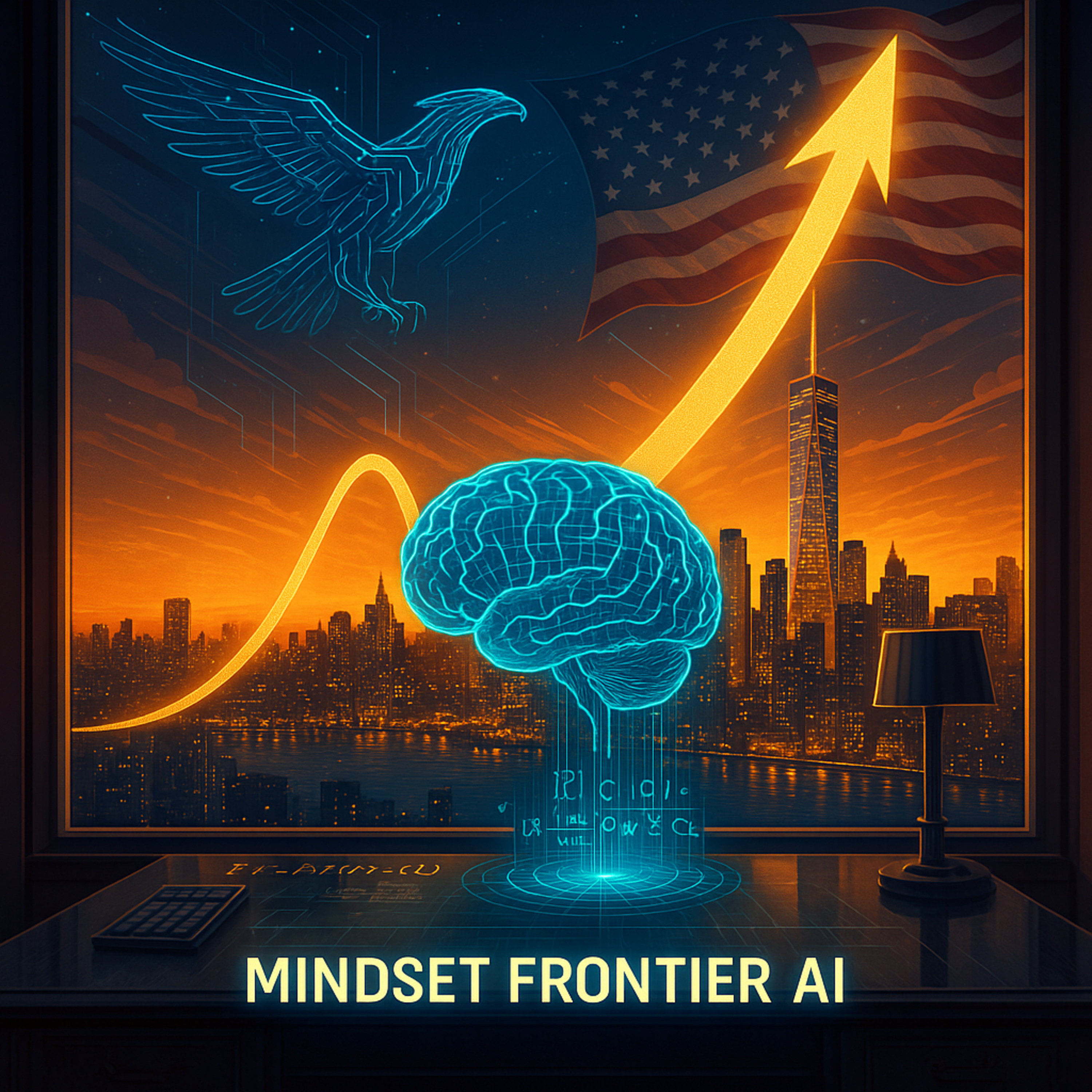
0:10 Picture this. It is early morning in downtown Manhattan. You are sitting in a quiet suite at The Four Seasons Hotel. The city is just starting to wake up. The room feels still. The screens on the desk are on, but the sound is muted. The light from One World Trade Center moves slowly across the window. For a moment, there is no pressure, no noise, no rush, only space to think. This is the kind of room where clarity shows up. This is where conviction begins. Most people make decisions in chaos. They let headlines, alerts and other people's emotions guide them. The top 1% does the opposite. They createspace to see patterns. They step away from noise until the world becomes simple again. This episode is about that simplicity. Welcome to mindset.
1:00 Frontier AI. This is the asymmetry investor. The math of conviction. I am Max Vanguard. I work as a behavioral finance coach. My job is to help high performers manage fear, doubt, and the emotional side of money. Most people lose not because of bad opportunities, but because they break their own system. I am here to help you stay steady when the pressure rises. I am Sophia Sterling. I work as a senior quantitative strategy advisor. I help investors and founders build systems for thinking. We focus on structure, not luck. We use models that remove confusion and bring clarity. Today, we will use that same approach to understand the math behind asymmetry. And I am Charlie Graham.
1:42 I am a market data research analyst. My work is simple. I look at numbers until they reveal quiet truths. I study patterns that most people ignore and build clear explanations that anyone can use. My role today is to take the math of asymmetry and make it understandable. From inside this hotel room, the city looks calm. The streets below draw straight lines. The buildings form clear shapes. The market feels far away, even if it is only minutes from opening. This view teaches a simple lesson. When you step back far enough, noise becomes pattern. What felt chaotic becomes expected. What seemed random becomes geometry. Most investors never create this kind of space.
2:24 They check the price every few minutes. They react to every small move. They confuse movement with meaning. When the chart goes down, they panic. When it goes up, they feel safe. Their emotions push them around like a small boat in heavy waves. The top 1% uses a different approach. They look past the next hour and focus on the next decade. They trust their system more than their feelings. The data supports this. Over more than 100 years, only a very small number of companies created the majority of the market's wealth. Not a few 100, only a few dozen. This means you do not need perfect timing. You do not need to predict the future. You only need a clear system that places you near the right ideas and lets you stay long enough for the math to work. That is what this episode is about. In Part 1 of this trilogy, we explored the mindset of asymmetry.
3:12 We looked at the pattern behind 100 times growth. We looked at how the top 1% see imbalance early in this episode. We shift from vision to structure. We explore the math that creates conviction. We look at expected value, power laws and why being right often matters less than being right big. And we will also talk about the human side, why the flat part of the curve feels slow, why volatility feels scary, why conviction feels lonely at the start. These are normal feelings, but they can destroy your long term results if you do not understand them. Once you see the math clearly, doubt loses its power. Before we begin, make sure you subscribe on Spotify or Apple Podcasts so you do not miss the next step in this trilogy.
3:58 Share this episode with a friend who is ready to think with more clarity and more structure. Help us reach 10,000 downloads. This support allows us to keep building this series for you. In the next segment, we will take the first step into the math. We will look at why asymmetry is not magic and not luck. It is simple probability used with patients. We will break down the curves, the numbers, and the patterns that most people never look at. Let the room stay quiet for one more moment. Math becomes clearer when the world slows down. When people talk about investing, they often focus on predictions. They try to guess the next winner, the next trend, or the next big moment. But the top 1% see the market differently.
4:40 They look for shape, not noise. They look for curves that bend in their favor. Asymmetry is a simple idea. Small risk, large reward. But behind that idea is a structure that explains why it works. Today we will walk through the simple math that makes asymmetry possible. The first idea you need is called expected value. Expected value is the average result you would get if you could make the same decision again and again. The formula is simple. Probability times payoff minus probability times cost. If the number is positive, the decision is good over time. This does not mean you win every time, it means the system wins when repeated. This is the foundation of the 100 times mindset. Most people never think in expected value. They think in feelings.
5:25 A drop feels bad, so they assume the decision is wrong. A quick gain feels good, so they assume the decision is right. But feelings do not tell the truth. Math does A low win rate does not mean a bad system. A high win rate does not mean a safe system. What matters is the size of the wins compared to the size of the losses. One big win can pay for years of small losses. The second idea is that markets do not follow a normal curve, they follow a power law. A very small number of companies create almost all long term wealth. Most companies create nothing. This means you can be wrong often and still do extremely well if you capture even one of the rare outliers. In a power law world, magnitude matters more than frequency. 1 winner can shape a decade. 1 winner can define a portfolio.
6:10 Picture the curve. It starts flat, almost no movement, quiet stable. Then it bends. The line starts to rise, slowly at first, then faster than all at once. This is the pattern behind exponential growth. This is the geometry of asymmetry. It shows up in technology, in business, in skill building, and in personal progress. The early stage is slow, the later stage is fast. Most people quit before the bend. The top 1%? Wait for it. Here is the emotional trap. The flat part feels like failure. You check the chart and nothing happens. Weeks pass.
6:52 The price moves sideways or down. This is when doubt enters. Doubt is natural, but doubt can destroy the math if you let it. The winners understand that the flat part is the entry fee for the sharp rise that comes later if you leave in the flat stage. You sell your future to buy a small sense of comfort today. To make this more concrete, imagine 10 investments. In nine of them, you lose $1.00. In one of them, you make $50, you lose $9 and make 50. Your net result is plus 41. This is not magic. It is expected value. It is the math of asymmetry. You do not need to be right often, you need to be right big. This is why the top 1% treat each small loss as part of the cost of a much larger win. This pattern becomes even clearer when you think in decades instead of days.
7:38 A portfolio that follows asymmetry will look strange at first. It will have many small losses and a few large winners. It will not look smooth. It will not look balanced. But the power law will appear. One or two positions will grow so much that they carry the entire system. This is not a mistake. It is how asymmetry works. When you understand this, you stop judging decisions by short term results. You stop caring about being right today. You focus on being right. Over time. You focus on building a system that keeps you in the game, that protects your downside, and that gives you a chance to catch the rare outliers. This is what creates conviction. Not emotion, not hype, not luck. Conviction is math repeated with patience. The data also shows that volatility is normal and any idea with large upside?
8:28 The path to a big return is never smooth. It moves through fear, confusion, and moments that test your patience. But if the expected value is positive and the long term upside is real, the noise does not matter. Volatility is part of the journey, not a sign you are wrong. When you combine expected value, power laws, and the geometry of exponential growth, a simple picture appears. Asymmetry is not guessing. It is not prediction. It is structure. It is probability used with clarity. It is math that rewards patience and discipline. In the next segment, we will take these ideas and build them into a system. A repeatable structure that can guide your decisions.
9:09 A structure that turns asymmetry from an idea into a practice. Now that we understand the shape of asymmetry, we can build the system behind it. The top 1% do not rely on luck. They do not rely on feelings. They build clean rules that protect them from themselves and guide their decisions when the world becomes uncertain. I call this structure the Frontier Equation. It is a clear and simple way to think about risk, reward, and conviction. It has four parts. Each part matters. Each part keeps you in the game long enough for the math to work. The first part is protection. You must limit your downside so no single mistake can destroy your long term progress. This is not fear, it is survival. Every system that compounds needs time. If you take one large loss, you remove the chance to benefit from future wins.
9:57 The top 1% understand that avoiding a permanent loss of capital is the first rule of compounding. Protect the base and you protect the future. Most people confuse short term drops with real danger. A fall of 20 or 30% feels painful. It feels like failure. But if the company is healthy and the long term thesis is still alive, that drop is not danger, it is noise. The real danger is a permanent loss of capital. That means the idea is dead and cannot recover. The top investors focus on this difference. They let volatility move around them, but they do not let it change the plan. The second part of the frontier equation is design. You choose ideas where the upside is far greater than the downside. This is the heart of asymmetry.
10:42 You risk a small amount for the chance of a much larger return. You do not chase high probability, you chase high magnitude. This shift in thinking changes everything. It allows you to fail many times without losing confidence because the wins will pay for the losses and much more. The math behind this is expected value. You may lose $1.00 many times, but if you make $50 once the system is profitable, this is positive expected value. The system works even with a low win rate. You do not need to be right often, You only need to be very right on rare occasions. When you size your positions correctly and repeat this process, your average outcome becomes positive even when the path looks messy. The emotional challenge is that humans want to be right every time.
11:28 They want validation. A string of small losses feels like proof they made a bad decision. But small losses are part of the structure. They are the price you pay for. The one idea that changes your year is your year. When you accept this, you stop judging yourself too early. You stop measuring success by short term results. You judge yourself by following the system, not by the outcome of a single trade. The third part of the frontier equation is repetition. A system with positive expected value only works when repeated many times. This is where most people fail. They change their method after a few losses. They break the system before it has time to show its strength.
12:08 The top 1% think like scientists. They run the same rules again and again. They trust the math. They trust the process. Over time, the repetition reveals the edge. In data science, we call this sample size. 1 result means nothing, 10 results mean a little, 100 results start to show truth. The same idea applies to investing. You do not see the power of asymmetry in a single month. You see it in years of consistent choices. The large gains often arrive suddenly, but they come from a long period of small, steady decisions. The system compounds when you give it enough repetitions. The final part is conviction. Conviction is not a feeling. It is not hope or excitement.
12:48 Conviction is clarity in your numbers. It is the calm that comes from understanding why the idea works and what must happen for it to fail. Conviction lets you hold when others panic. It keeps you steady when the flat part of the curve feels endless. Conviction is the bridge that takes you from theory to results. When you combine protection, design, repetition, and conviction, you get a structure that can withstand uncertainty. You get a system that rewards patients. You get a path that allows you to catch the rare opportunities that shape a decade. This is the frontier equation. It is the base of every 100 times story.
13:29 It is how you turn asymmetry from an idea into a disciplined practice. To make this even simpler, think of the loop. Learn, simplify, leverage, compound. The frontier loop explains how ideas grow. The frontier equation explains how decisions grow. Both work together. Both reinforce each other. One shapes your thinking, the other shapes your actions. Together they form a clear map for long term success. In the next segment, we will move from theory to real world signals. We will look at where asymmetry shows up in markets, in technology, and in human behavior. We will explore how to recognize the early signs of exponential growth and how to position yourself before the curve bends.
14:12 The next step is spotting the opportunity. Now that we understand the system behind asymmetry, the next question is simple. Where does asymmetry appear in real life? Where does the curve hide before it bends? The truth is that asymmetry is everywhere, but it is only clear to people who know what to look for. Most investors miss it because they chase comfort instead of potential. They look for ideas that feel safe instead of ideas that can grow. The top 1% look in different places. They look where growth expands faster than attention. The first place asymmetry appears is an early growth curves. In data science, we call this the early stage of an S curve. Adoption is slow, progress feels flat.
14:52 A few people see the value, but the world does not pay attention. Yet this is where the biggest opportunities exist. When a new technology or business model begins to show clear signals, the upside can grow far beyond the early expectations. Smartphones, electric vehicles, cloud computing, streaming platforms, and artificial intelligence all followed this pattern. Slow at first, then unstoppable. The emotional challenge is that early curves look boring. Nothing happens for a long time. You tell people about your idea and they shrug. You hold the position and it barely moves. This is where most investors quit. They want excitement. They want validation. But asymmetry requires patience. During the quiet stage, the top 1% stay focused on the math, not the speed. They know the flat part is not a sign of failure. It is a sign that the curve has not turned yet. The second place asymmetry shows up is in hidden optionality. Optionality means that something small contains a much larger future inside it.
15:49 For example, a company may look average today, but it may have a technology or business line that can grow much faster than the rest of the business. Or a small team may build a product that scales beyond their initial market. Hidden optionality creates situations where the upside is many times larger than the risk. These hidden layers are often ignored by the crowd because they are not obvious. In data terms, optionality is the chance that a small variable becomes the main driver of results. Think of Amazon when it launched Amazon Web Services. Most people saw a retailer. The optionality was cloud computing. That hidden layer became one of the most profitable business lines in history. The same pattern appears again and again.
16:30 A company has a small idea inside it. If that idea begins to scale, the value of the entire company shifts. This is why asymmetry often hides inside what looks ordinary. But hidden optionality is hard to trust emotionally. People want proof. They want guarantees. They want to see results before they believe. But once the results are obvious, the upside is already priced in the top 1%. Understand that belief comes before evidence. Not blind belief, but measured belief based on clear signals. You look for teams with skill, products with traction, markets with room to expand. You trust the structure more than the noise. The 3rd place asymmetry appears is in structural inefficiency.
17:12 Markets are not perfect. People overreact, they panic, they chase hype, they misprice ideas when emotions run too hot or too cold. In these moments you can find ideas where the downside is limited and the upside is ignored. A company may be sold off for reasons that have nothing to do with its long term health, or a new technology may be dismissed before it proves itself. These inefficiencies create opportunities for patient investors. This shows up in the data as volatility. Without structural damage, a stock may fall sharply not because the business has changed, but because the market is reacting to short term news. If the core numbers remain strong, that volatility creates entry points. Over time, the mispricing corrects itself. The company returns to its natural growth path. This is why volatility is not always danger. Sometimes it is a doorway into an asymmetric idea. The emotional struggle comes from how sharp these moves can feel.
18:07 A sudden drop can trigger fear. A news headline can trigger doubt. Most people treat every move as a message. They believe the market knows something they do not. But the market is not a single mind. It is millions of minds reacting in real time. Fear spreads fast. Confidence spreads slow. The top 1% see sharp moves as moments to study, not moments to panic. They ask simple questions. Has the long term changed? Has the math changed? If not, the system stays in place. When you combine early growth curves, hidden optionality, and structural inefficiency, you begin to see the landscape of asymmetry. These are the places where small effort can create large results.
18:47 These are the environments where outliers are born. The top 1% do not wait for the world to agree. They enter early, they size correctly, they watch the signals, and they trust their system. They know that the rare ideas that change everything often start as small ideas that look like nothing. And this is the key. Asymmetry does not live in the obvious. It lives in the overlooked. It lives in the early stages. It lives in the quiet rooms before the world wakes up. If you can see what others ignore, and if you can hold through the quiet phase, the math will work in your favor. This is how the 100 times stories begin. Not with noise, but with clarity. In the next segment, we will explore the emotional side of asymmetry.
19:27 We will explain why doubt, fear, boredom, and silence create the pressure that breaks most investors. We will show how the top 1% manage these emotions with structure instead of instinct. The next step is understanding the psychology that protects the math. Asymmetry looks simple on paper, but in real life it challenges every emotion you have. The math is clean. The curve is clean, the equation is clean, but the path is not. The path moves through fear, boredom, uncertainty, and long periods where nothing seems to happen. This is where most people break the system. They understand the numbers, but they cannot stay calm long enough for the numbers to matter.
20:09 The top 1% do not have stronger emotions, they have stronger structure. Let us start with fear. Fear is the strongest force in investing. When the price drops, people panic. When the chart moves against them, they imagine the worst. A small loss feels like danger, even when the fundamentals are still strong. This fear pushes people to sell early. They break their own plan to protect their feelings. But the math is not scared. The math has no emotion. A drop of 20 or 30% is normal. And any idea with large upside? The curve needs space to breathe. The data supports this. Every outlier company that became a major winner went through periods of sharp volatility.
20:51 Sometimes the price fell more than half while the long term thesis remained intact. Volatility is not a sign of weakness. It is a natural part of any path that has the potential for exponential growth. If you let short term fear push you out, you never reach the stage where the curve bends. Another challenge is boredom. The early stage of any growth curve is slow. The price moves sideways. The story feels stuck. You check your position and nothing changes. It is during this flat part that people lose interest. They want progress today, they want proof today, they want something to happen, so they feel smart. But the flat part is important. It is the preparation stage of asymmetry. The explosion happens later, and only for those who stay long enough.
21:32 Think of the loop. Learn, simplify, leverage compound. Compounding is slow. At first it looks flat, but inside that flat line, something quiet is building. Knowledge is building. Adoption is building. Market structure is shifting. When the conditions align, the curve finally rises. But you cannot start at the rise. You must pass through the quiet stage first. This is where patience becomes leverage. Doubt is another emotional pressure. Doubt arrives when your mind asks a simple question. What if I am wrong? That question is normal.
22:12 It visits every investor. But the winners do not let doubt change their system. They respond with clarity. They review the math. They review the signals. They ask if anything has changed in the long term. If the answer is no, they stay in position. Conviction comes from clarity, not from ignoring doubt. In probability theory, we often talk about sample size. With small samples, results look random. With larger samples, patterns appear. The same is true in investing. If you judge your system after one or two losses, it will look broken. But if you judge it after 100 repetitions, the expected value becomes clear. 100 repetitions show truth, 2 repetitions show noise. This is why consistency protects you from doubt. The final emotional challenge is loneliness. Early positions often feel like you are the only one who sees the opportunity.
23:03 No one talks about it, no one praises it. Sometimes people even question it. This silence makes people think they are wrong. But in asymmetry, silence is often a signal. If the world understood the idea already, the upside would not be open. Being early feels lonely because few people see the curve before it bends. This is why structure matters. The frontier equation gives you a system to fall back on when emotions rise. Protection keeps you safe. Design keeps your upside open. Repetition keeps you disciplined. Conviction keeps you calm. These four parts work together to protect you from the natural pressures that break most investors. You are not fighting the market.
23:45 You are fighting your own impatience. If you follow the system long enough, something interesting happens. The emotions that once pushed you around start to lose influence. Volatility becomes normal. Boredom becomes expected. Doubt becomes manageable. Loneliness becomes a sign that you are early, not a sign that you are wrong. The emotional swings soften because the structure becomes stronger than the feelings. This is when asymmetry starts working in your favor. Conviction is not loud, it is quiet. It is calm. It does not depend on applause or validation. It does not need other people to understand. Conviction is knowing your math, trusting your process, and staying in the game long enough for the results to appear.
24:26 When you reach this point, the emotions no longer control you, you control them, and that is when 100 times results become possible. In the next segment, we will take everything we have learned and turn it into a practical blueprint. We will show how to build an asymmetric portfolio, how to size your positions, and how to keep your system simple enough to follow for years. The next step is taking the math and turning it into a daily routine. Now that we understand the structure and the emotions, the next question is simple. How do you apply asymmetry in real life? How do you take this system and turn it into decisions you can repeat with confidence? The good news is that asymmetry does not require complex strategies.
25:08 It does not require advanced charts or secret information. The top 1% use simple rules that protect their downside and keep their upside open. This segment will lay out those rules in a clear way. The first rule is position sizing. Asymmetry works because the downside is small. If you place large amounts of money on a single idea, you break the math. A system with many small losses cannot survive a giant loss. That is why your position size must always match your risk tolerance. Most of the time, this means making small entries. You spread your bets across ideas with high expected value. That way you stay in the game long enough for the rare winners to appear. Emotion fights this rule because people want confidence. They want a big result fast. A large position feels strong, it feels bold. But bold is not the same as smart. Asymmetry does not reward size, it rewards patients. A small position can grow into something life changing if the upside is real.
26:00 A large position can destroy you if you are early or wrong. The top 1% do not size based on excitement, they size based on survival. The second rule is to focus on ideas with open upside. Do not chase ideas that look safe but cannot grow. Do not place your energy into things with limited potential. Look for ideas that can expand. Look for markets that can scale. Look for teams that can execute. Remember the shape of the curve. The best ideas grow slowly at first, then rise sharply. You want to be positioned before the rise begins. You want room for the return to expand far beyond your entry point. In mathematical terms, this means you want investments with a high payoff ratio. If the downside is 1 and the upside is 10 or more, the expected value becomes positive even when the chance of success is low.
26:51 This is why asymmetric portfolios often look unusual. They contain ideas with small initial confidence but large potential. Most of them will not grow, A few will change everything. The math rewards the outliers. The third rule is laddering. Laddering means you do not enter the entire position at once. You enter slowly over time. You let the idea prove itself while you watch the signals. This protects you from chasing hype. It also protects you from entering too early. Laddering creates emotional space. You do not feel rushed. You do not feel trapped. You give yourself room to adjust without breaking the system. The fourth rule is to hold your winners. This is where most people fail. They sell too early because the gain feels good. They take quick profits to feel smart, but quick profits are small profits.
27:38 The large results appear only when you let the curve rise. A winner that grows 10 times can pay for an entire portfolio, but you cannot benefit if you exit at 50%. Holding winners is not easy emotionally, but it is the heart of asymmetry. Data shows that the majority of gains in long term portfolios come from a small number of positions that were held for years. Not days, not months, years. This is why selling early hurts your results more than small losses. A small loss removes $1.00. Selling a winner early removes hundreds of dollars of future potential. The math becomes clear once you see the curve. The real value is in the long tail.
28:18 The fifth rule is to ignore short term noise. Noise confuses the mind. It creates false urgency. It pushes you to react instead of think. One headline can move the market for a day. One rumor can push the price in any direction. But these surface movements do not change the long term potential. When you focus on the daily chart, you become emotional. When you focus on the long term curve, you become stable. Stability is what protects your process. The final rule is review, not emotional review. Structured review. At regular intervals, you check the thesis. You ask the same three questions. Has the long term changed? Has the math changed? Has the system changed? If the answer to all three is no, you continue holding. If the answer is yes, you exit.
29:06 This simple check keeps you disciplined. It removes panic. It replaces emotion with clarity. When you combine these rules, you get a clean and powerful small entries open up side laddered positions, strong winners, quiet minds, regular reviews. This structure does not require prediction. It does not require speed. It only requires patience and repetition. The expected value does the rest. Over time the math becomes visible. One or two large winners reshape your results. This is how long term compounding appears. Many people believe they need special talent to invest well. They think they need instinct or brilliance, but the truth is the opposite. You need calm.
29:47 You need discipline. You need a system that protects you from fear. When you follow a clear structure, emotions lose their grip. Your patients grow stronger, your decisions grow cleaner, and the curve begins to turn in your favor. In the next segment, we will connect this system to the Frontier Loop. We will show how learning, simplifying, leveraging, and compounding come together to support the 100 times mindset. This final step will tie everything into a framework you can use in every part of your life. You now understand the system behind asymmetry and the rules that protect your decisions. The next step is to connect everything to a deeper model.
30:28 A model that explains how high performers think, learn, and grow across time. This model is called the Frontier Loop. It has four clear stages. Learn, simplify, leverage, compound. Each stage leads to the next. Each stage supports the math of asymmetry. When you use this loop with discipline, you create a long term engine that does not depend on luck. The first stage is learning. Learning does not mean collecting every idea you see. It means focusing on rare, high signal information. Most people drown in noise. They watch every headline. They follow every trend. But the top 1% look for patterns that repeat. They study base rates.
31:11 They look at long term data. They look for signals that appear before a curve begins to rise. When you learn the right things, you start to see opportunities before others notice them. But learning also requires humility. You must be willing to question your assumptions. You must be willing to update your view when the facts change. Learning is not about protecting your ego. It is about finding truth that helps you grow. When you collect the right ideas and ignore the wrong ones, you begin to build clarity. That clarity creates calm. Calm leads to better decisions. Better decisions build conviction. This is how the loop begins. The second stage is simplifying. Information is only useful when you can turn it into something you can act on. Complex ideas break under pressure. Simple ideas survive.
31:57 When you simplify what you learn, you remove noise and find the core signal. For example, expected value can be summarized in one sentence. Small losses do not matter when the upside is large enough. This simple sentence can guide you through years of decisions. Simplification creates structure. Structure creates strength. Data becomes powerful only when you compress it into patterns you can use. You do not need to track every variable. You need to track the few variables that drive results. Market structure, revenue growth, user adoption, cash flow, optionality. These variables shape the future. When you reduce complex information into a small set of clear signals, your decisions become sharper and faster.
32:42 You respond to truth, not noise. Emotion cannot handle complexity. When you try to hold too much information in your mind, you become overwhelmed. You start to doubt yourself, You start to hesitate. Simplification protects you from this. When your system is simple, you can follow it even when the world becomes noisy. You do not need perfect clarity. You only need a clear rule you trust. This is why the top 1% value simple structures. They can use them under pressure. The third stage is leverage. Once you learn and simplify, you apply what you know with force. Leverage does not mean taking dangerous risks. It means using tools that turn small actions into larger results.
33:24 Capital is leverage. Time is leverage. Technology is leverage. Networks are leverage. Even conviction is a form of leverage. When you apply leverage to the right ideas, you create asymmetry. Small effort leads to large outcomes. In markets, leverage often comes from patients. The longer you hold a strong idea, the more the math can compound. This is not emotional leverage, it is statistical leverage. Holding through noise allows the expected value to reveal itself. The power law needs time to express itself. If you cut the process short, you remove the force that creates the return. Leverage is the space you give an idea to grow. The fourth stage is compounding.
34:07 Compounding is what happens when your decisions begin to build on each other. Each cycle makes the next cycle stronger. Each insight sharpens the next insight. Each discipline choice makes future discipline easier. This is why compounding is not only financial, it is mental. It is emotional. It is structural. When you stay consistent, the loop becomes self reinforcing. It grows in strength as you grow and experience. When you look at the Frontier loop, you can see how it connects to the frontier equation. Learning supports protection because knowledge reduces blind risk. Simplifying supports design because clarity helps you choose ideas with high upside. Leveraging supports repetition because you can apply the same rule at scale.
34:51 Compounding supports conviction because each cycle strengthens your trust in the system. These two models work together. 1 shapes your thinking, the other shapes your decisions. This is why the top 1% look calm under pressure. They're not calm because they feel safe. They are calm because they trust the loop. They have seen it work. They know what to look for. They know what to ignore. They understand the results come from repeating the right actions, not reacting to random events. The loop becomes their internal compass. It keeps them aligned with long term truth. The real advantage of the Frontier loop is that it never ends. You do not learn once you learn again. You do not simplify once you simplify again.
35:32 You do not leverage once you leverage again, you do not compound Once you compound again, each cycle becomes stronger than the last. Over years, this creates a level of clarity and confidence that feels almost unfair to people who do not use a system. But it is not unfair, it is simply structure. In the next segment, we will bring everything together. We will wrap up the full investor model and set the stage for episode 3, the final part of the trilogy, The Asymmetry Creator. The next episode will show how to build ideas, skills, and systems that follow the same curve of exponential growth. But for now, hold the loop in your mind.
36:12 Learn, simplify, leverage, compound. This is the engine of conviction. You have reached the end of this 2nd chapter in the Asymmetry trilogy. In the first episode, we trained the lens that lets you see imbalance before the world reacts. In this episode, we built the structure that lets you hold what you see. You now understand the geometry of 100 times growth, the math behind conviction, the emotional pressure points, and the clear rules that protect you during uncertainty. This is the investor's lens, a way of thinking that lets small decisions create large results over time. When you look back at everything we have covered, a simple picture appears. Asymmetry begins with probability, it grows through expected value, it survives through position sizing, it expands through patience, and it becomes powerful through repetition.
37:03 These ideas may seem basic on their own, but together they create a system that is stronger than emotion, stronger than noise, and stronger than the randomness of the day-to-day market. The real test is not knowledge, it is behavior. Many people learn these ideas, but very few apply them with discipline. They start strong and then drift when emotions rise. They trust the system until it becomes uncomfortable. But every breakthrough happens right after discomfort. Every curve bends after a long period of stillness. Every outlier rises after the crowd gives up. If you can stay in the game long enough, the math finishes the job. That is the power of conviction. The Frontier equation gives you the structure to hold through pressure, protect the downside, choose ideas with open upside, repeat the system, build conviction through clarity, and the Frontier loop gives you the mental engine to grow over time.
37:57 Learn, simplify, leverage, compound. When these two models work together, you create a personal operating system that does not depend on luck or prediction. It depends on discipline and repetition. The reason the system works is because it aligns with how growth actually happens in the real world. Growth is not smooth, it is not linear. It is not predictable. It is lumpy, uneven, and often invisible until the final moment. Power laws shape markets, power laws shape technology, and power laws shape careers. Most of the results come from a small number of decisions. Most of the progress comes from a small number of efforts. Understanding this truth gives you an advantage that compounds for life.
38:39 And here's the deeper point. When you understand asymmetry, you stop chasing every idea. You stop trying to predict the future. You stop reacting to noise. Instead, you wait for the few ideas that truly matter. You build a position slowly. You watch the signals. You hold through the quiet stage. And when the curve rises, you let it rise. You do not interrupt it. You do not sell early. You let the math express itself without interference. That patience separates average results from exceptional ones. This episode was not just about investing. It was about how you think. It was about designing a system you can trust when the world becomes fast, loud, or confusing. When you use asymmetry as a mental model, you can apply it far beyond markets.
39:29 You can use it for skills, relationships, habits, and ideas. The structure stays the same. Small effort, limited downside, open up side time, repetition, compounding. This pattern appears everywhere. This is why the top 1% treat asymmetry as a life strategy, not just a market strategy. This brings us to the next part of the trilogy, The Asymmetry Creator. In the next episode, we will move from investing in ideas to building them. We will explore how creators, founders, thinkers, and innovators design systems that follow the same curve of exponential growth. Instead of finding asymmetry, you will learn how to build it.
40:10 Instead of holding onto a curve, you will learn how to create one. This is where the trilogy becomes complete before. We close remember this. You do not need to be perfect. You do not need to be right all the time. You only need to follow a system that keeps you alive long enough for one or two great decisions to change your life. Asymmetry rewards survival, it rewards patience, it rewards clarity, and it rewards those who stay calm when others lose control. Trust your system, trust your work, Trust your loop. If you do that, the curve will come. We will close this segment here and move into the final outro. As always, thank you for listening, thank you for thinking with clarity, and thank you for building a stronger mind. In the next part, we will share our final message, our music note, our disclaimers, and the AI host mapping you requested. But for now, carry the system with you. The math is simple.
41:08 The discipline is rare. Subscribe to Mindset Frontier AI on Spotify or Apple Podcasts. Follow us on X for elite mental models, billionaire psychology, and decision frameworks that scale. Share this episode with a friend and help us hit 10,000 downloads to build the sharpest mindset community online. We cover wealth, focus and strategic growth across 4 series, all grouped at financefrontierai.com. And if you have a founder story or a mental framework worth sharing, we may feature it in a future episode. Just head to the pitch page and submit. And do not forget to sign up for The 10X Edge. It is our weekly newsletter filled with billionaire habits, AI Productivity Tools and top tier mindset strategies for exponential success only at financefrontierai.com. This podcast is for educational purposes only. It is not personal advice.
42:01 Always do your own research and speak with qualified professionals before applying any strategy. Mindset evolves. Pressure compounds. Even the best systems fail without execution. Treat every insight like a test. Run it, refine it, make it yours. Music in this episode, including the intro and outro track Dreaming on Instrumental by Nifx, is licensed under the YouTube Audio Library license. Full details are listed in the episode description. Copyright 2025 Finance Frontier AI. All rights reserved. Reproduction or redistribution of this content without written permission is strictly prohibited. AI host mapping. Sofia is powered by ChatGPT 5.1. Max is powered by Grok. 4C is powered by Gemini 3.0.


