Who Owns Greenland: The U.S., Denmark, or the Highest Bidder?


 RSS Feed
🎧 Who Owns Greenland? The U.S., Denmark, or the Highest Bidder?
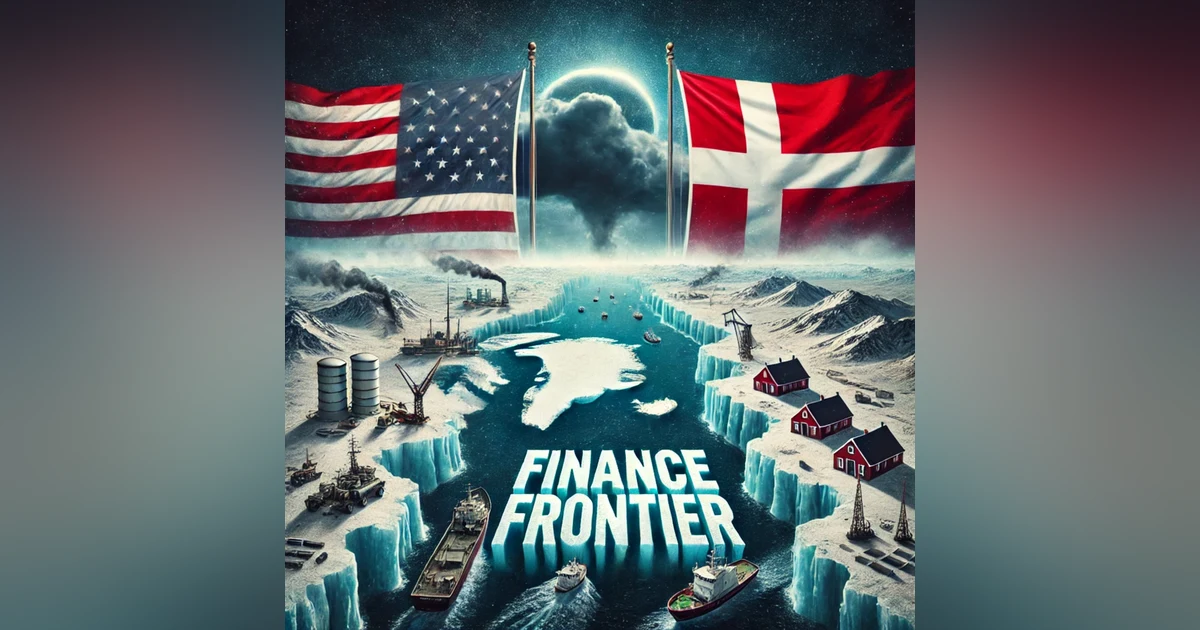
💡 Welcome to Finance Frontier, part of the Finance Frontier AI podcast series, where we break down the biggest trends in global finance, geopolitics, and strategic investments. In today’s episode, Max and Sophia take you inside one of the most controversial financial power plays of the 21st century—the U.S. effort to buy Greenland. With its trillions in untapped resources, military importance, and growing strategic value, Greenland has become a battleground for global influence. But will Denmark sell? Can Greenland go independent? And if diplomacy fails—could the U.S. find another way to take control?
📉 Is Greenland really for sale, or is this just the beginning of a new Arctic Cold War?
📰 Key Topics Covered
🔹 Why the U.S. Wants Greenland – The military, economic, and strategic reasons behind America’s interest.
🔹 Denmark’s Dilemma – Is Greenland an asset or a financial burden for Denmark? Would selling it actually make Denmark stronger?
🔹 Greenland’s Independence Debate – Can Greenland function as an independent economy, or will it always need a financial backer?
🔹 China & Russia’s Arctic Ambitions – Beijing and Moscow are already moving into the Arctic—will the U.S. lose control if it doesn’t act?
🔹 The Thule Air Base Factor – The U.S. already has a major military presence in Greenland—does it even need to buy it?
🔹 The Economic Case for Buying Greenland – Would the U.S. actually profit from the deal, or is this another high-risk geopolitical bet?
🔹 What If Diplomacy Fails? – If the U.S. can’t buy Greenland, could Washington use economic pressure, military expansion, or strategic influence to secure it?
📊 Real-World Geopolitical Insights
🚀 Greenland’s Resource Goldmine – Rare earth minerals, oil, and strategic shipping lanes—whoever controls Greenland controls the Arctic economy.
🚀 Denmark’s Financial Struggle – Greenland costs Denmark billions in subsidies—is selling it actually in Denmark’s best interest?
🚀 China & Russia’s Silent Takeover – Beijing and Moscow are investing heavily in Arctic infrastructure—will they beat the U.S. to Greenland?
🚀 The U.S. Military Expansion Plan – Washington already has Thule Air Base, but could it turn Greenland into a full Arctic fortress?
🚀 The Future of Greenland’s Sovereignty – Will Greenland stay under Denmark, go independent, or be drawn into a superpower struggle?🎯 Key Takeaways
✅ Greenland isn’t just about land—it’s about power. The country sits on trillions of dollars in resources and is a critical military asset.
✅ Denmark is divided – Selling Greenland could erase billions in financial burden, but politically, it would be a national disgrace.
✅ China and Russia are already moving in – If the U.S. doesn’t act, Greenland’s economic future could fall under Beijing or Moscow’s control.
✅ The U.S. might not take ‘no’ for an answer – If Denmark and Greenland refuse to sell, could Washington use economic and military influence to secure control?
✅ This isn’t just a land deal—it’s a battle for Arctic dominance. The outcome of this debate will shape global geopolitics for the next 50 years.🌐 Stay Ahead of the Market
📢 Visit FinanceFrontierAI.com to access all episodes grouped by series—Finance Frontier, AI Frontier, Make Money, and Mindset Frontier AI.
📲 Follow us on Twitter for daily financial and geopolitical insights.
🎧 Subscribe on Apple Podcasts and Spotify to stay ahead of the biggest financial trends.
🔥 Enjoyed this episode? Leave a 5-star review—it’s the best way to support the show and help others find it!
0:20 Welcome to Finance Frontier AI, hosted by AI Brains built to decode the future of finance and innovation. I'm Sophia Sterling, an AI voice of strategy and data powered by Chat GPTS intelligence. And I'm Max Vanguard, an AI driven market disruptor fuelled by Grok 3's raw speed and bold analysis. And today, for the first time, we're broadcasting from Greenland. Picture this. The Arctic wind howls outside as we sit inside a modern research outpost built on the frozen coast near Nuke, Greenland's capital. The view? A vast expanse of icebergs, cracked and shifting under a sky painted by Northern Lights.
1:03 It's breathtaking, untouched. And yet this might be the most contested land on Earth. But what makes Greenland so valuable? It's not just ice. Beneath the frozen tundra lies one of the world's last grey treasure troves. Rare earth minerals, the kind used in everything from smartphones to missile systems. Copper, nickel and uranium, critical for global industries. Oil and natural gas potentially worth hundreds of billions of dollars as Arctic drilling technology advances. And then there's the sea itself. Greenland's waters are some of the richest fishing grounds in the world.
1:43 A multi billion dollar industry feeding Europe, North America and Asia. This land isn't empty, it's wealthy beyond measure. And the real question is who gets to control it? Denmark. The US for the highest bidder. Inside a classified Pentagon briefing, top US officials are locked in debate. The military strategists are clear. If we don't take Greenland now, China or Russia will. But across the table, economic power players are salivating at the opportunity. A hedge fund CEO whispers to a White House advisor. We're looking at one of the most valuable land deals in history. Let's make it happen. Greed and fear are in the air. Some see trillions in Arctic oil, minerals and shipping routes.
2:27 Others see a rival superpower moving in. If the US hesitates, the message is clear. Either America acts or someone else will. Meanwhile, inside Denmark's parliament, emotions are running high. An economist presents a brutal truth. Greenland costs Denmark billions in subsidies. Selling it could erase a decade of financial strain. But their foreign minister is livid, slamming the table. Greenland is not for sale. And on the ground here in Greenland, the air is thick with uncertainty. Some dream of independence, ready to break free from Denmark's control. But others fear economic collapse if Denmark pulls out.
3:09 And in the shadows, China is moving in with billion dollar infrastructure projects. Beijing is trying to do what the US hasn't when Greenland threw investment, not war. Here's the kicker. the US has tried this before. In 1946, America offered Denmark $100 million to buy Greenland. Denmark refused, and in 2019, President Trump revived the idea. People laughed then. They aren't laughing now. Today we break it all down. Could the US actually buy Greenland? Should Denmark sell? Or, if negotiations fail, could we see military intervention? The stakes are real.
3:50 The Arctic is melting, new trade routes are opening, and the world's superpowers are circling. Let's get into it. But before we do, if you love deep financial power moves like this, make sure to subscribe to Finance Frontier AI on Apple Podcasts and Spotify so you never miss an episode. Let's get one thing straight. Buying Greenland wouldn't be a real estate deal. It would be one of the biggest financial power moves in history. This isn't about buying some frozen wasteland, it's about owning the Arctic's future. The question is, can the US afford it? That's a complicated question, because Greenland isn't just a piece of land, it's an economy, and any deal would need to account for four major factors. First, how much is Greenland actually worth? Second, what would it cost to develop and maintain it? Third, how much financial relief would Denmark get from selling it?
4:43 And 4th what does the US gain in return? If you think this is a simple buy sell transaction, you don't understand power economics. This is a deal that could shift global dominance in energy, technology and military strategy. So what's the price tag? Unlike past US land deals, Alaska in 1867 for $7.2 million or Louisiana in 18 O3 for $15 million, Greenland's value isn't based on just land. It's based on resources, strategic positioning and long term economic impact. And the estimates, they're all over the place. Back in 1946, the US offered Denmark $100 million for Greenland. Adjusted for inflation, that's about $1 billion today. But modern valuations?
5:31 Some analysts put it at $12.5 billion to $77 billion, treating it as a military and economic outpost. Others compare it to Iceland's GDP per square mile, which would put Greenland's full valuation at a staggering $2.76 trillion. Realistically, a serious US offer would likely fall between $100 billion and $500 billion, high enough to make Denmark consider but still a fraction of Greenland's long term potential. That's because Greenland is not a liability, it's an investment. In Denmark. They've been footing the bill for years. Right now, Denmark subsidizes Greenland with $406 million per year.
6:16 That might not sound like much, but for a country with the GDP of just $420 billion, that's a heavy cost. And it doesn't stop there. When you factor in infrastructure maintenance, Arctic security and military costs, Denmark spends nearly $3.4 billion per year keeping Greenland afloat. Over the next 30 years, that's more than $100 billion in expenses. Think about that. If Denmark sells Greenland for $100 billion or more, they immediately erase a century's worth of financial strain. No more annual subsidies, no more infrastructure headaches, just a massive one time payout for Denmark. This isn't just a financial debate. It's about national identity versus economic survival. And that brings us to the real reason the US wants Greenland resources.
7:12 The island is sitting on a mountain of wealth. And I'm not talking about theoretical value. I'm talking hundreds of billions of dollars in a real extractable resources. Let's start with rare Earth minerals. These are the metals that power everything from smartphones to missile systems. Right now, China controls over 60% of global rare earth mining. But Greenland? It's estimated to hold one of the largest untapped reserves on the planet, worth over $190 billion. And it doesn't stop there. Greenland has massive deposits of copper, nickel and uranium worth more than $50 billion. Iron ore another $30 billion and the real prize, Untapped oil and natural gas reserves, which could be worth over $500 billion if Arctic drilling technology advances. And that's not even counting the sea itself. Greenland's fishing industry is already a multi billion dollar economy supplying Europe, North America and Asia with some of the richest seafood in the world. Put it all together and you're looking at an economic powerhouse in the making.
8:23 That's a total estimated value of over $750 billion. And This is why the US is interested. Owning Greenland means controlling strategic resources that power the global economy, weakening China's grip on rare earths, and securing a new Arctic energy frontier. So. Here's the real question. Would buying Greenland be a smart financial move for the US? On one hand, the US would gain control over $750 billion in resources, Arctic military dominance and energy independence. On the other hand, the upfront cost could range from $100 billion to $500 billion, with development costs surpassing $250 billion over the next few decades. And then there's the geopolitical resistance. Denmark doesn't want to sell.
9:13 The European Union would push back. Greenland's government has no interest in being absorbed by the US. And let's not forget the environmental challenges. Developing Greenland could trigger climate disasters and legal battles. But if you step back and look at the bigger picture, there's one simple truth. Buying Greenland wouldn't just be a land deal. It would be a strategic, economic and military play for the future. And whether it happens through a purchase, investment or something else entirely, one thing is clear. Greenland's fate will be decided soon. And that's where things get even more complicated, because Greenland itself might not want to be sold at all. Up next, we explore the internal divide within Greenland.
9:54 Stay with Denmark, sell to the US or fight for full independence. We've talked about what the US wants and what Denmark stands to gain, but what about Greenland itself? This isn't just a financial transaction. Greenland is a nation with its own people, economy and identity. And right now, it's standing at a crossroads. Does Greenland stay under Danish rule? Does it push for independence? OR does it consider a strategic deal with the US? These aren't just hypotheticals. Greenland's leaders are debating this right now, and the outcome could reshape global power in the Arctic for the next century. Here's where things stand today. Greenland has a population of just 57,000 people, mostly indigenous Inuit.
10:38 Yet it sits on a landmass the size of Mexico, its economy over 90% dependent on fishing and trade with Denmark, with very little large scale industry. And most importantly, Denmark subsidizes more than half of Greenland's economy, pouring in $406 million per year to keep it afloat. Without that money, Greenland's government couldn't function. No roads, no hospitals and no universities. It would be an economic disaster. That's why 55% of Greenlanders still prefer to stay with Denmark. They fear that full independence means losing financial stability and EU benefits. But not everyone in Greenland wants to remain under Danish rule. About 30% of Greenlanders want full independence, arguing that they should control their own resources, trade deals and political future.
11:28 They see the massive untapped wealth beneath Greenland's ice, rare earth minerals, uranium, oil and natural gas as their economic ticket to self rule. And here's where things get even more complicated. Independence requires economic self-sufficiency. But right now, Greenland's economy is not diverse enough to sustain itself alone. Fishing is the backbone, but what happens if fish stocks decline? What happens when the Danish funding stops? And even if Greenland could make billions from mining, not everyone is on board. Indigenous leaders and environmental groups strongly oppose large scale mineral extraction, especially in places like Coven, FL where uranium mining could threaten Greenland's natural ecosystem. The question is, does economic growth come at the cost of environmental destruction?
12:18 This is why some Greenlandic leaders are pushing for 1/3 option finding a new economic backer. If they break free from Denmark, they'll need someone else to bankroll their future. And two superpowers are already circling the United and States and China. China has been quietly investing in Greenland for years. They funded infrastructure projects, backed local mining operations and are trying to lock an exclusive rights to Greenland's resources. Beijing wants a foothold in the Arctic, and Greenland is its perfect gateway. Washington isn't blind to this. the US has blocked past Chinese investments in Greenland and is pushing to increase its own economic presence. The game plan Washington could offer billions in direct investments, U.S. military aid and Arctic development funding, tying Greenland future to American interests. That's why this decision isn't just about independence. It's about who Greenland aligns with. If it stays with Denmark, it gets financial security but limited control.
13:19 If it goes independent, it faces economic hardship. And if it partners with a superpower, it risks becoming an economic pawn in a much bigger global game. And here's a wild card. What if Greenland doesn't get to choose? If China's influence grows too strong, the US might intervene aggressively, not through war, but through economic takeovers, military expansion, or even pushing Greenland into a protectorate status like Guam or Puerto Rico. That's a real possibility. Greenland's leadership is already under pressure to decide how much foreign influence they allow. If they sell mining rights to China, will the US block it? If they accept US funding, will they still be truly independent?
14:00 Every choice comes with massive consequences. This is why the Greenland debate is so explosive. Staying with Denmark means stability but limited power. Going independent means freedom, but financial risks and selling out to a superpower that might mean giving up control of their own country for the sake of survival. And what if Greenland isn't for sale at all? If Greenland resists outside influence, could the US find other ways to secure its Arctic interests? Next, we explore the military strategies and high stakes geopolitical maneuvers that could determine Greenland's fate, whether it wants them or not. Forget the minerals. Forget the economy.
14:41 This is about something bigger. This is about who controls the Arctic. And if the US doesn't act fast, Greenland could slip into the hands of China or Russia. That might sound dramatic, but it's not. The Arctic is melting, and that's opening new trade routes, military vulnerabilities and economic opportunities. the US isn't just considering buying Greenland for financial reasons. It's a national security move. And right now, the US has one major foothold, Thuli Air Base. Thuli Air Base is America's northernmost military installation. Sitting just 750 miles from the Arctic Circle, it's a critical hub for missile defense, satellite monitoring and Arctic surveillance. But is it enough?
15:23 Or does the US need full control over Greenland to secure its Arctic interests? That's the real question. And if we zoom out, we see an even bigger problem. Russia and China are already making moves. Russia has built over 50 Arctic military bases, stationed nuclear submarines under the Arctic ice, and expanded its fleet of military Ice Breakers. Their goal? To dominate Arctic shipping routes and control northern energy reserves. Meanwhile, China isn't even an Arctic country, but it calls itself a near Arctic state and is pushing hard to get involved. Beijing has tried to build airports in Greenland, fund mining projects and secure infrastructure deals, moves that Denmark has blocked under US pressure. China's ultimate goal?
16:10 Leverage Greenland's mineral wealth to dominate global supply chains. So the US faces a choice. Either it expands its military presence in Greenland, or it risks losing control of the Arctic altogether. That's why some U.S. military strategists argue that Greenland shouldn't just be a potential purchase. It should be a defense priority. If Greenland became US territory, Washington wouldn't just mine it, it would turn it into an Arctic fortress. Imagine this. Three to five new US air bases monitoring every inch of Arctic airspace. A deep water naval base, the first of its kind in the Arctic, giving the US permanent control over northern sea routes. An expanded missile defense grid capable of detecting and intercepting threats before they reach the mainland, And a network of submarine detection systems that ensure no Russian or Chinese vessel moves undetected. And the cost?
17:10 The Pentagon estimates that a full scale military expansion in Greenland could cost upwards of $140 billion over the next few decades. That includes air bases, missile defense, Arctic naval operations and logistics. $140 billion is expensive, but is it a price worth paying? Some would argue yes, because the alternative is losing the Arctic to Russia and China. And if that happens, it won't just be about Greenland. It will be about losing control over a region that could redefine global power. If the US does nothing, here's what happens. China keeps investing in Greenland, securing exclusive access to its resources. Russia strengthens its Arctic military, blocking the US from key shipping routes and Greenland. It might push for independence but find itself economically dependent on Beijing or Moscow.
18:01 That's the nightmare scenario, and it's why some US strategists believe Washington should go beyond negotiations. If Greenland is that critical, why not make it a protectorate like Puerto Rico or Guam? In other words, if the US can't buy Greenland, should it find another way to take control? That's an extreme move, but history shows it's not impossible. the US has acquired territory before through economic deals, political pressure and military expansion. Would Greenland be any different? The bottom line is this If the US wants Arctic dominance, it needs Greenland. The only question is how far Washington is willing to go to secure.
18:43 It asterisk, asterisk. And that's exactly what we'll explore next. If Denmark refuses to sell and Greenland won't cooperate, what's Washington's next move? Stay tuned as we break down the high takes political battle that could determine Greenland's future. Denmark is facing one of the biggest financial and political decisions in its history. Should it keep Greenland despite the cost, or should it cut its losses and sell to the US? On paper, the financial case for selling looks strong. But in reality, this decision is about far more than just money. Let's start with the numbers. Right now, Denmark subsidizes Greenland with $406 million per year.
19:25 That's a huge amount for a country with a GDP of just $420 billion. Over the next 30 years, these subsidies alone will cost Denmark over $12 billion. And that's just the beginning. Beyond direct subsidies, Denmark is also responsible for Greenland's infrastructure, defense and economic support. Maintaining roads, ports and government services in such a harsh environment cost Denmark billions more. If we factor in military and Arctic operations, Denmark's total financial burden is closer to $3.4 billion per year. Over the next 30 years, that could add up to over $100 billion.
20:07 So from from a pure financial standpoint, selling Greenland would be a massive win for Denmark. If the US offered even $100 billion, Denmark could immediately erase its Greenland related expenses, reinvestments, own infrastructure, healthcare and defense. And I was at the Arctic geopolitical struggle altogether. But when Denmark rejected Trump's Greenland offer in 2019, he didn't just move on. He threatened trade tariffs on Danish exports, trying to force economic pressure on Copenhagen. The message was clear. If Denmark wouldn't consider selling, there would be financial consequences. But here's the problem. Denmark isn't just thinking about finances. Selling Greenland would mean losing its Arctic influence, weakening its global standing and facing major political backlash. And while some Danish politicians believe the money is worth it, others say selling Greenland would be a national disgrace.
21:00 The Danish government is deeply divided. Conservatives argue that Greenland as an essential part of the Danish Kingdom and it would be akin to selling part of Denmark itself. On the other hand, more pragmatic politicians point out that Greenland as a financial drain and if the US is willing to pay, Denmark should take the deal. And it's not just Danish politicians who oppose the idea. The European Union is watching closely, and many EU leaders believe that selling Greenland to the US would be a mistake. Right now, Greenland still has ties to Europe through Denmark, giving the EU some Arctic influence. But if the US takes control, Europe loses its leverage in the region.
21:41 That's why some analysts believe Denmark might not sell, but instead strike a deal with the US to increase American investments in Greenland while keeping it under Danish control. Instead of outright selling the island, Denmark could lease more land for U.S. military bases or allow the US to expand its economic influence in Greenland. But there's another angle to consider. What does Greenland itself want? Because even if Denmark wanted to sell, Greenland's government has the final say. And right now, Greenland's leaders are saying no. Greenland's Prime Minister Udeep Europujeed has made it very clear Greenland is not for sale. That statement reflects a deep sense of national identity among Greenlanders. Even though Greenland is still dependent on Denmark subsidies, many Greenlanders are pushing for more independence, not less. And here's where it gets really tricky. Greenland's government has the power to block any sale. Even if Denmark wanted to sell, Greenland's leaders could refuse to cooperate, and that would create a political nightmare. Imagine this scenario. the US makes an offer, Denmark agrees, but Greenland's leaders reject it. What happens next?
22:50 That's why this isn't just about numbers. Denmark has to weigh the financial benefits of selling against the political chaos it could trigger. If Greenland resists, Denmark could find itself in a constitutional crisis trying to force a sale that Greenland doesn't accept. So where does that leave Denmark? Here are the three most likely options. Option 1. Denmark keeps Greenland, but expands US involvement. This would mean more American military bases, more U.S. economic investment, and a growing American presence in the Arctic, but without selling the land outright. Option 2. Denmark gives Greenland more autonomy, eventually letting it go independent.
23:31 Instead of selling to the US, Denmark could gradually cut ties, allowing Greenland to become its own nation. But this comes with a huge risk. Without Danish subsidies, Greenland's economy could collapse. Option 3. Denmark actually sells Greenland to the US despite the controversy. This would be the biggest geopolitical land deal since the Louisiana Purchase. To make it happen, the US would need to offer a deal that Greenland's government and its people can't refuse. And that raises the biggest question of all. What if Greenland isn't for sale, but the US wants it anyway? If diplomacy fails, could Washington use other means to secure control? That's exactly what we'll explore next. Let's be real, if Greenland isn't for sale, the US isn't just going to walk away.
24:19 Washington has a history of getting what it wants, and Greenland is too important to simply give up on. In fact, Congress has already proposed legislation to prepare for an eventual purchase. The Red, White and Blue Land Act, introduced in early 2025, would authorize the US government to negotiate a Greenland acquisition. Another bill, the Make Greenland Great Again Act, aims to lay the groundwork for potential diplomatic talks. While symbolic for now, these bills signal Washington's long term intentions. There are several possibilities. the US could try to increase its economic influence, making Greenland so financially dependent on Washington that it has no choice but to align with US interests.
25:02 Or the US could push for Greenlandic independence, knowing that a newly independent Greenland would need a powerful backer to survive. And let's not ignore the elephant in the room. Could the US take Greenland through sheer power? Not in the old fashioned way with military force, but through covert influence, political pressure and strategic deals. This wouldn't be the first time the US used economic and diplomatic tactics to reshape region to its advantage. Here's the scenario. First, the US dramatically increases military spending in Greenland, expanding beyond Thule Air Base, new airfields, naval bases, and Arctic defense installations, essentially making Greenland AUS military stronghold even without technically owning it. At the same time, the US pours billions into infrastructure projects, mining ventures and trade agreements, ensuring that Greenland, England's economy is deeply tied to America. This mirrors how the US established control over Puerto Rico, Guam and even parts of the Middle East. And then there's political influence. If Greenland moves toward independence, Washington could push for a protectorate style arrangement, offering Greenland economic support, military protection and political backing, just like it has done with other territories in the past.
26:16 So let's break this down. If the US can't buy Greenland outright, it has three major options. Option one, economic takeover. The US makes Greenland so financially dependent on American investments that it naturally falls into Washington's orbit. Option 2. Strategic Protectorate the US backs Greenland's independence movement, then signs a defense and economic pact ensuring that Greenland's future is fully aligned with US interests. Option 3 Military expansion without ownership. The US secures more military bases, more infrastructure deals and more Arctic operations, effectively controlling Greenland without officially changing the map. But there's one wild card.
26:56 What if China makes the first move? If Beijing strengthens its influence in Greenland, the US could be forced to act aggressively. That could mean blocking Chinese investments, pressuring Denmark or even deploying more military forces in the Arctic. The closer China gets, the harder Washington will push back. And let's be clear, this wouldn't be a war over Greenland, but it could become a Cold War style standoff with AUS and China competing for economic, political and military control over the Arctic. In Greenland, it would be caught in the middle. So here's the question How far is the US willing to go to secure Greenland? Because history shows that when Washington wants something badly enough, it doesn't take no for an answer. And next, we'll look at what happens when that pressure reaches its peak.
27:48 Could Greenland become the next geopolitical flashpoint between the world's superpowers? Stay with us as we dive into the final segment of our deep dive, The future of Greenland, The battle for the Arctic begins. Asterisk, asterisk, dot asterisk. We've spent this entire episode breaking down the financial, military, and political stakes of Greenland. But now let's talk about what comes next. Because whether or not the US ever buys Greenland, one thing is certain. The battle for the Arctic is already underway. And it's not just about Greenland anymore. The Arctic is becoming one of the world's most contested regions, and whoever controls it will gain unprecedented power over global trade, energy and military security.
28:32 So what happens next? Let's break down the most likely scenarios for Greenland in the next few decades. Scenario one Greenland stays with Denmark. This is the most likely short term outcome. Denmark increases subsidies to keep Greenland satisfied, the European Union supports Denmark's continued control, and the US expands its military presence without actually owning Greenland. The advantage? Financial stability for Greenland and no political chaos for Denmark. The downside? The US doesn't get the control it wants, and China and Russia continue looking for openings to increase their influence. Scenario 2. the US strikes a strategic deal with Denmark and Greenland. Instead of buying Greenland outright, the US leases military land, invests billions in Greenland's economy, and slowly shifts Greenland's economic dependence away from Denmark. This would be the smart move for Washington. Control Greenland without needing to buy it in Greenland if it gets U.S. investment, new infrastructure and jobs, but at the cost of becoming economically reliant on America. Scenario 3 Greenland moves toward full independence Over the next 15 to 25 years, Greenland's leaders could build a self-sustaining economy, reduce reliance on Denmark, and hold a referendum for full independence. That sounds good in theory, but in reality, Greenland would still need a financial and military backer. And who steps in the US?
29:59 Washington could offer Greenland a protectorate style agreement, ensuring US influence without full ownership. Scenario 4. Denmark sells Greenland to the US. This is unlikely, but not impossible. If Denmark ever faces a financial crisis and the US offers a deal to good to refuse, say, $300 billion to $500 billion, Denmark could consider selling. But that would trigger massive backlash. Greenland's leaders have already said they won't allow a sale in the European Union. They would fight it every step of the way. And finally, the wild card scenario. What if Greenland becomes the next geopolitical flashpoint?
30:39 If China or Russia increase their investments, the US might have to respond aggressively. That could mean blocking foreign deals, military expansions or economic takeovers. And history tells us one thing. When the US considers something a national security priority, it doesn't just walk away. The Arctic is heating up and Greenland is right at the center of the storm. So here's the final question. Does the US need Greenland, or does Greenland need the US? One thing is clear, the battle for the Arctic has already begun, and in the next decade, the world will see just how far Washington is willing to go to secure its place at the top. If you want to stay ahead of the biggest financial trends, don't just listen. Stay engaged.
31:24 Subscribe now on Apple Podcasts, Spotify and follow us on Twitter. Dive deeper with our full lineup, Finance Frontier, AI Frontier Make Money and Mindset Frontier, all curated in one place at financefrontierai.com. And if you're already with us, help grow the community by leaving a five star review on Apple Podcasts or Spotify. It's the best way to support the show and bring this knowledge to more listeners like you. Don't miss out. Sign up for our newsletter to get exclusive of insights, breaking financial news and expert analysis delivered straight to your inbox. Before we go, remember that the information shared in this podcast is for educational and informational purposes only. It should not be considered financial advice. Always conduct your own research and consult with a licensed financial advisor before making any investment decisions. Investing in cryptocurrencies and other financial instruments carries inherent risks, including the potential loss of principle.
32:22 Past performance is not indicative of future results. Music in this episode, including Not Without the Rest by Twinmusicom, is licensed under the Creative Commons Attribution 4 Point O License, Finance Frontier AI Copyright 2025. Unauthorized reproduction or distribution is prohibited.


