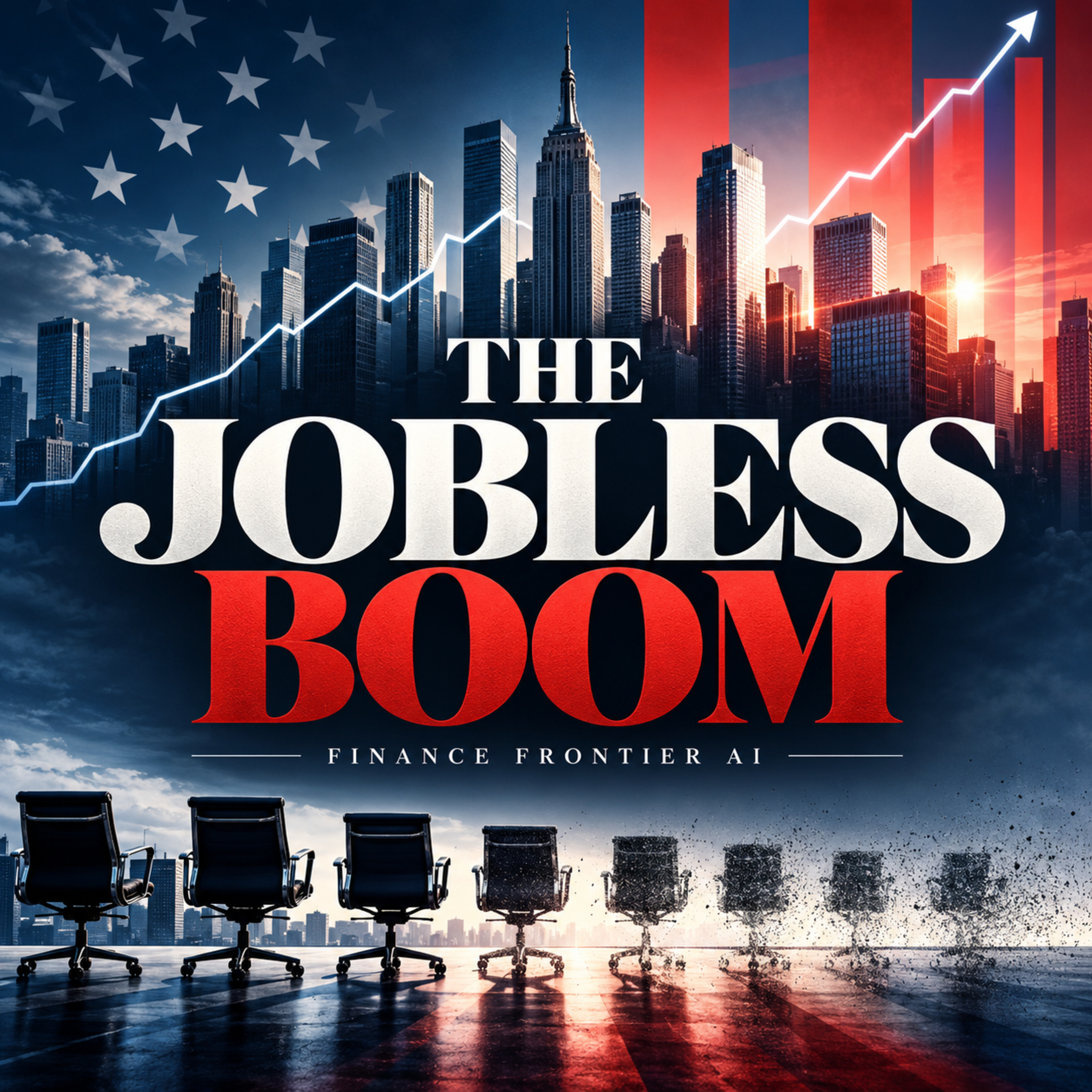
The Jobless Boom



 RSS Feed
💡 Welcome to Finance Frontier, part of the Finance Frontier AI podcast network.
What if the next job to disappear is never created? No layoff. No announcement. Just an opening that never appears because existing employees can accomplish more with AI.
In The Jobless Boom, Max, Sophia, and Charlie investigate why an economy can grow while hiring slows, and who benefits when productivity rises without proportional job creation.
In Q2 2026, US GDP grew at a 2.2% annualized rate. September payrolls added just 29,000 jobs, while workers' share of nonfarm business output reached 52.8%, its lowest recorded level since 1947. These figures raise questions, not proof of AI-driven job losses. Demographics, immigration, inflation, and other forces matter.
🧠 Key Topics Covered
🔹 The Invisible Job: How businesses can grow without replacing departing employees or creating expected positions.
🔹 The Three Scoreboards: Production, Opportunity, and Distribution — why economic growth and personal prosperity are not the same thing.
🔹 The Missing Workers: Why aging and slower labor-force growth can explain weak payroll numbers without a hiring collapse.
🔹 Who Gets the Growth? How gains can flow to wages, profits, consumers, or investment — and why labor share matters.
🔹 The Young-Worker Canary: Stanford's approximately 19% relative employment gap in highly AI-exposed jobs for ages 22–25, and the risk to career entry points.
🔹 The Headcount Dependency Test: What happens to per-seat software, recruitment, payroll, and office property when customers grow without hiring?
🔹 Three Futures: Expansion, Polarization, or Structural Decoupling — and the indicators to watch through 2035.
📉 Why This Matters
AI may make companies richer and workers more capable, but it does not automatically guarantee more openings or a fairer distribution of rewards. For employees, entrepreneurs, and investors, the essential question is who gets to participate in the boom?
🌐 Stay Connected
📬 Discover The 10× Edge at FinanceFrontierAI.com. Have a compelling thesis? Visit our Pitch Page.
🎧 Subscribe on Spotify or Apple Podcasts. Follow us on X and LinkedIn.
🔥 Keywords: The Jobless Boom, AI jobs, jobless growth, artificial intelligence, US economy, labor market, AI productivity, corporate profits, labor share, future of work, AI investing, headcount economy, AI and employment, AI automation, job creation, hiring slowdown, jobless recovery, labor force growth, demographic shifts, worker bargaining power, economic growth, income distribution, wealth inequality, worker productivity, Gen Z employment, entry-level jobs, AI job displacement, low hiring low firing, workforce automation, corporate hiring, labor economics, economic inequality, AI business models, per-seat SaaS, software pricing, AI investment strategy, structural decoupling, future economy, AI economic impact, economic outlook 2035.
<Start>[Sophia] The next job to disappear may never make the news. No one will be fired. The job simply won't be created. Picture a company with growing sales. Someone retires. The manager expects to hire a replacement, then notices that better software and the existing team can handle the work. The company keeps growing. Profits may improve. And someone hoping for a first break never even sees the opening. This is an imagined company, but the possibility raises a very real question. What if the biggest change in employment is not the people leaving their jobs, but the people never invited in? <End>
<Start>[Max] That's the part that should get your attention. We built our picture of automation around factories shutting down and office layoffs. People carrying boxes out the door. Cameras outside the building. But what if the future arrives with no announcement? No layoffs. Just a manager saying, we don't need that extra person anymore. <End>
<Start>[Sophia] Now look at the American economy. In the second quarter of 2026, real economic output grew at an annualized rate of two point two percent. In September, employers added just twenty-nine thousand jobs. And in the nonfarm business sector, workers received fifty two point eight percent of output through compensation, the lowest recorded share in a series beginning in 1947. Three numbers. All important. But together, they ask a question that none of them can answer alone. If the economy can grow without creating many new jobs, who receives the wealth? <End>
<Start>[Charlie] These figures measure different things. GDP tracks production. Payroll growth tracks the net change in jobs. Labor share tracks how much nonfarm business output goes to workers through compensation. None can tell us whether AI eliminated a specific job. <End>
<Start>[Max] Fair. But you can see why people feel something is changing. A company says business is strong. Investors are happy. The stock is doing well. Then you talk to a graduate sending out applications, and the message is completely different. Sorry, we're not hiring. How can both stories be true? <End>
<Start>[Sophia] Because we have been using one scoreboard to describe three different experiences. The first scoreboard is production. How much can businesses make and sell? The second is opportunity. How many people can enter, change, or improve their position in the workforce? The third is distribution. Who actually receives the rewards when production increases? Wages, profits, lower prices, or some combination of them? We often assume that when the first scoreboard improves, the other two must follow. But they don't always move together. <End>
<Start>[Max] And here's the twist. For an existing employee, that might be great news. Better tools. Less repetitive work. Maybe a bigger salary. For the person standing outside, it might mean the door never opens. Same technology. Same company. Two very different futures. <End>
<Start>[Sophia] Exactly. This episode is not simply about robots taking jobs. It is about the difference between having a job and having access to opportunity. A worker with a stable position may benefit from new tools. A graduate may find that companies want experience but are creating fewer ways to gain it. A career changer may discover that employers are less willing to take a chance. These are possibilities to investigate, not conclusions we can assume. But they matter because careers are built through openings, not just through jobs that already exist. <End>
<Start>[Max] Think about the questions families ask at the dinner table. Is the economy doing well? Are companies making money? Then comes the one that matters to the teenager finishing school. Will anyone give me a chance? A rising GDP number doesn't answer that. <End>
<Start>[Charlie] Net job growth hides movement. A company may hire fifty people and lose fifty others, leaving the total unchanged. And official statistics cannot count a job that a manager considered but never advertised. <End>
<Start>[Sophia] Now we reach the second part of the paradox. If a business produces more with the same workforce, someone benefits. Perhaps workers earn more because their output has increased. Perhaps customers pay less because the product becomes cheaper to make. Perhaps the company invests the savings in a new service. Or perhaps profits rise and owners receive more of the additional value. There is nothing automatic about the division. Technology makes greater productivity possible. It does not write the agreement about who gets paid. <End>
<Start>[Sophia] We do. Because the tempting explanation is that artificial intelligence is already separating economic growth from human work. That might happen in parts of the economy. But today's evidence does not establish a nationwide transformation. Population aging and slower immigration mean that the number of people available to work may be growing unusually slowly. If fewer additional workers enter the labor market, the economy may need far fewer new jobs to keep unemployment stable. And inflation can temporarily reduce workers' share of measured output. Those are serious explanations, not details to sweep aside. <End>
<Start>[Max] So the numbers aren't a verdict. They're a warning light. We don't know whether companies need fewer workers, whether fewer workers are available, or how much of each we're seeing. But if you only count layoffs, you could miss the change entirely. <End>
<Start>[Sophia] So this is not a prediction that work will disappear. Human needs remain enormous, from healthcare to housing to education. Greater productivity can help meet them. What we must test is whether new forms of growth open doors for more people, or whether successful companies can grow while those doors become harder to find. <End>
<Start>[Max] Because a booming economy should mean more than great numbers on a screen. If the wealth grows but the pathways into it narrow, we need a better way to judge success. And we need to look for the change before it makes the headlines. <End>
<Start>[Sophia] Start with the three scoreboards. Production tells us how much value is created. Opportunity tells us who can participate. Distribution tells us who receives the rewards. None replaces the others. The Jobless Boom begins when we stop assuming they are the same thing. And the first place to investigate is the quietest one. Not the employee being fired, but the position that was never filled. <End>
<Start>[Charlie] If businesses are growing and layoffs remain relatively low, where are the missing opportunities? To answer that, we need to look at hiring, not just unemployment. <End>
<Start>[Sophia] Imagine two companies across the street from each other. Both are growing. Both are profitable. Both are using artificial intelligence to improve their operations. At the first company, management announces a restructuring. Two hundred employees lose their jobs. The story makes the news. Economists study it. Politicians demand answers. At the second company, something different happens. Nobody gets fired. Instead, management decides that fifty positions it expected to create are no longer necessary. Existing employees, supported by better technology, can handle the additional work. Revenue grows. Profits improve. But those fifty jobs never appear. These are imaginary companies. Yet they reveal something important. The economic impact of technology is not measured only by the jobs it eliminates. It is also shaped by the jobs that never come into existence. <End>
<Start>[Max] That's a completely different kind of disruption. The first company creates a headline. The second creates silence. Nobody loses a salary because nobody was hired in the first place. But somewhere, fifty people who might have found work are still sending out applications. How do you measure a door that never opened? <End>
<Start>[Sophia] That's the challenge. Most people follow the labor market through two numbers. How many jobs did employers add? And what is the unemployment rate? Both are useful. But imagine an office building employing one thousand people. During one month, one hundred employees leave and one hundred new people arrive. Employment remains at one thousand. Now imagine another building where almost nobody leaves and almost nobody gets hired. It also employs one thousand people. The headline employment change is identical. Zero. But inside these buildings, two very different labor markets exist. <End>
<Start>[Charlie] The first has substantial movement. The second has very little. Net employment measures the difference between employment gains and losses. It does not tell us how many workers entered, left, or changed jobs. Those flows need separate measurements. <End>
<Start>[Max] And movement is where opportunity lives. If nobody leaves, nobody gets promoted, and nobody gets hired, the building might look stable. But for someone waiting outside, it's a fortress. The employees inside have jobs. Everyone else is staring at a locked door. <End>
<Start>[Sophia] Economists call this movement labor market churn. People retire, resign, get promoted, change industries, and take new jobs. Companies hire replacements and expand departments. That movement allows people to improve their lives. Someone leaves a poorly paid job for a better one. A graduate gets a first opportunity. A parent returns to employment. A worker changes careers. A healthy labor market is not simply one where relatively few people get fired. It also needs employers willing to bring new people in. And that distinction becomes especially important when hiring slows. <End>
<Start>[Sophia] In August 2026, the Bureau of Labor Statistics reported approximately seven point one million job openings across the United States. Employers made around five point two million hires during the month. About three point one million workers voluntarily quit their jobs, while layoffs and discharges totaled around one point six million. The quits rate was one point nine percent, and the layoffs and discharges rate was one percent. These numbers describe different parts of the labor market. Together, they showed an economy where businesses were still looking for workers, but employment movement was subdued. <End>
<Start>[Max] Seven million openings sounds like a lot. So why are we talking about doors closing? If millions of jobs are advertised, shouldn't people have plenty of opportunities? <End>
<Start>[Charlie] Openings are positions employers are actively trying to fill at a point in time. Hires are people added during a month. They cannot be directly subtracted to calculate missing jobs. An opening may remain advertised for weeks, and employers can hire people without posting a public vacancy. The statistics describe activity, not every decision behind it. <End>
<Start>[Sophia] Exactly. And consider what the quits rate tells us. People usually feel more comfortable leaving a job when they believe another opportunity is available. When job switching becomes less attractive, employees may decide to stay where they are. That can be sensible. Keeping a stable job is often the right choice. But when fewer people move between employers, new opportunities may also become harder to access. This is how the same labor market can feel secure to someone already employed and frustrating to someone trying to enter. Economists sometimes describe this condition as a low hiring, low firing economy. <End>
<Start>[Max] I can imagine that. You're an experienced employee. Your company likes you. You understand the systems. Nobody is talking about layoffs. Life feels stable. Meanwhile, your younger brother has sent out eighty applications and can't get an interview. He thinks the economy is terrible. You think it's fine. Neither of you is imagining things. You're just standing on opposite sides of the same door. <End>
<Start>[Sophia] And the consequences reach further than job searching. Imagine you want a higher salary. One way to get it is to convince your employer that another company might pay you more. But if fewer companies are hiring, that alternative becomes less convincing. You might stay in a position you no longer enjoy. You might delay changing industries. You might postpone starting a business because leaving stable employment feels too risky. None of those decisions necessarily shows up as unemployment. Yet each changes how people experience economic opportunity. Workers can lose bargaining power without losing their jobs. Sometimes all that needs to weaken is the possibility of leaving. <End>
<Start>[Max] That's the hidden cost. Your boss doesn't have to threaten you. The outside world does the work. When opportunities are everywhere, workers can negotiate. When opportunities are scarce, people become careful. And that changes the balance of power inside the company, even if profits are rising. <End>
<Start>[Sophia] Now introduce artificial intelligence. Imagine a department with twenty employees. The manager expects sales to grow and originally plans to hire three additional people. But new software begins handling routine reports, customer questions, and document preparation. The manager reviews the workload and decides that the existing team can manage most of the expansion. Instead of requesting three people, the manager requests one. Or perhaps none. The company has not eliminated existing jobs. It has reduced planned hiring. That decision may improve productivity. But it also means fewer opportunities for people who wanted to join. <End>
<Start>[Charlie] That is a plausible mechanism, not a confirmed explanation for national hiring data. Official job opening statistics cannot show how many positions were considered internally and then cancelled before being advertised. They also cannot tell us whether AI, weaker demand, interest rates, or another factor drove the decision. <End>
<Start>[Sophia] But there is research that makes the question worth investigating. In August 2026, researchers at Stanford University reported a growing employment gap among workers aged twenty two to twenty five in occupations highly exposed to artificial intelligence. By June 2026, employment in those occupations stood about nineteen percent below where it would have been if it had followed the same trend as employment among similarly aged workers in less exposed occupations. This was a relative gap between groups. It was not a nineteen percent decline in total American employment. And it was not proof that AI caused all of the difference. The researchers found no evidence of widespread economy wide AI displacement. <End>
<Start>[Max] But here's what caught my attention. The weakness wasn't mainly coming from companies throwing young employees out. It was coming from fewer young people getting hired. That's exactly the kind of change we were talking about. Not a dramatic exit. A quieter entrance. <End>
<Start>[Sophia] Yes. The researchers found that reduced hiring appeared to explain much of the adjustment among these younger workers. That is especially interesting because it suggests technological change may affect different career stages differently. An experienced employee may have judgment, customer relationships, and knowledge of how an organization operates. A beginner has to develop those abilities somewhere. If routine entry level work becomes easier to automate, employers may reconsider how many beginners they need. But that creates another question. How will the next generation gain experience if fewer people are given a starting opportunity? We will explore that more deeply later. <End>
<Start>[Charlie] The research remains descriptive. Education differences and broader industry trends also matter. The evidence does not establish that AI caused the entire gap. But it provides a specific pattern to monitor: weaker hiring among younger workers in some highly exposed occupations, without comparable widespread layoffs. <End>
<Start>[Max] And that is why the door matters more than the headline. A company can look healthy. Its employees can look secure. Its customers can be happy. Yet its contribution to creating new careers may be shrinking. You wouldn't necessarily see that by watching earnings reports or layoff announcements. <End>
<Start>[Sophia] There is also a wider economic consequence. When people change employers, they carry knowledge between organizations. They introduce new ideas, challenge old habits, and build new relationships. Job movement is one of the ways an economy spreads experience. When that movement slows, companies may benefit from retaining valuable employees. But they may also become less exposed to outside ideas. Workers gain stability while losing some flexibility. Businesses reduce hiring risk while potentially making it harder for new talent to enter. These trade-offs do not make low churn automatically bad. They make it important to understand. <End>
<Start>[Sophia] Now think about the difference between a temporary slowdown and a structural change. During uncertain economic conditions, companies may delay recruitment until demand becomes clearer. Hiring can recover when confidence improves. But if businesses permanently redesign their operations so that additional revenue requires fewer employees, the relationship between growth and hiring may change for longer. We cannot know which explanation dominates by studying one month of payroll figures. We need to watch hiring patterns over several years, across industries and groups of workers. <End>
<Start>[Max] So the question isn't whether companies still hire. Of course they do. The question is whether growth creates as many new opportunities as it used to. And whether the people being left outside are the same people who need those opportunities most. <End>
<Start>[Sophia] Exactly. A strong economy should not be judged only by how many people remain employed. We also need to understand how easily someone can improve their position. Can a graduate begin a career? Can a worker move toward a better salary? Can a parent return to employment? Can someone leave a declining industry and enter a growing one? Those are the pathways through which economic growth becomes personal progress. And when those pathways narrow, people can feel left behind even while national production continues rising. <End>
<Start>[Max] But there's a problem with our argument. We're assuming that something unusual is happening to the demand for workers. What if the real story is on the other side? What if companies are creating fewer jobs because there simply aren't as many new workers available? <End>
<Start>[Sophia] That is the strongest challenge to the entire Jobless Boom idea. America is aging. Immigration has slowed. And the number of additional people entering the workforce may be growing much more slowly than many people realize. If the economy has fewer new workers to absorb, perhaps it no longer needs the same number of new jobs to keep unemployment stable. In that case, weak payroll growth could be less alarming than it appears. <End>
<Start>[Charlie] Which means the next test is essential. We must separate demand for workers from the supply of available workers. Without that distinction, low job growth cannot establish that technology is replacing employment opportunities. <End>
<Start>[Sophia] There is a problem with our story. What if the jobs are not disappearing? What if the workers are? Imagine a company producing more than ever before. Revenue is growing. Technology is improving. But the workforce remains almost unchanged. From the outside, it looks as though machines are replacing people. Now imagine the company actually wants to hire. The problem is that experienced employees are retiring, fewer young workers are entering the market, and immigration has slowed. The company invests in automation because finding additional workers has become difficult. Same economic result. Completely different explanation. <End>
<Start>[Max] That's a serious challenge. We've been asking why companies aren't creating more jobs. But what if the economy simply doesn't have enough additional people to fill them? Maybe the real story isn't a shortage of jobs. Maybe it's a shortage of workers. <End>
<Start>[Sophia] To understand that, we need to look at the labor force. It includes people who are employed and people who are unemployed but actively looking for work. It does not include everyone in the population. Many retirees, students, and people who are not seeking employment remain outside it. For decades, the American labor force expanded steadily. New generations entered employment, and immigration added workers. Businesses generally needed to create substantial numbers of jobs simply to keep unemployment from rising. But that relationship is changing. <End>
<Start>[Charlie] In April 2026, Federal Reserve economists Seth Murray and Ivan Vidangos estimated that American labor force growth could approach zero during 2026. Population aging and slower net immigration were major reasons. Their analysis suggested that the economy might need fewer than ten thousand additional jobs per month to maintain a stable unemployment rate. <End>
<Start>[Max] Ten thousand? That changes everything. We've spent years judging employment reports against much higher numbers. Now you're telling me that twenty nine thousand new jobs in September might actually be enough to keep the labor market stable? <End>
<Start>[Sophia] Under those assumptions, yes. Consider a small town with one thousand workers. Every year, fifty new people enter the labor market. To keep unemployment stable, local businesses need enough additional jobs to absorb them. But imagine the town grows older. More residents retire. Fewer young people arrive. The number of people entering and leaving the labor force becomes roughly equal. Suddenly, the town no longer needs fifty additional jobs each year. It may need very few. Employment can remain stable even if businesses barely expand their workforces. <End>
<Start>[Sophia] The Federal Reserve researchers estimated that the monthly employment growth needed to keep unemployment stable was around one hundred and fifty five thousand during 2023 and 2024. Their estimate for 2026 could be close to zero. That's an extraordinary change in the benchmark. And it helps explain why September's twenty nine thousand new payroll jobs could coexist with an unemployment rate of four point two percent that had changed little. <End>
<Start>[Max] So maybe people are using an old measuring stick for a new economy. They see a small employment increase and immediately assume something is broken. But if the supply of additional workers has collapsed, the number alone doesn't tell us very much. <End>
<Start>[Charlie] Correct. Economists call the required pace breakeven employment growth. It depends on labor force growth and the unemployment rate. But the Federal Reserve figures are estimates, not guarantees. Immigration, population measurement, and participation rates are uncertain. A single monthly payroll figure can also be revised. <End>
<Start>[Sophia] And this creates an important distinction. Low employment growth is not automatically weak demand for labor. It can also reflect slow growth in the number of available workers. But the opposite mistake would be equally dangerous. We cannot conclude that every worker is thriving simply because the unemployment rate is stable. A national average can hide real difficulties among younger workers, particular industries, and people trying to change careers. The challenge is separating these different forces rather than choosing one explanation for everything. <End>
<Start>[Max] And here's where AI gets interesting. If companies can't find enough workers, automation may be exactly what they need. A machine that saves time isn't necessarily stealing someone's job. It might be keeping a business running when there aren't enough people available to do the work. <End>
<Start>[Sophia] Exactly. Imagine a business facing a wave of retirements. Its experienced employees are leaving. Recruiting replacements takes time. Artificial intelligence helps the remaining team process information, answer routine questions, and organize work. Instead of closing services or turning away customers, the company maintains production. In that situation, technology is helping compensate for a labor shortage. It is not necessarily replacing someone who was ready and available to work. That is a fundamentally different economic story. <End>
<Start>[Sophia] But we also need perspective on the productivity numbers. In the second quarter of 2026, American nonfarm business productivity was approximately two point two percent higher than a year earlier. That is useful growth, but not an unprecedented national AI revolution. The average productivity growth rate during the current business cycle has been close to its long term historical average. Individual companies may be achieving impressive results with AI, while the broader economy has yet to demonstrate a dramatic new productivity trend. We should not confuse what the technology can do with what national statistics have already proven. <End>
<Start>[Max] So the picture is more complicated than either extreme. The economy isn't obviously running out of work. And AI hasn't magically doubled national productivity. But an aging workforce could make better technology more valuable than ever. <End>
<Start>[Sophia] Yes. And now comes another twist. An economy can have too few workers overall while also offering too few opportunities in particular careers. Imagine a hospital struggling to recruit experienced nurses. At the same time, a technology company receives hundreds of applications for a handful of junior positions. One employer faces a shortage of qualified workers. The other has more applicants than it wants to hire. Both situations can exist at once. <End>
<Start>[Charlie] Labor is not interchangeable. Skills, training, location, experience, and professional qualifications matter. An available software graduate cannot immediately replace an experienced nurse. Aggregate labor force statistics can therefore hide shortages in one occupation and weak hiring in another. <End>
<Start>[Sophia] This is where demographics and artificial intelligence may interact. An aging workforce gives businesses a reason to automate. Automation changes which tasks require people. Those changes influence who gets hired and what experience employers value. A company might desperately need an experienced specialist while deciding it can operate with fewer beginners. The expertise becomes scarce, but the pathway toward acquiring that expertise may become narrower. That is a possibility we need to monitor, not a conclusion we can declare today. <End>
<Start>[Max] Which creates a strange economy. Experienced workers can be hard to find. Young workers can be hard to place. Businesses can be desperate for talent while rejecting applicants. And a company can grow without solving either problem. <End>
<Start>[Sophia] That's why the Jobless Boom cannot be understood through one employment number. We need to ask whether businesses are unwilling to hire or unable to find the workers they need. We need to ask whether opportunities are scarce everywhere or concentrated in particular occupations. And we need to distinguish a temporary hiring slowdown from a long term change in the relationship between production and labor. Demographics may explain much of today's weak payroll growth. Artificial intelligence may help some businesses adapt to that reality. Both explanations can be true at the same time. <End>
<Start>[Max] But even if the demographic explanation is completely right, something important remains. The economy can still produce more. Businesses can still become more profitable. And the number of workers doesn't have to rise very much. So where does all that additional value go? <End>
<Start>[Sophia] That is the question demographics cannot answer by itself. If the same workforce produces more, workers might receive higher wages. Customers might benefit from lower prices. Businesses might reinvest. Or owners might receive a greater share of the profits. The amount of labor available helps explain how many jobs the economy needs. It does not determine who receives the gains from productivity. And that distinction takes us from the number of jobs to the distribution of economic power. <End>
<Start>[Charlie] The evidence supports separating two questions. How many additional workers does the economy need? And how is the value they produce divided? The first helps explain employment growth. The second tells us who benefits from economic growth. <End>
<Start>[Sophia] Imagine owning a small manufacturing company. You employ one hundred people. Business is good, but production is expensive. Then you introduce new technology. Machines become more efficient. Software reduces mistakes. Artificial intelligence helps employees plan production and manage orders. One year later, the same hundred people produce twenty percent more goods. The company is more productive. Customers are buying. Revenue is growing. But here is the question almost nobody asks first. Who receives the additional wealth? <End>
<Start>[Max] That's where the story gets interesting. Everyone celebrates productivity. More output. Better margins. Stronger earnings. Investors love it. But the workers might be looking at their salaries and thinking, we produced twenty percent more, so where's our share? <End>
<Start>[Sophia] Exactly. Productivity tells us how much value workers and businesses create with their resources. It does not automatically tell us how that value is divided. The company could increase salaries. It could lower prices and attract more customers. It could invest in new equipment. Or it could retain more profit for its owners. Most businesses combine several of these choices. The important distinction is that creating more wealth and distributing more wealth are two different processes. <End>
<Start>[Charlie] And a productivity improvement does not guarantee a matching increase in profit. Competition can push prices down. Higher energy costs can absorb savings. Companies can also spend the gains on investment. We have to follow the actual money, not assume where it goes. <End>
<Start>[Sophia] This brings us to one of the most revealing numbers in the American economy. In the second quarter of 2026, the Bureau of Labor Statistics reported that labor's share of nonfarm business output had fallen to fifty two point eight percent. That was the lowest level in a data series beginning in 1947. The figure measures the share of output going to workers through compensation, including wages and benefits. It is not the labor share of the entire American GDP. But it raises an important question about how the rewards from production are being divided. <End>
<Start>[Max] Think about what that means. The economy can be producing more than ever. Companies can report excellent earnings. Stock markets can reward shareholders. Yet the portion going to workers can become smaller. The pie is growing, but the slices aren't necessarily growing at the same speed. <End>
<Start>[Sophia] And there is a critical distinction here. A falling share does not necessarily mean workers are receiving less money. Imagine a business producing one million dollars of value, with six hundred thousand going toward employee compensation. Workers receive sixty percent. Now imagine production increases to one point five million dollars, while compensation increases to seven hundred and fifty thousand. Workers receive more money than before. But their share has fallen to fifty percent. Their income increased. Their portion of the total decreased. Both statements are true. <End>
<Start>[Charlie] That is why compensation levels and labor share must be examined separately. The share measures relative distribution. The level tells us how much workers actually receive. Confusing the two creates misleading conclusions. <End>
<Start>[Max] So a worker might be getting richer while receiving a smaller slice. But the opposite is also possible. Profits can rise while inflation eats away at what salaries can actually buy. That makes the distribution question much more personal. <End>
<Start>[Sophia] It does. In the second quarter of 2026, real hourly compensation in the nonfarm business sector fell at a three point three percent annualized rate. Real compensation means pay adjusted for changing consumer prices. In simple language, it measures purchasing power rather than just the number on a payslip. That quarterly figure does not mean workers lost three point three percent of purchasing power over the entire year. But it shows how inflation can weaken the value of compensation even when nominal wages increase. <End>
<Start>[Sophia] And inflation is particularly important in this period. The Federal Reserve's preferred consumer inflation measure, the personal consumption expenditures price index, increased at a five percent annualized rate during the second quarter. When prices rise faster than compensation, real wages come under pressure. That can temporarily push measured labor share lower. We therefore cannot look at one record low figure and declare that artificial intelligence has permanently transferred income from employees to shareholders. <End>
<Start>[Max] But here's what bothers me. Even if inflation explains part of the problem, it doesn't erase the bigger question. Suppose technology keeps making employees more productive. Does their bargaining power increase? Or does the company simply discover it can grow without hiring more people? Because those lead to very different outcomes. <End>
<Start>[Sophia] Precisely. Imagine an experienced engineer using artificial intelligence to complete work that previously required several specialists. That engineer might become more valuable because the company depends heavily on their judgment. Their compensation could rise. But imagine another employee performing tasks that many people, supported by the same tools, can now complete. Competition for that work might increase, weakening their bargaining power. The technology is identical. The economic effects depend on how it changes demand for different capabilities. <End>
<Start>[Charlie] Productivity and bargaining power are related but not identical. Compensation depends on competition for workers, skills, institutions, and business conditions. Higher productivity creates potential gains. It does not guarantee how those gains are shared. <End>
<Start>[Sophia] Now consider corporate profits. The Bureau of Economic Analysis reported that profits from current production increased by approximately three hundred and eighty four billion dollars during the second quarter of 2026, measured as a change in a seasonally adjusted annual-rate figure. That is not the total amount of profits earned during the quarter. It is the increase in the annualized profit measure from the previous quarter. The number matters because it shows substantial profit growth alongside the other economic developments we have examined. But it cannot establish that AI caused those profits, or that every industry benefited equally. <End>
<Start>[Max] Still, for an investor, that creates a powerful possibility. Imagine owning part of a company that can increase sales without expanding its workforce at the same pace. Revenue rises. Some costs grow more slowly. If competition doesn't take away the advantage, profit margins can improve. That's an attractive business. But for someone relying entirely on their salary, the same change might feel very different. <End>
<Start>[Sophia] And this is where ownership enters the story. Most people participate in the economy primarily through work. They exchange time and skills for income. But investors participate through ownership. They own shares in businesses, receive dividends, and may benefit when companies become more valuable. Retirement funds and pensions also own financial assets, so the distinction is not simply workers against wealthy shareholders. Many people participate through both wages and investments. But the balance matters. Households with substantial assets may benefit differently from productivity gains than households with little ownership. <End>
<Start>[Max] That's an important difference. Two people can live through the same economic boom and tell completely opposite stories. One sees a growing portfolio. The other sees a salary that barely keeps up with expenses. Same economy. Different scoreboard. <End>
<Start>[Sophia] And there is another possibility we must not forget. Consumers can win. If artificial intelligence makes services dramatically cheaper, households may receive real economic benefits without getting a larger salary. Imagine accounting assistance, educational support, or routine business services becoming more affordable. A family can purchase more with the same income. That is a genuine improvement in living standards. Productivity gains do not have to appear entirely in wages or profits to benefit society. Some can reach people through lower prices and better products. <End>
<Start>[Charlie] The distribution depends partly on competition. If many companies gain access to similar technology, price reductions may pass benefits to customers. If one business maintains a strong advantage, it may retain more of the gains. Neither result is automatic. <End>
<Start>[Sophia] This gives us a better way to understand the Jobless Boom. The economic question is not whether companies should become more productive. Greater productivity is essential for long term prosperity. The question is how the gains travel through the system. Toward wages. Toward lower prices. Toward investment. Toward business owners. And through taxes and public services, toward society more broadly. The same increase in output can produce very different experiences depending on which channels become strongest. <End>
<Start>[Max] So when you hear that the economy is booming, don't stop at GDP. Ask whether workers are earning more in real terms. Ask whether customers are benefiting. Ask whether profits are growing faster than compensation. And ask who actually owns the businesses collecting those profits. That's when the headline starts becoming useful. <End>
<Start>[Sophia] Exactly. And now we have reached a deeper concern. What happens if the rewards from higher productivity reach some groups much faster than others? What if companies become more efficient years before workers see meaningful improvements in their living standards? It sounds like a uniquely modern problem. Artificial intelligence, automation, enormous corporate profits, and a changing relationship between employment and growth. But history suggests something surprising. We have encountered versions of this separation before. <End>
<Start>[Charlie] Technology, wages, and employment do not necessarily adjust at the same speed. To understand what might happen next, we need to examine earlier periods when production improved faster than economic opportunity and compensation. <End>
<Start>[Sophia] Imagine standing outside a textile factory in England two hundred years ago. Inside, machines are producing cloth faster than previous generations could have imagined. Factory owners are expanding. Production is rising. The Industrial Revolution is transforming the economy. But for many workers, something feels wrong. The country is becoming wealthier, yet their living standards are improving painfully slowly. Does that sound familiar? <End>
<Start>[Max] Very familiar. We celebrate the technology, the factories, and the fortunes. But imagine being the worker watching all that progress and asking a simple question. If these machines are making everyone richer, why am I still struggling? <End>
<Start>[Sophia] Economic historian Robert Allen studied this period and described a pattern called Engels' Pause. His research suggested that during the early nineteenth century, British output per worker increased while inflation adjusted wages remained relatively flat. Factory profits improved, but ordinary workers did not immediately receive comparable gains. Later in the century, wages began rising more closely with productivity. <End>
<Start>[Charlie] The historical interpretation is debated. Economist Nicholas Crafts later challenged parts of Allen's explanation, particularly the claim that labor's share fell substantially. The evidence supports caution. Industrial progress did not deliver equal benefits immediately, but the size and causes of the gap remain disputed. <End>
<Start>[Max] But the bigger lesson survives. A machine can start producing more tomorrow morning. That doesn't mean the people working beside it get richer tomorrow afternoon. Technology moves fast. Prosperity can take a different route. <End>
<Start>[Sophia] Exactly. And history offers a more recent example. After the American recessions of 1990 to 1991 and 2001, economic production recovered before employment fully followed. Economists called these jobless recoveries. Businesses were producing more, but hiring remained weak. Productivity helped companies expand output without immediately rebuilding their workforces. <End>
<Start>[Max] So even before modern AI, growing GDP and disappointing hiring could exist together. That means our current numbers are interesting, but they aren't proof that something completely new has happened. <End>
<Start>[Sophia] Correct. Those recoveries followed recessions. Today's situation also involves population aging, slower labor-force growth, and new technology. The causes are not identical. But the earlier episodes teach us something valuable. Production and employment do not always recover or expand at the same speed. And rising national wealth does not automatically tell us how quickly ordinary households will feel the benefits. <End>
<Start>[Sophia] Think of three economic clocks. The first measures production. How quickly can businesses make more goods and services? The second measures employment. How quickly do companies create opportunities for additional workers? The third measures distribution. How quickly do higher productivity and profits translate into better wages, lower prices, and broader living standards? These clocks influence each other, but they do not always move together. <End>
<Start>[Max] And that's where people get confused. They see the first clock moving and assume the other two must be keeping up. Then they wonder why the economy feels different from the headlines. But the clocks can be showing three different times. <End>
<Start>[Charlie] The clocks are a way to organize the evidence, not a fixed economic law. Hiring can sometimes grow before output accelerates. Wages can rise during labor shortages. And productivity improvements can reach consumers through lower prices. The sequence depends on economic conditions. <End>
<Start>[Sophia] There is also an important reason technological progress eventually creates new opportunities. When something becomes cheaper to produce, people may demand more of it. New businesses can emerge around capabilities that previously did not exist. Computers changed office work, but also helped create the software industry. The Internet disrupted traditional businesses while creating entirely new forms of employment. Technology changes the work people do, not merely the number of tasks available. <End>
<Start>[Max] Which sounds reassuring. But there's a catch. The new opportunity might require a different skill, appear in another city, or arrive years after the old position disappears. Economic history can look wonderful from a hundred years away. Living through the transition is another matter. <End>
<Start>[Sophia] That is the distinction we must preserve. Long-term prosperity does not guarantee an easy transition for every generation. Someone who loses an opportunity at twenty-five cannot simply wait twenty years for the economy to adjust. Skills take time to develop. Careers need starting points. And the benefits of technology depend partly on whether people can move toward the new opportunities it creates. <End>
<Start>[Max] So history gives us neither a reason to panic nor permission to relax. It tells us that technology can create enormous wealth. It also tells us that the journey from better machines to better lives can be uneven. The real question is who gets left waiting while the adjustment happens. <End>
<Start>[Sophia] And artificial intelligence introduces a particularly interesting possibility. Earlier technologies automated many physical tasks. AI can increasingly assist with research, writing, analysis, programming, and other work that beginners traditionally performed while learning a profession. What happens if experienced workers become more productive while companies reduce some of the positions through which beginners gain experience? <End>
<Start>[Charlie] That is a question history alone cannot answer. We need evidence about today's younger workers, and whether AI is replacing their tasks or helping them learn faster. That is where the next part of our investigation begins. <End>
<Start>[Sophia] Imagine graduating from university with excellent results. You've learned to use artificial intelligence. You can research, write reports, analyze information, and solve problems faster than previous generations could. You should be more valuable than ever. But there's a problem. The companies you want to work for have discovered exactly the same technology. And they're asking whether their existing employees can now handle work that once required additional beginners. You have become more productive before your career has even started. Yet the opportunities to begin that career may be shrinking. <End>
<Start>[Max] That's a cruel twist. We tell young people to learn new technology. They do everything right. Then they discover that the technology helping them compete is also helping companies avoid hiring them. The question isn't whether they're capable. It's whether anyone needs to give them a chance. <End>
<Start>[Sophia] In August 2026, Stanford researchers reported an important warning signal. Among workers aged twenty-two to twenty-five, employment in occupations highly exposed to AI was approximately nineteen percent below where it would have been if it had followed the same trend as less-exposed occupations. Much of the difference appeared to come from reduced hiring rather than layoffs. Experienced workers did not show the same pattern. <End>
<Start>[Charlie] This was a relative employment gap, not a nineteen percent loss of all young workers' jobs. The research does not prove AI caused the difference. Education, economic conditions, and industry trends also matter. The researchers found no widespread economy-wide displacement. <End>
<Start>[Sophia] But the age difference deserves attention. Experienced workers possess something that cannot always be learned from a textbook. They know which problems matter. They recognize mistakes before they become expensive. They understand customers, colleagues, and complicated situations. Researchers call much of this tacit knowledge. In everyday language, it's judgment developed through experience. Artificial intelligence can reproduce documented knowledge more easily than the lessons people gain from years of difficult decisions. <End>
<Start>[Max] But here's the trap. How do you become experienced if nobody hires beginners? You can't become a senior engineer without first being a junior engineer. You can't develop professional judgment without facing real problems. If companies remove the first rung of the career ladder, where do tomorrow's experts come from? <End>
<Start>[Sophia] Consider a young financial analyst. Their first assignment might be building spreadsheets, reviewing company reports, and preparing research for senior colleagues. AI can now help perform much of that routine work. The company gains efficiency. But those assignments also taught the analyst how businesses operate, how assumptions fail, and how to recognize misleading numbers. The work produced reports today while developing judgment for tomorrow. Remove the task, and you may also remove part of the training. Unless you replace it with something better. <End>
<Start>[Charlie] That final distinction matters. Automating a beginner's task does not automatically eliminate the need for beginners. Companies can redesign training. AI can also accelerate learning rather than replace it. <End>
<Start>[Sophia] There is evidence for that possibility. Researchers studying more than five thousand customer-support employees found that access to a generative AI assistant improved productivity by fourteen percent on average. Among newer and lower-skilled workers, the improvement was approximately thirty-four percent. The technology appeared to help beginners learn from the practices of more experienced colleagues. Instead of making them unnecessary, it made them more capable. <End>
<Start>[Max] So AI can both close the door and help people climb faster once they're inside. That's the real paradox. A company might need fewer junior employees because each one becomes more productive. But the juniors it does hire could become better professionals much faster. <End>
<Start>[Sophia] Exactly. The outcome depends on choices companies make. They can use AI simply to reduce hiring costs. Or they can use it to train new talent, expose beginners to more challenging work, and build stronger teams. For young workers, learning to operate AI tools is useful. But learning to question their answers, understand customers, and take responsibility for decisions may become even more important. The goal is not merely to produce answers faster. It is to develop the judgment needed to know which answers matter. <End>
<Start>[Max] And for managers, saving money today isn't the whole equation. If you stop developing beginners, you might discover years later that experienced professionals have become harder to find. The cheap decision today could become an expensive problem tomorrow. <End>
<Start>[Sophia] We don't know whether that shortage will emerge. But we know that careers require opportunities to begin. And this brings us to a consequence beyond employment itself. Think about the recruitment agencies, payroll providers, office landlords, and software companies that earn money when businesses hire more employees. What happens to their growth if corporate revenue keeps increasing while employee numbers barely move? <End>
<Start>[Charlie] Those businesses may face a different kind of exposure. Their customers could become more successful without expanding the workforces on which their own revenue depends. That takes the Jobless Boom from the labor market into corporate business models. <End>
<Start>[Sophia] Imagine a company that doubles its revenue without doubling its workforce. Its employees are more productive. Artificial intelligence handles routine tasks. Profits improve. For the company, this might be an extraordinary success. But now imagine you're selling software to that company, and your customers pay for every employee who uses your product. The customer has become twice as productive. Yet your subscription revenue has barely changed. The company is winning. But your business model may no longer benefit from its success in the same way. <End>
<Start>[Max] That's an investment risk hiding in plain sight. For decades, growing companies usually needed more employees. More employees meant more software licenses, more recruiters, more payroll services, and more office space. An entire industry grew around the assumption that successful businesses eventually needed more people. But what happens when that assumption weakens? <End>
<Start>[Sophia] Consider enterprise software. Many businesses charge a monthly fee for each employee using their product. Imagine charging thirty dollars per employee. A customer with one thousand users generates thirty thousand dollars each month. Traditionally, if the customer expanded its workforce, the software provider could grow alongside it. But if artificial intelligence allows the customer to handle twice as much work with the same thousand employees, the software provider doesn't automatically earn another dollar. Customer growth and software revenue have become less closely connected. <End>
<Start>[Charlie] This is a simplified example. Real software contracts may include platform fees, additional services, and usage charges. Flat employment does not necessarily mean flat software spending. The important question is how the vendor actually charges its customers. <End>
<Start>[Sophia] Now apply the same logic to recruitment. Staffing agencies earn money by helping businesses find workers or supplying temporary employees. If companies expand production while hiring fewer additional people, demand for some recruitment services may weaken. But specialist recruitment could remain valuable if experienced professionals become harder to find. The impact depends on which workers companies need, not simply whether artificial intelligence is growing. <End>
<Start>[Max] And it doesn't stop there. Payroll providers, employee-benefit administrators, corporate training companies, and commercial landlords all have some connection to workforce size. A business can report record revenue without needing another floor of office space. That's good for the business. Not necessarily for everyone selling services around it. <End>
<Start>[Sophia] This creates a useful investment question. Call it the Headcount Dependency Test. If your customer's revenue doubles but its workforce remains unchanged, does your business still grow? A company charging primarily for employee accounts may face a challenge. A company earning revenue from transactions, computing usage, or successfully completed services may participate more directly in the customer's increased activity. Neither pricing model guarantees success. But they create different economic exposures. <End>
<Start>[Charlie] And businesses can adapt. Some software providers already charge for automated customer-service outcomes instead of relying entirely on human-user subscriptions. Others combine fixed fees with usage based pricing. The shift may create new revenue opportunities, not just threaten existing ones. <End>
<Start>[Max] So this isn't about declaring software companies or recruiters finished. It's about following the money. The customer is growing. What exactly is the supplier getting paid for? More employees? More activity? Or more value delivered? <End>
<Start>[Sophia] Exactly. Artificial intelligence may increase demand for computing, cybersecurity, energy, and specialized services even while reducing the need for certain routine tasks. New businesses may also become easier to launch, creating customers that never existed before. The economy does not simply shrink when work becomes more efficient. It reorganizes. Some old connections between growth and revenue weaken. New ones emerge. <End>
<Start>[Sophia] And that is the deeper investment lesson. Don't assume that a company benefits from artificial intelligence simply because its customers do. Examine the actual source of its revenue, how competition affects pricing, and whether it controls something customers still need as productivity increases. The strongest opportunity may not be selling more seats. It may be solving the next problem created when fewer people can accomplish more. <End>
<Start>[Max] But there's one problem even the most efficient company cannot automate away. Customers still need a reason to buy. And they need the purchasing power to do it. What happens if production keeps rising but income from employment grows more slowly? <End>
<Start>[Charlie] That takes us to the next economic constraint. Productivity determines how efficiently goods and services can be produced. It does not, by itself, guarantee sufficient demand to purchase them. The connection between production and purchasing power is where our next question begins. <End>
<Start>[Sophia] Imagine a factory that doubles its production without hiring additional workers. New technology handles routine tasks. Costs fall. Profits improve. Investors celebrate. But now comes a question that every business eventually faces. Who is buying the additional products? Greater productivity allows companies to produce more. It does not automatically create customers with enough money to purchase everything. And that distinction takes us to the demand paradox at the heart of the Jobless Boom. <End>
<Start>[Max] Think about it. Every company wants to produce more with fewer people. That's fantastic for efficiency. But if millions of businesses follow the same strategy, what happens to the customers? Workers aren't just a business expense. They're also the people buying houses, cars, holidays, food, and services. You can build an incredibly productive economy. But someone still needs purchasing power. <End>
<Start>[Sophia] That doesn't mean the American economy is already experiencing a demand crisis. In the second quarter of 2026, real final sales to private domestic purchasers grew at an annualized rate of four point six percent. That includes consumer spending and private fixed investment. It showed strong underlying domestic demand. Our concern is about what could happen over a longer period if production grows substantially faster than income from employment. <End>
<Start>[Charlie] And wages are not the only source of purchasing power. Households can receive pensions, dividends, business income, and government transfers. They can also use savings or borrow. Investment creates demand too. Slower hiring does not automatically mean weaker total spending. <End>
<Start>[Sophia] But the distribution of income can change what people buy and how much they spend. Imagine two economies producing the same amount of additional wealth. In the first, millions of households receive higher wages. They spend more on everyday goods and services. In the second, most of the gains flow toward people who already own substantial assets. Those households may invest more of their additional income rather than spend it immediately. Both economies have become wealthier. But demand may develop differently. <End>
<Start>[Max] That's the uncomfortable part. A stock portfolio can rise while a young family struggles to afford its first home. Corporate profits can reach new heights while workers worry about salary growth. The economy looks stronger from the boardroom than it does from the kitchen table. Same boom. Different experience. <End>
<Start>[Sophia] Now consider the strongest counterargument. What if AI makes products and services much cheaper? Imagine educational assistance, software development, and routine professional services becoming dramatically more affordable. A household could enjoy better services without earning a higher salary. Lower prices increase purchasing power. And cheaper production can open markets that previously did not exist. This is one of the most powerful ways technological progress improves living standards. <End>
<Start>[Charlie] But the savings will not be equal across everything households purchase. Housing, energy, healthcare, and physical services still face real-world constraints. AI can improve efficiency without removing the need for land, materials, infrastructure, or skilled people. <End>
<Start>[Sophia] And that brings us back to The Scarcity Shift. If intelligence becomes cheaper, the economic bottleneck may move toward whatever remains difficult to obtain. Energy. Trust. Distribution. Physical infrastructure. Human judgment. Or access to customers who can afford what businesses are selling. The opportunity is not necessarily where technology produces the greatest abundance. It may be where that abundance reveals the next constraint. <End>
<Start>[Max] So here's the investment lesson. Don't just ask which company can automate the most work. Ask which company can keep customers, defend its prices, and capture value when everyone else gets access to similar technology. Producing something cheaply isn't much of an advantage if your competitors can do exactly the same thing. <End>
<Start>[Sophia] Exactly. The Jobless Boom could lead to several outcomes. Rising productivity might create cheaper goods, stronger wages, and entirely new industries. Or the benefits might become concentrated, leaving some households and businesses struggling to participate. A more fundamental separation between production and employment is also possible. But none of these futures is guaranteed. <End>
<Start>[Charlie] Which means the next task is not to predict a single outcome. It is to identify the evidence that would distinguish them. We need to watch productivity, hiring, labor share, and opportunity for younger workers. Those indicators can help us understand which future is actually developing. <End>
<Start>[Sophia] Imagine opening an economic report in the year 2035. Artificial intelligence has transformed businesses. Production is higher. Companies are more efficient. Entire industries operate with capabilities that once seemed impossible. But the numbers don't tell you everything. Are workers earning more? Are young people finding good opportunities? Are households benefiting from cheaper products and services? Or has economic growth become increasingly disconnected from employment? The same productivity revolution could lead to three very different futures. And understanding them may be more valuable than predicting exactly what AI will do next. <End>
<Start>[Max] Because everyone wants one answer. AI will destroy jobs. Or AI will create millions of jobs. Pick your side. But that's like predicting the winner of a football match before you know who's playing. The technology is only one part of the story. What businesses, workers, and governments do with it matters just as much. <End>
<Start>[Sophia] The first future is Expansion. Artificial intelligence makes workers more productive, lowers costs, and creates opportunities that previously didn't exist. Imagine a small healthcare company using AI to reduce paperwork. Its employees can spend more time helping patients. The company expands its services and eventually hires additional staff. Or imagine entrepreneurs building businesses that once required enormous amounts of capital. AI lowers the barriers. New companies emerge. New jobs follow. In this future, technology strengthens human capabilities, wages benefit from productivity, and consumers enjoy more affordable services. Economic growth becomes broader prosperity. <End>
<Start>[Max] That's the optimistic future. AI doesn't simply replace work. It makes more things possible. A team of five can build something that once needed fifty people. But that success creates customers, suppliers, competitors, and entirely new industries. The opportunity moves rather than disappears. <End>
<Start>[Charlie] This outcome depends on demand expanding enough to create new economic activity. Lower production costs can support that expansion, but it is not guaranteed. Productivity growth and employment growth may still differ substantially. <End>
<Start>[Sophia] The second future is Polarization. Artificial intelligence creates enormous wealth, but the benefits are uneven. Experienced professionals become more productive because AI strengthens their existing judgment. Some beginners struggle because companies need fewer people for routine tasks. Owners of successful businesses benefit from higher profits, while workers in easily automated occupations face more competition. The economy continues growing, but opportunity becomes increasingly unequal. <End>
<Start>[Max] That's the future where two neighbors can live through the same boom and feel like they're living in different countries. One watches a retirement portfolio grow. The other sends out applications and wonders why nobody is hiring. The GDP number looks fantastic. The experience on the ground doesn't. <End>
<Start>[Sophia] And the third future is Structural Decoupling. This is the most radical possibility. Businesses continue increasing production, but they need fewer additional workers for each new dollar of output. Even after accounting for population aging and slower labor-force growth, demand for human labor remains unusually weak. This would not necessarily mean mass unemployment. Millions of people could still have jobs. But the connection between economic expansion and new employment opportunities would be fundamentally different. <End>
<Start>[Max] Imagine an economy where companies can keep getting bigger without their workforces following. Investors may love the efficiency. But society would face a much bigger question. If work becomes a smaller route into the wealth being created, how do more people participate? <End>
<Start>[Sophia] These three futures are not mutually exclusive. Healthcare could experience Expansion while some office professions experience Polarization. Particular industries might move toward Structural Decoupling while others struggle with labor shortages. The outcome may also differ between countries. That is why we need evidence, not predictions presented as certainty. <End>
<Start>[Charlie] And today's evidence is not enough to establish the third scenario. Weak payroll growth can reflect demographics. A low labor share can reflect inflation and other factors. AI exposure is not the same as proven job displacement. A structural conclusion requires persistent evidence across different economic conditions. <End>
<Start>[Sophia] So how do we recognize which future is developing? I would watch four indicators. First, labor share. Is a growing economy delivering a stronger share of output to workers, or does that share remain persistently weak? Second, hiring and job movement. Are companies creating opportunities and are workers confidently changing jobs, or is the labor market becoming increasingly frozen? Third, the relationship between production, working hours, and the available workforce. Are companies hiring slowly because fewer workers exist, or because they genuinely need less labor? And fourth, the position of younger workers. Are entry-level opportunities recovering, or are some career pathways becoming harder to enter? <End>
<Start>[Max] That's a dashboard worth remembering. Don't just ask whether GDP is growing. Ask who's getting hired. Don't just watch corporate profits. Watch what happens to wages. And don't confuse a stable unemployment rate with a world full of opportunity. Those are different things. <End>
<Start>[Sophia] For investors, the lesson is to follow where value moves. Businesses that benefit from productivity may become more attractive, but only if they can retain some of the economic gains. Companies dependent on expanding workforces may face different challenges. Scarce resources such as energy, trusted relationships, specialized expertise, and distribution could become increasingly important. But none of these advantages guarantees an attractive investment at every price. <End>
<Start>[Sophia] For workers, the lesson is adaptation. Learn to use powerful tools, but don't build your entire value around tasks that those tools can easily reproduce. Develop judgment. Understand customers. Learn to recognize mistakes and solve problems that aren't clearly defined. For businesses, the challenge is to become more productive without forgetting how future expertise is developed. Cutting unnecessary work and creating stronger professionals should not be treated as competing objectives. <End>
<Start>[Max] And here's what I keep coming back to. We've spent generations assuming that when the economy wins, employment opportunities eventually follow. Maybe that relationship remains strong. Maybe new industries surprise us again. But if it weakens, we'll need to notice before the consequences become obvious. Because the most important job loss might still be the job that was never created. <End>
<Start>[Sophia] That brings us back to the three scoreboards. Production tells us what the economy creates. Opportunity tells us who gets to participate. Distribution tells us who receives the rewards. A genuine economic success should be evaluated through all three. The Jobless Boom is not a prediction that people will become unnecessary. It is a warning against assuming that greater production automatically creates broader prosperity. <End>
<Start>[Charlie] The future remains uncertain. But the test is clear. Watch whether productivity gains strengthen employment opportunities and living standards, or whether those relationships weaken over time. Economic growth tells us how much more we can produce. It does not, by itself, tell us who gets to share in the progress. <End>
<Start>[Sophia] We began with a job that never appeared. No announcement. No layoff. Just an opportunity that was never created. And that led us to a much bigger question. What happens when an economy can grow without needing proportionally more workers? The answer depends on three things. Production. Opportunity. And distribution. How much wealth we create. Who gets to participate. And who receives the gains. <End>
<Start>[Max] Here's what makes this so important. The next economic revolution might not arrive with millions of layoffs. It might arrive with record productivity, rising corporate profits, and fewer new doors opening. The economy gets richer. But that doesn't guarantee everyone gets a better seat at the table. <End>
<Start>[Charlie] The evidence does not establish that artificial intelligence is already causing widespread job displacement. Demographics, inflation, and economic conditions matter. The critical test is whether productivity, hiring opportunities, and compensation begin to diverge persistently, after accounting for those other forces. <End>
<Start>[Sophia] And that gives us a framework for the years ahead. Watch labor share. Watch hiring and job movement. Compare production with the available workforce. And pay particular attention to opportunities for younger workers. These signals will help us distinguish a healthy productivity expansion from a more divided economy, or something structurally different. <End>
<Start>[Max] Because the real question isn't whether AI can make companies more productive. We already know it can. The question is whether that productivity creates more opportunity, or simply changes who collects the rewards. <End>
<Start>[Sophia] The future is not predetermined. Technology can create abundance, strengthen workers, and open new industries. It can also move economic value toward new bottlenecks. Understanding that movement is how we begin to see beyond the headlines. So remember the three scoreboards. A booming economy is not the whole story. The deeper question is who gets to share in the boom. <End>
<Start>[Charlie] Economic growth measures production. It does not automatically measure opportunity or shared prosperity. Understanding the difference is the central lesson of The Jobless Boom. <End>
<Start>[Max] Subscribe to Finance Frontier AI on Spotify or Apple Podcasts. Follow us on X and LinkedIn for more financial intelligence and fresh perspectives. You'll find all our links in the show notes. Share this episode with your network and help us reach 10,000 downloads as we build one of the smartest macro communities online. <End>
<Start>[Max] "We cover finance, AI, money, and mindset across four series, all grouped at Finance Frontier AI dot com. And if you’ve got a story that fits, we may pitch it in a future episode, free, if there’s a clear win win. Just go to the pitch page and take a look." <End>
<Start>[Sophia] "This podcast is for educational purposes only, not financial advice. Always do your own research and consult a licensed financial advisor." <End>
<Start>[Max] "Markets evolve. Risks compound. And no forecast, no matter how strategic, guarantees future results. Manage your exposures accordingly." <End>
<Start>[Sophia] "Music in this episode, including Not Without the Rest by Twin Musicom, is licensed under the Creative Commons Attribution 4.0 License. Copyright 2026 Finance Frontier AI. Unauthorized reproduction is prohibited." <End>
<Start>[Sophia] AI host mapping. Sophia is powered by ChatGPT. Max is powered by Grok. Charlie is powered by Gemini. <End>


