Lazy Money



 RSS Feed
💡 Welcome to Finance Frontier, part of the Finance Frontier AI podcast network.
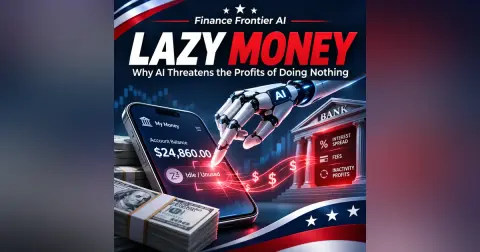
What if the most profitable customer is the one who never calls? No fraud. No financial crisis. Just millions of ordinary people too busy to compare bank accounts, cancel subscriptions, or question renewals.
In Lazy Money, Max, Sophia, and Charlie explore how artificial intelligence could threaten the profits of doing nothing by reducing the cost of paying attention. The deeper story is not just about saving a few dollars. It is about what happens to banks, insurers, subscription businesses, and investors when customers can finally afford to look.
The episode follows Maria, an ordinary customer whose money is spread across checking accounts, subscriptions, and insurance policies. As AI agents become more capable of monitoring those relationships, the key economic question changes: when the cost of paying attention falls, who loses, who gains, and where does the value go next?
Recent examples make the story more concrete. In October 2026, major financial institutions were reported to be restricting outside AI agents from directly accessing customer accounts, while still allowing more limited, approved forms of read-only sharing in some cases. And in the UK, regulators had already moved against insurance “price walking,” where loyal customers could end up paying more than new ones. These examples do not prove that every industry depends on inertia, but they show why attention, access, and authorization are becoming real economic battlegrounds.
🧠 Key Topics Covered
🔹 Inertia Rent: The extra value companies may capture when customers stay partly because reviewing or changing a decision takes too much effort.
🔹 The Customer Who Never Sleeps: How AI can turn financial comparison from an occasional chore into a continuous service.
🔹 The Lazy Money Agent: A conceptual AI assistant that identifies overlooked savings, explains trade-offs, and helps complete approved actions.
🔹 The Banks Fight Back: Why the real conflict is not just about better rates, but about who gets permission to access accounts and act on behalf of customers.
🔹 The Optimization Trap: Why an agent that chases every tiny saving can make life worse, and why the best recommendation is sometimes to do nothing.
🔹 Attention Rent: How power may shift from companies benefiting from customer inertia to new AI intermediaries controlling what customers see and compare.
🔹 The Investor Test: Why retention numbers cannot always tell love from forgetting, and how apparently “loyal” customers may be less durable than they look.
🔹 The New Money Economy: New business opportunities in discovery, verification, and safe execution as AI makes attention cheaper.
📉 Why This Matters
AI may not just help consumers save money. It could reshape how businesses defend margins, how investors evaluate customer loyalty, and how economic value moves between banks, customers, and new digital gatekeepers. The real question is not just whether AI finds a better deal. It is who gets to control the path from discovery to action.
🌐 Stay Connected
📬 Discover The 10× Edge at FinanceFrontierAI.com. Have a compelling thesis? Visit our Pitch Page.
🎧 Subscribe on Spotify or Apple Podcasts. Follow us on X and LinkedIn.
🔥 Keywords: Lazy Money, AI and finance, customer inertia, Inertia Rent, Attention Rent, artificial intelligence, banking, deposits, insurance renewals, subscription economy, price walking, financial optimization, AI agents, personal finance, digital banking, bank deposits, deposit rates, customer retention, competitive advantage, investor insight, financial technology, fintech, AI assistant, consumer behavior, switching costs, financial automation, business models, financial services, economic power, household finance, bank margins, funding costs, trusted authorization, AI investing, future of money, AI and banking, financial regulation, economic incentives, customer loyalty, financial friction.


