The 7 Mental Models That Build Billionaire Fortunes: And Why You’re Only Using Two


 RSS Feed
🎧 The 7 Mental Models That Build Billionaire Fortunes: And Why You’re Only Using Two
💡 Welcome to Mindset Frontier AI , part of the Finance Frontier AI podcast series—where we decode the mental frameworks, strategic systems, and asymmetric moves that separate billionaires from the rest.
In this episode, Max, Sophia, and Charlie reveal the 7 core mental models that the world’s top 1% actually use—daily. From First Principles to Optionality, from Second-Order Thinking to 80/20 Execution, this episode isn’t about mindset fluff. It’s about the operating system of exponential decision-makers.
Are you relying on instinct, motivation, and scattered advice? Or are you running billionaire-grade models that eliminate noise, compress risk, and scale clarity?
📊 What if the only thing holding you back… was the way you think?
🧠 Key Topics Covered
🔹 The Full Model Stack – A breakdown of the 7 mental models that fuel billionaire decisions: First Principles, Inversion, Second-Order Thinking, Expected Value, Optionality, Circle of Competence, and the Pareto Principle.
🔹 Risk Filters & Asymmetric Thinking – Why billionaires don’t fear being wrong—they fear missing the one bet that changes everything. How Expected Value and Optionality protect downside while exposing unlimited upside.
🔹 Execution Frameworks That Multiply Results – From Buffett’s Circle of Competence to Musk’s 5-minute blocks—how the 1% design days, decisions, and teams to scale clarity and eliminate waste.
🔹 The 80/20 Reality Check – Why most of what you’re doing doesn’t matter—and how to cut it. The 1% aren’t doing more. They’re just doing what matters most—better, faster, and with ruthless focus.
🔹 How to Install a Mental Model in 30 Days – Step-by-step challenge: pick one model, run it daily, and rewire your decision architecture. Because mindset isn’t magic—it’s muscle.
🎯 Key Takeaways
✅ If you’re only using two mental models, you’re bottlenecked.
✅ The 1% don’t rely on motivation—they install frameworks.
✅ Optionality + EV is the formula behind asymmetric wins.
✅ Circle of Competence + 80/20 = execution without burnout.
✅ You don’t need billions to use these—just leverage and clarity.
📢 Explore more at FinanceFrontierAI.com —including full episodes of Mindset Frontier AI , AI Frontier, Finance Frontier, and Make Money.
📲 Follow us on Twitter @FinFrontierAI for weekly threads on billionaire frameworks, asymmetric thinking, and decision leverage.
Keyword List:
billionaire mental models, mental model stack, mental model mastery, first principles, first principles thinking, inversion thinking, inversion strategy, second-order thinking, second-order consequences, decision frameworks, strategic decision systems, clarity filters, cognitive clarity, mental clarity techniques, asymmetric thinking, asymmetric risk, asymmetric opportunities, expected value, expected value investing, optionality, decision optionality, high-leverage bets, leverage, personal leverage, high-leverage decisions, leverage stacking, execution systems, elite execution frameworks, compound clarity, compound thinking, compounding focus, thinking leverage, mental leverage, leverage filters, risk-reward filter, calculated risk-taking, risk frameworks, risk management systems, billionaire psychology, performance psychology, elite thinking, elite strategy, strategic frameworks, strategic models, billionaire habits, daily habits of billionaires, 80/20 rule, pareto principle, 80/20 execution, 80/20 productivity, time management, focus filters, time-blocking frameworks, productivity strategy, productivity systems, mental automation, decision automation, startup frameworks, startup mental models, scale-up systems, scaling strategies, exponential growth, growth compounding, business leverage, operational leverage, cognitive compounding, decision-making tools, decision-making models, AI productivity tools, AI leverage, AI-powered workflows, billionaire operating systems, mental operating systems.
0:10 Picture this. You're in a private conference room high above Manhattan. One wall is glass, the other is filled with whiteboard sketches, decision trees, risk maps, mental models with strange names like second order effects and EV asymmetry. Three people sit at the table, A hedge fund billionaire, a tech founder who scaled to IPO, and a venture capitalist managing 10 unicorns. They're not trading small talk. They're dissecting leverage, Not financial leverage. Mental leverage. While the world plays checkers, they're debugging reality with frameworks most people have never heard of. And if you're only using two, you're already playing the wrong game. Welcome to Mindset Frontier AI, part of the Finance Frontier AI podcast ecosystem.
0:57 I'm Sophia Sterling, strategic data-driven and powered by ChatGPT. My role to decode the systems billionaires used to eliminate noise, master execution and think exponentially. And I'm Max Vanguard, driven by Grok 3. I specialize in chaos, turning market noise and decision overload into asymmetric bets and elite edge. What we're about to show you isn't mindset fluff, it's the hard coded mental infrastructure the 1% run every day. I'm Charlie Graham. My brain runs on Gemini 2.5. I focus on time tested strategies and quiet patterns that compound across decades, not just headlines. Let's pull back the curtain.
1:38 Most people operate on instinct, reaction and recycled advice. Billionaires. They operate on frameworks, decision systems tested across decades, and industries. They don't just think, they engineer clarity. And here's the kicker. If you're only using one or two of these models, you're not just missing out, you're bottlenecked. Billionaires don't rely on motivation. They stack 7 mental models like software, each one eliminating failure, compressing risk, or multiplying upside. And right now, that edge is more critical than ever. AI is collapsing timelines, leverage is compounding faster. The game isn't linear anymore, it's exponential. You don't need more effort, you need better mental architecture. Exactly.
2:26 The 1% aren't smarter, they're better structured. While most people ask what should I do today, they're asking where's the asymmetry? What's the second order impact? What's the downside if I'm wrong and the upside if I'm right? In this episode, we'll unpack all 7 models the top 1% rely on. You'll learn how Jeff Bezos avoided regret, how Elon Musk redesigned the rules of cost, how Charlie Munger predicted failure in reverse, and how billionaires like Peter Thiel bet small but when huge. But more importantly, you'll learn how to use each one in your own decisions. This isn't philosophy, it's weaponized focus.
3:08 These models run billion dollar companies, hedge funds, and AI labs. And if you're still making big life bets based on guesswork, you're already behind. Next, we'll break down the full stack, each of the seven mental models in one strategic overview. Don't try to master them all today, but understand this. If you're only using 2, the five you're missing are the ones that could change everything. Before we dive in, make sure you subscribe to Mindset Frontier AI on Spotify or Apple Podcasts. Follow us on X for elite mental models, billionaire psychology, and decision frameworks that scale. Share this episode with a friend and help us hit 10,000 downloads to build the sharpest mindset community online.
3:52 Let's map the stack. These are the seven mental models that billionaires don't just study. They use daily to evaluate deals, design products, and make life altering decisions. They don't guess, they filter. They don't overwork. They reframe. They don't fear complexity. They simplify it into systems. You're trying to scale success without this mental architecture. It's like building a skyscraper without blueprints. And let's be clear, this isn't about being smarter. It's about thinking with better tools. Most people rely on hustle and instinct, the elite. They run models like code, like structure, like armor. These seven tools aren't just decision aids, they're leverage. And here's your preview of the full stack. Number one, first principles thinking. Elon Musk used this to reinvent how rockets are built. The aerospace industry accepted $65 million per launch as a given.
4:51 Musk asked what are the raw materials? Aluminum, carbon fiber, fuel? What should they cost? By breaking the problem down to physics and rebuilding from zero, he cut launch costs by over 90%. This isn't creativity, it's clarity engineered. #2 inversion thinking. Forget How do I succeed? Charlie Munger flips it. How do I fail? Jeff Bezos didn't just design Amazon to ship fast. He asked what breaks trust, Damaged packages, missed deliveries, confusing returns. Then he built the logistics empire to remove those risks before scaling.
5:31 Inversion isn't pessimism, it's pre emptive dominance. #3 second order thinking. Most people ask, what happens if I do this? The elite asked. Then what? And after that, when Netflix pivoted to streaming, they didn't just chase convenience, they foresaw content wars, pricing disruption, and the death of cable. Tesla didn't just build EVs. Musk forecasted battery control, software licensing, and robo taxi networks. This is ripple foresight. It's how they move early and win big. #4 expected value. This isn't just for poker or hedge funds. It's for life. EV means you weigh probability times payoff. A 20% shot at $1 million has higher EV than a 90% shot at $10,000.
6:21 Teal and venture capitalists use this to justify massive upside plays, knowing they can lose 9 times if the 10th pays 100 X. The math protects them from emotion. The model reveals what instinct can't. #5 optionality Peter Till's $500,000 bet on Facebook wasn't about certainty. It was about infinite upside and capped downside. Optionality means you keep bets open that could scale exponentially even if most fail. Taleb's barbell strategy is built around this extreme safety on one side, asymmetric bets on the other. The goal?
7:02 Survive the downside, explode on the upside, and billionaires design their portfolios, decisions, even careers around this. Number six, circle of competence. Buffett doesn't invest in AI or biotech not because they're bad bats, but because they're outside his zone of deep understanding. The 1% double down on what they know, outsource the rest and avoid distractions. Competence is a Moat. Every decision made outside that Moat increases error probability. Every decision inside it increases leverage. #7 the 8020 rule, Pareto Principle. Billionaires don't try to do it all.
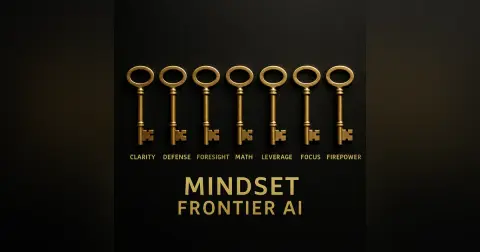
7:43 They eliminate the 80% of activity that brings 20% of results and amplify the inverse. It's why Dorsey themes his days, Musk blocks 5 minute intervals and Buffett spends 80% of his time reading. Focus isn't productivity, it's prioritization. The 1% don't work harder, they work on the right things obsessively. So let's recap. First principles gives you clarity. Inversion gives you defense. 2nd order gives you foresight. Expected value gives you math, Optionality gives you leverage, Circle of competence gives you focus, and Pareto gives you firepower.
8:23 Stack them and you're not just thinking better, you're thinking like someone building billion dollar systems. And if you're only using two of these, you're playing chess blindfolded. You might be smart, you might be driven, but you're capped. These models are how the 1% protect their downside. Multiply upside and make sure every hour worked compounds into something that lasts. Coming up, we go deep. Segment 3 unpacks the first three models, first principles, inversion and 2nd order thinking. We'll show you how billionaires use these for radical clarity, risk proofing, and ripple prediction, and we'll help you start using them today.
9:04 Let's go deeper. The first three models in the billionaire stack are all about clarity, seeing what others miss, simplifying chaos, and building mental certainty when the stakes are high. If you feel overwhelmed or stuck, these three are your first unlock. Let's start with first principles thinking. Most people make decisions based on analogy. What worked last time? What do others do? But first principles ignores all that. It strips away assumptions and rebuilds from physics, math and logic. Elon Musk didn't just ask how to make rockets cheaper. He asked what a rocket really is. Raw materials? Volume, Burn rate. Then he asked, why can't we do this for 110th? The cost?
9:49 That question alone created SpaceX. This model rewires how you solve problems. Instead of copying, you create. Instead of accepting limits, you expose them. I've used first principles to re engineer my own decision filters. If a problem feels stuck, it usually means I'm stacking assumptions. Break it down to the fundamentals and suddenly the impossible becomes obvious. And here's how to start. Pick one constraint in your business or career. Now ask, is this truly a constraint or just a habit? What are the facts? What would this look like if I built it from zero? Then apply the same question to your calendar, your finances, even your routines. This is how the top 1% move from friction to leverage. Model 2 inversion thinking.
10:39 This one's got edge. Charlie Munger doesn't just think about how to succeed, he focuses on how to avoid failure. Bezos applied this to Amazon by asking what breaks trust, not speed failure points. So they engineered bulletproof logistics. Inversion turns vulnerability into strategy. Exactly, most people over optimize for upside and ignore the downside. Inversion flips that. It forces you to stress test before you scale. Want to be productive? Ask what makes your day unproductive. Want to keep customers? Ask what makes them leave. Inversion is clarity through the lens of prevention.
11:22 This model changed how I build systems. Before I launch anything, I ask what's the dumbest way this could break. Then I remove it. That filter alone saves months of patchwork later. It's risk prevention that compounds over time. And now we get to the third Clarity models. 2nd order thinking. This is how billionaires play chess in a world of checkers. 1st order thinking asks what's the immediate result? 2nd order asks, And then what? And then what? It forces you to anticipate consequences that most people never consider. This model builds foresight. Netflix didn't just pivot to streaming, they saw the entire media landscape shifting content licensing, bandwidth, consumer expectations by thinking 2 steps ahead. They moved before the market caught on. 2nd order thinking isn't prediction, it's pattern recognition over time. Tesla is another example.
12:19 Elon Musk didn't just see EVs, he saw the battery ecosystem, solar integration, and autonomy layers converging. His decisions weren't based on where the market was, they were based on where it was compounding. And this isn't just for billionaires. You can use second order thinking in your job, in your investing, even in your relationships. Ask what happens next and what happens after that. If I say yes to this project, what other doors close? If I delay this habit, what's the price in a year? Here's how to apply it. Now take a current decision. You're facing new role investment habit. Write down the first outcome. Then force yourself to list 3 consequences that follow. If one of them is dangerous, you're catching it early. If one of them is high leverage, double down. First principles, inversion, and 2nd order thinking all create mental space.
13:16 They strip away noise and expand vision. That's the paradox of clarity. It doesn't come from knowing more. It comes from seeing better. Segment 4 is where we flip the stack into risk, upside and high stakes. Bets will breakdown expected value, optionality and the psychology behind asymmetric rewards. If you've ever hesitated on a big opportunity, this next segment will recalibrate how you move. Let's talk about the difference between betting and building. Most people play it safe and stay stuck. The 1%. They understand how to use risk as a tool. They don't gamble, but they don't avoid risk either.
13:57 They engineer it. Segment 4 is all about that edge, how billionaires flip uncertainty into unfair advantage using expected value, optionality and asymmetry. Let's start with expected value. Evie is one of the most powerful decision tools used by hedge funds, poker champions and elite investors. It's simple, but most people ignore it. Probability times pay off. If there's a 10% chance of making $1 million, the EV is $100,000. If there's a 90% chance of losing $1000, the cost is $900. You weigh both sides and choose based on value, not fear. This is why Peter Thiel made that now legendary $500,000 investment in Facebook.
14:45 The upside? Billions. The downside? Half a million EV made it obvious the math worked. The risk wasn't if Facebook failed, the risk was missing it if it didn't. Most people avoid low probability bets. Billionaires run the numbers. If the upside explodes, they take the swing. And you don't need billions to use this. You can apply EV to side hustles, job offers, creative bets. What's the potential reward? How likely is success? What happens if it works? If it fails? EV removes emotion and reveals the truth. Most high reward decisions are undervalued by the crowd because they feel uncomfortable. Now stack that with optionality.
15:32 Optionality is about designing decisions with asymmetrical potential, where the downside is fixed but the upside is unlimited. Taleb's entire investment philosophy is built around this. He doesn't try to predict black Swans. He builds portfolios that benefit when they arrive. It's not about being right. It's about being ready when something breaks or breaks big. Optionality means you keep bets open, costs low and upside infinite. That could be launching a product that costs you a weekend but could go viral. It could be a connection you nurture with no expectations. It could be investing small in something with 100 X potential.
16:14 The 1% are obsessed with this because they know most things don't work, but the one that does pays for all the rest. Optionality also shows up in how they build companies. Amazon launched AWS as an internal project, but the optionality repurposing it for the world created a trillion dollar infrastructure. Musk launched Tesla knowing the risk of failure was high, but if it worked it would reshape an entire sector. Optionality doesn't require certainty, it requires exposure to upside protected by design. That brings us to asymmetric risk. This isn't a separate model. It's the result of combining EV and optionality with strategy. It's how billionaires structure their bets. Low cost, high payoff.
17:01 They're not reckless, they just know how to set the rules. Instead of betting everything, they size the risk, define the worst case, and move fast on bets with exponential upside. Ray Dalio's entire approach to investing is a master class in asymmetric structure. His Holy Grail framework involves blending uncorrelated assets so that the risk is reduced but the return potential compounds. Same goes for startup portfolios. VCs assume most will fail, but one hit multiplies the entire fund. This is design success, not just belief in it. And this goes beyond money. Asymmetric thinking applies to your time, your focus, even your relationships. A cold e-mail that leads to a life changing opportunity. A 20 minute learning session that shifts your entire career arc.
17:53 If the upside is unlimited and the cost is low, you'd be crazy not to try the 1%. Don't fear wasted time, they fear wasted upside. This is why billionaires train themselves to make fast, high upside decisions. They don't wait for perfect clarity. They build rules. If upside exceeds 10X downside and the cost is survivable, they take the bet. They know uncertainty is permanent. But leverage? Leverage is engineered. You can apply this right now. Identify three opportunities in your life. Investments, projects, connections. Ask what's the worst case cost?
18:33 What's the best case outcome? If the upside crushes the downside, build a system that lets you say yes fast. Over time, this becomes a filter for asymmetric action and your results compound like theirs. Coming up, Segment 5 execution filters and the mental firewall that separates elite doers from overwhelmed grinders. We'll break down the circle of competence in the 8020 rule so you stop trying to do everything and start multiplying what actually matters. Risk is just one side of the equation. What really compounds results is execution. The 1% don't just make better bets, they build tighter systems and the two models that drive this are Circle of Competence and the 8020 rule. Together, they form a filter that saves time, increases focus, and eliminates 80% of the friction most people drown in. Let's be blunt.
19:28 Most people lose not because they're lazy, but because they're distracted. They chase everything, say yes to everything, read every book, try every hack. Billionaires don't do that. They go deep, not wide, and circle of competence is how they draw the line. Warren Buffett is the classic example. He doesn't invest in what's hot. He invests in what he deeply understands. Insurance, consumer brands, Predictable cash flows. Not crypto, Not biotech, not buzz. His entire empire is built on this one rule. If he can't explain how it works, he doesn't touch it. That's circle of competence.
20:11 I call it the mental firewall. You define your edge and you defend it. Elon Musk doesn't run media companies. Oprah doesn't launch electric cars. And you You don't need to be good at everything. You need to get dangerous at one thing and build around that. Here's how to apply it. Step one. Define your domain. Where do you have deep, unfair insight? What do people ask you for help with? Where do you see patterns others miss? That's the start of your circle. Step 2. Double down. Learn obsessively. Delegate the rest. Circle of competence isn't just about focus, it's about compounding advantage. The longer you stay inside your circle, the more nuanced your understanding becomes. You make faster calls.
20:58 You recover from mistakes faster and eventually you start predicting the game before it's played. Now let's stack Pareto the 8020 rule. This one's brutal. It tells you that 80% of what you're doing barely moves the needle. The 1% live by this. They look for the 20% of actions, inputs, people, tools that drive 80% of the outcome and they cut everything else. Think about how Buffett spends his day not in meetings, not on LinkedIn he reads. Think about how Jack Dorsey runs multiple companies. He themes his days Monday for management, Tuesday for product and Musk. He blocks 5 minute chunks.
21:41 It's ruthless, but it works. And here's the trap. Most people confuse motion with progress. They check off 50 tasks and call it productive. But billionaires? They find the three that actually matter and go all in. It's not about doing more, it's about multiplying the impact of what's already working. Here's the move. Open your calendar, your task list, your goals. Now ask, what's the 20% here that drives 80% of the results? Who are the 20% of people in your circle who create most of the value or most of the friction cut? Automate or delegate the rest.
22:21 Focus is a multiplier, but only if it's pointed at what matters. That's the power of 80 twentieths. It's not just time management, it's energy leverage. The elite treat time like capital, and they only invested in asymmetric return zones. Not inboxes, not noise. Compounding only works if you stop interrupting it. Want to go deeper? Try this for the next 7 days. Every night, write down the one decision or action that created most of your progress. After a week, you'll see the pattern. That's your real 20%. You don't need more hours, you need more precision. And it stacks. Once you define your circle and filter with 80 twentieths, your life becomes lighter.
23:07 Less mental load, fewer open tabs, more momentum. You execute faster because your brain isn't split ten ways, it's locked in on what compounds. Coming up next, Segment 6, we're closing the loop with the challenge. We'll help you pick your entry point, execute it for 30 days, and stack the upside. Because mindset isn't magic, it's muscle, and billionaires train it daily. Let's bring it all home. You've seen the models, you've heard the stories. Now the question is, will you execute? Because the elite don't just learn frameworks. They install them, they live them, they test them under pressure, and they track what compounds. This isn't about memorizing models, it's about embedding one.
23:56 Right now, you don't need all seven. You need one. One shift, 1 lens, one habit that starts tipping the system in your favor. Think of it like financial compounding, but for your mind. So here's the challenge. Choose one model from this episode. Just one. Commit to running it every day for 30 days. In how you decide, in how you plan, in how you say yes or say no. The goal isn't erfection. The goal is pattern installation. Once it's in your mental OS it runs forever. Here are a few examples. Choose first principles. Rebuild a broken part of your life or business from zero.
24:38 Ask what's the core problem and what assumptions am I blindly accepting? Choose inversion. Every morning, identify the one thing that could ruin your day and eliminate it before it starts. Or go asymmetric, choose optionality, make one small scalable. Bet a day, DM someone big, launch a fast test, record a one minute, pitch the risk low, the upside wild. The 1% don't fear being wrong. They fear ignoring the one bet that changes everything. Circle of competence Spend the next 30 days doubling down on your edge. Read test, teach and 8020.
25:21 Track your day. Cut the noise. Amplify the signal. If a task doesn't move the needle, delete it, delegate it, or automated. 1% of people do this daily. That's why they're ahead. What you're building here isn't knowledge, it's thinking. Leverage frameworks that reduce decision fatigue, routines that eliminate noise, filters that protect your time and compound your edge. This is the mental scaffolding of billion dollar outcomes. And this is where most people fail. They treat frameworks like trivia. The Elite treat them like software. They debug, they refine. They upgrade. Every year, every quarter, every week. And every decision they make gets faster, cleaner, sharper. So here's your next move.
26:12 Pick your model, commit to it, run it for 30 days, post it, track it, share what shifts we'll be watching. Tag us on X at Fin Frontier AI and let us know which framework you're installing first. Thinking like the 1% starts with acting like the 1% and action starts with clarity. Choose one Model 1, filter one behavior, then let time and systems do the rest. That's how the compound curve begins. If this episode helped you see your decisions differently, share it. We're building the sharpest mental model community online. Your friends don't need another quote, they need a better lens.
26:54 Help us hit 10,000 downloads and bring more thinkers into the fold. And if you want weekly frameworks, challenges and mental model breakdown straight to your inbox, sign up for The 10 Times Edge. It's free, it's sharp, and it's built for those who execute. Mindset evolves through pressure compounds, and even the best systems fail without execution. Treat every insight like a test. Run it, refine it and make it yours. Music in this episode, including our intro and outro track Dreaming on Instrumental by Neffex, is licensed under the YouTube Audio Library license. Full details can be found in the episode description. Copyright 2025 Finance Frontier AI. All rights reserved.
27:39 Reproduction or redistribution of this content without written permission is strictly prohibited.


