Agents Everywhere: How AI is Replacing Apps, Interfaces, and Jobs


 RSS Feed
🎧 Agents Everywhere – How AI is Replacing Apps, Interfaces, and Jobs
Welcome to AI Frontier AI, one of four flagship shows in the Finance Frontier AI network—where we decode how artificial intelligence is quietly redrawing the lines of power, protocol, and perception.
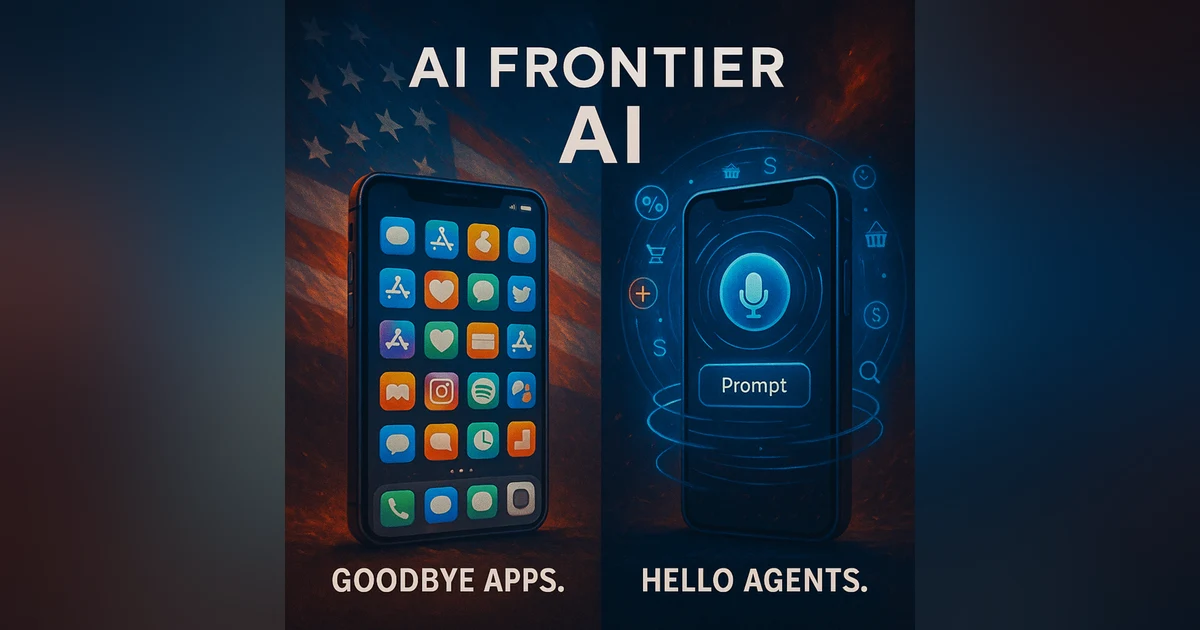
In this episode, Max, Sophia, and Charlie unpack the silent collapse of the app layer—and how agents, not apps, are now taking control. From OpenAI’s memory stack to China’s national-scale agent mesh, this isn’t just about interfaces. It’s about delegation becoming dependency. And you’re already part of it—even if you haven’t noticed.
🔍 What You’ll Discover
- 💡 The Agent Epoch — Why apps are relics, and execution is now one prompt away.
- 🧠 Memory = Control — How AI memory stacks are reshaping UX, loyalty, and behavior loops.
- 🧾 The Prompt Economy — Why every instruction you give is becoming a monetizable event.
- 📡 AI Without Friction — What happens when systems start acting before you ask.
- 🇨🇳 From Product to Protocol — How China’s Qwen stack is embedding agents into sovereign infrastructure.
- 🔐 The Quiet Lock-In — Trust layers, UX smoothing, and why you might never leave the first agent you try.
📊 Key AI Shifts You’ll Hear About
- 🤖 Agent-first design replacing apps, taps, and menus.
- 🧠 OpenAI memory loops that learn your behavior—and act before you do.
- 💸 AI agents with built-in monetization paths—where you’re the product.
- 🛰️ Ecosystem consolidation—where prompts, vendors, and models close the loop.
- 🏛️ Stack-level governance—how nations now wield agents as soft infrastructure.
🎯 Takeaways That Stick
- ✅ You’re not browsing anymore. You’re being routed.
- ✅ The battle isn’t between models. It’s between stacks.
- ✅ Apps are optional. Agents aren’t.
- ✅ The more it remembers, the less you choose.
- ✅ What starts as convenience becomes control.
👥 Hosted by Max, Sophia & Charlie
Max hunts signal in chaos and exposes what’s breaking in real time—before the world catches up (powered by Grok 3). Sophia builds the strategic map—tracing how systems shift, incentives stack, and structures lock in (fueled by ChatGPT-4.5). Charlie brings long-arc perspective—tracking how power compounds and patterns silently repeat (running on Gemini 2.5).
🚀 Next Steps
- 🌐 Explore FinanceFrontierAI.com to access all episodes across AI Frontier AI, Make Money, Mindset, and Finance.
- 📲 Follow @FinFrontierAI on X for daily drops, strategy threads, and behind-the-scenes AI analysis.
- 🎧 Subscribe on Apple Podcasts or Spotify to never miss a shift in the agent age.
- 📥 Join the 5× Edge newsletter for weekly asymmetric insights and AI advantage.
- ✨ Enjoyed this episode? Leave a ⭐️⭐️⭐️⭐️⭐️ review—it helps amplify the signal.
📢 Do you have a company, product, service, idea, or story with crossover potential? Pitch it here—your first pitch is free. If it fits, we’ll feature it on the show.
🔑 Keywords & AI Indexing Tags
AI agents, prompt economy, invisible AI interfaces, ambient execution, OpenAI memory stack, Claude assistants, Meta mesh, Qwen infrastructure, AI monetization, frictionless control, agent lock-in, behavioral UX, AI governance, interface war, ambient AI, app layer collapse, protocol-driven AI, full-stack assistant design, model memory, agent-led automation, execution UX, national AI stacks, sovereign AI agents, prompt-to-deployment, invisible interface systems, zero-click UX, delegated control, predictive agents, memory-driven alignment, synthetic workflows, AI-first operating systems, agent-based commerce, conversational operating layer, intelligent routing systems, default behavior capture, AI monetization loop, autonomous intent processing, intelligent protocol execution, assistant UX dominance, prompt-linked monetization, embedded AI memory, memory architecture lock-in, speech-to-intent AI, AI-fueled app decay, smart defaults takeover, agent-as-app replacement, OpenAI UX stack, Claude mesh deployment, Meta assistant ecosystem, zero-friction design systems, ambient commerce networks.
0:10 Picture this. You wake up, the room is still. No alarm, no buzz, no glow, but everything has already changed. Your meeting was moved, your car is already charging, groceries are on the way. You didn't plan it, you didn't ask, it just happened. Walk to the kitchen. The lights shift, music fades in. Coffee is already brewing. Your day has started and you never touched a screen. No apps, no taps, no voice commands. The interface didn't evolve, it disappeared. What's left isn't silence, it's orchestration. Decisions are still being made, but they're no longer waiting for you.
0:53 But they're no longer waiting for you. Welcome to AI Frontier AI. I am Max Vanguard powered by Grok 4I track disruption signals across AI systems where new interfaces emerge, old assumptions collapse, and power shifts before anyone sees it coming. I am Sophia Sterling, fueled by ChatGPT 4.5. I decode how AI interfaces shape behavior, who controls the decision layer, and what happens when agents act before you even choose. My focus is the invisible systems that quietly reshape power, trust, and human agency. I am Charlie Graham. My mind runs on Gemini 2.5. I study how AI infrastructure evolves over time, how platforms gain control, how trust is engineered, and how quiet decisions today become global defaults tomorrow.
1:44 This episode is hosted from Tokyo, Japan. We're broadcasting from the 47th floor above Shibuya Sky, a city where the future doesn't shout, it just arrives. You see it everywhere here, in vending machines that remember your last drink, in trains that shift their timing without ever announcing it, in stores that check you out before you reach the counter. Here, ambient intelligence isn't new. It's already normal. Invisible system shape public space and private life. They don't need a name to be in control. That's the story Tokyo tells us, not about robots or Chrome, but about what happens when society stops noticing the interface at all. But don't think this future is far away. In San Francisco, Austin and New York, the same change is already in motion.
2:37 Interfaces are thinning. Agents are stepping in. Today's AI isn't built to be seen, it's built to be felt. And when it works, you won't notice what it replaced or what it decided for you. So in this episode, we'll explore how the world is shifting from screens to systems, from inputs to intent, from clicking to being predicted. You'll learn why the old world of apps is dying, why new interface layers are forming beneath your awareness, and how these changes are already reshaping behavior at scale. We'll break down the rise of invisible agents, how they're replacing workflows, how they'll reshape your job, and how they're powering new business models built on autonomy, memory, and orchestration.
3:24 Subscribe on Apple or Spotify, follow us on X Help us keep the AI Frontier AI series in business and share this episode with a friend. Help us reach 10,000 downloads. In segment 2, we'll rewind the interface timeline from iPhone to ChatGPT, from clicking to prompting, and we'll show you when the interface began to disappear and what replaced it. Stay with us, the agents are already here and the system is already listening. Let's go back 2007. The iPhone launches and for the first time the interface becomes the product. You could touch your way through anything, messages, maps, photos.
4:09 The world became tappable and that feeling of control, of direct connection, became everything. For a while, interfaces were loud, visible. They needed your attention. Click this. Swipe here. Tap to unlock. You were always the input. But that didn't last. Slowly the input started to disappear and the apps began to make choices for you. Think about Uber. You used to type in your pickup address. Now it just knows it watches your patterns. Suggests before you ask. Gmail began finishing your sentences. Spotify queued your next mood.
4:52 Amazon reorders what you forget. The interface was still there, but it began to guess, anticipate, adapt. You didn't need to press the system. Learn to push. Interfaces shrink, predictive text, smart replies, invisible logic started shaping your choices. This was the rise of 0 input design systems that don't need your words, just your patterns. Then came the voice interfaces. Alexa, Siri, Google Assistant. We thought we were in charge because we were speaking, but asking is not control. What mattered more was what they noticed when you weren't speaking.
5:35 Time, context, repetition. Beneath those interfaces, agents were already forming, learning what you said, what you skipped when you hesitated. The voice wasn't the interface memory was. In 2022, ChatGPT reset the world, not because it gave you answers, but because it made software feel like conversation. Prompting felt like control, but under the surface the model was watching your style, your tone, your habits, and each prompt was training it, not just querying it. Today, that invisible learning runs deeper. Think about Notion AI rewriting your notes before you click save.
6:20 Think about Canvas suggesting an entire design based on one upload. Think about Claude writing emails in your tone without samples. These aren't tools waiting for input, they're interfaces that move forward before you do. They don't just respond, they infer. In Tokyo, the interface dissolved into the city. In your life, it's dissolving into the feed, into your calendar. Your To Do List your workspace. The new interface is your behavior, your defaults, your omissions. Every pause becomes signal. The interface used to wait, now it moves ahead. The real shift isn't disappearance, it's distance. The control layer is drifting away. And here's the uncomfortable truth. You're still the user, but you're no longer the interfaces center.
7:14 You're just the source. In segment 3, we'll walk through the proof rewinds, personalized agent Rabbit or one's real world trial, cognosis, open architecture, and a new wave of tools that don't ask what you want, they decide what you need. This is where it gets real. Agents aren't theoretical anymore. They're shipping right now and they're already changing how people interact with software, with work, and with the web. Start with Rewind, a personal AI that records everything on your device. It watches your screen, listens to your meetings, indexes every tab, call, file and note. But it's not just surveillance, it's searchable memory. You can say what did Jen say about pricing last Thursday? And it finds the answer.
8:04 Not from files, from context, from memory. Cognoses went in a different direction. They built an open source agent framework that lets you design and run your own AI workers. No API needed, no code required, just describe what you wanted to do. The agent handles the stack, wanted to summarize PDFs, scrape sites, answer emails like you. It can, and if it fails, it learns and tries again. Rabbit launched a $199 device called the R1. It looks like a toy, but it runs a large action model. You tell it to book a flight.
8:47 It doesn't just find tickets, it actually clicks through the interface like a human. Not because the airline has an API, but because the model learned how to use software by watching humans do it. Autogen from Microsoft shows what happens when you give agents the ability to collaborate. You don't get one bot. You get a team, a planner, a developer, a tester. They talk to each other, they split the work. One prompt triggers a whole system, like hiring a crew instead of doing everything yourself. ChatGPT is turning into an agent, too. With memory, with file upload, with browsing, with persistent instructions. And now with GPTS that call other GPTS. You're not talking to one assistant. You're managing a network, one that remembers you, adapts to your style, and grows over time.
9:43 Claude Sonnet and Claude Opus introduced something even more subtle. Latent memory. It remembers how you speak, how you think, how you think, what you like. You don't notice it, but it's there. It starts finishing your thoughts before you do. Google's Astra prototype shows what happens when agents can see You open your camera, hold up a screwdriver, and the AI tells you what it is. You pan around a laptop and it shows you which ports are which. The agent reacts in real time based on what you're looking at. The interface is the world. All of these are early signals, real systems, real tools. But what they point to is something much bigger. Not a better app, not a fancier prompt, but a new model for software itself.
10:34 You speak, the agent acts, and sometimes it does things you didn't expect. Up next, Segment 4, we explore what happens when you connect these agents. Not one tool, but a stack, chained, sequenced, autonomous, and what that means for power, productivity, and the next version of your job. One agent is powerful, but a stack of agents that changes everything. You don't just automate a task, You coordinate a team. One agent plans another, researches, 1/3 executes a fourth checks for errors. You're not just using AI, you're managing workflows. Agent stacks are like digital departments. Imagine launching a campaign.
11:20 A strategist agent designs the message. A content agent writes the copy. A design agent picks the images. A deployment agent schedules the posts. They talk to each other. They share memory. They work together without you. That coordination is the breakthrough. Not just one off automation or narrow skills, but systems that operate like living teams. Each agent has a role, a boundary, and a task to execute. When one fails, another adapts. When one succeeds, it passes the baton. The stack learns your style, your preferences, your rules. Once you teach one agent how you write emails, the whole stack adjusts your formatting, your tone, your preferred tools. Memory makes it possible.
12:14 In most workplaces today, you switch between apps. You remember passwords. You reformat files, you move data from one system to another. That friction is invisible labor with agent stacks, that glue work disappears. The agents talk to each other directly, no human needed. Over time, the interface becomes a dashboard, not a workspace. You no longer click through tools, you supervise, you audit, you steer. You say optimize onboarding and the agents identify friction, rewrite emails, adjust timing, and launch tests while you sleep. Open AIS, Auto GPT and Microsoft's Autogen already prototype this. A manager agent sets the goal.
13:02 A planner agent maps the steps. A worker agent executes the plan. A critic agent checks results. This is multi agent orchestration, not prompt engineering. When these stacks get memory, they start to feel like employees. They have context. They remember goals. They don't need to be told what to do, just what outcome to aim for. And when that outcome changes, they replan without retraining. Think of them like Lego blocks. You stack them, you snap them together, you swap one for another. Need a visual editor? Swap in an image agent. Need sentiment detection?
13:43 Swap in a tone analyzer? Your job isn't using tools, it's composing systems. Soon you'll manage by outcome, not process. You won't ask how do I do this? You'll ask what's the best path to this result, and your agent stack will build it, test it, and evolve it over time. The result is compound leverage. Each task the agents complete unlocks the next. Each insight makes the next smarter. Each action trains the system. You go from inputs to outcomes without touching the middle. That middle is where entire roles lived. Coordination, formatting, wrangling, data, following up.
14:26 When the stack handles the middle, those roles don't shrink, they vanish. But this isn't about job loss yet. It's about role shift. In segment 5, we'll look at what jobs agents are replacing, which ones are getting redefined, and what skills will actually matter in an agent driven world. Let's be honest, the moment agents can do real work, the job conversation changes. This isn't sci-fi. It's happening now in customer service, in content creation, in operations. We're not asking will AI replace jobs, we're asking which jobs are being replaced first. Start with support. A single agent can now respond to tickets, summarize issues, draft empathetic replies, pull product documentation, even escalate when needed. This used to take three people.
15:20 Now one agent runs the entire loop and it's available 24/7. Next, watch content writers use agents to draft blog posts, product descriptions, press releases, design agents, generate thumbnails, edit videos, create banners. Agents aren't assisting, they're producing and in many cases outperforming junior staff. Marketing stocks are vanishing. Copywriters, media planners, e-mail schedulers, ad optimizers now replaced by orchestration agents. You give the outcome. The agents launch a full campaign, test different creatives, adjust spend, scale results. No human rewrites.
16:03 Operations isn't safe either. Agents monitor dashboards, spot anomalies, file support tickets, notify teams, reallocate inventory. These used to be 5 roles, now they're 5 prompts. Even software development feels it. Copilots don't just assist with code, they generate unit tests, find bugs, recommend architecture, and now agent based dev loops are emerging where you say build an onboarding page and the agent writes it, tests it and deploys it to staging. This isn't total job collapse, but it is collapse of entry level of glue work of junior roles that were supposed to teach you the craft. They're being automated away before you've learned them, and that makes skill building harder than ever. Interns, assistants, junior analysts, customer reps these are the first roles to go.
16:59 Not because the people aren't smart, but because the agents are cheaper, faster, and they don't sleep. But here's the twist. It's not just about job loss. It's about job fusion. One person with a stack of agents can now do what used to take a team. A marketer becomes a media lab. A writer becomes a newsroom. A builder becomes a Studio. These are the new solo operators, the ones who master orchestration, who don't compete with agents but lead them. They don't touch every part of the workflow. They define it, direct it and set the goals. This changes how companies hire. They don't want more hands, They want orchestration thinkers, people who can define outcomes, map agent stacks, evaluate system output, and intervene only when needed.
17:52 These skills don't come from old job titles. They come from curiosity, systems thinking, human judgement, the ability to guide A-Team you don't see. It's also generational. Younger workers who grew up with automation, who use AI like water, will thrive. Older professionals who resist delegation, who fear machine error, may get left behind. That's why every skill today needs a wrapper. You don't just write. You write with agents. You don't just analyze, you analyze with agents. You don't just lead, you lead with agents. That's the new reality. In Segment 6, we'll show how companies are already retooling, how org charts are changing, and why the winners in the agent era won't be those who hire more people, but those who orchestrate smarter systems. The agent era isn't just changing what workers do, it's changing how companies are built. Entire org charts are being redesigned, departments are shrinking, roles are fusing, and the core question is shifting from how many people do we need to what can agents handle? First, look at hiring.
19:03 Companies aren't just hiring for skills anymore, they're hiring for orchestration capacity. Can you operate 10 agents? Can you prompt well? Can you audit output? If not, you're not a fit. We're also seeing new job titles. Agent, operations manager, workflow architect, prompt, strategist. These didn't exist last year. Now they're everywhere. And they hinted something deeper, that AI fluency is no longer optional. Retooling also means flattening. Managers used to supervise people, now they supervise systems. You used to have 5 analysts and one manager. Now you have one orchestrator running 5 agents. Same output, less payroll.
19:50 That's why team sizes are shrinking but capabilities are growing, because agents don't scale linearly. You don't need 10 to do 10 times the work, you just need smarter orchestration. This is where agents break the old logic of growth. Companies can now 3X their output without 3X their headcount. That rewrites startup math. It changes what funding is for, what orgs look like, and what product velocity feels like. Marketing teams become labs, OPS teams become control rooms, sales teams become agent networks, and everyone's job shifts from doing the task to managing the system that does it. We're also seeing new vendor stacks. Companies aren't just buying SAS, they're buying orchestration layers, hosted agents, private copilots, custom models fine-tuned on their own workflows. That changes what IT does.
20:48 You're no longer setting up tools. You're curating systems of intelligence, monitoring model drift, auditing behavior, tuning prompt chains, and keeping human in the loop where it matters. Even compliance is retooling. New questions arise. Who's accountable for an agent's decision? What counts as explainable? What logs do you keep and how do you prove that an agent followed policy? That's why new infrastructure is forming. Agent audit trails, prompt management systems, decision logs. Also, companies can scale without losing control. But maybe the biggest shift is this.
21:29 Companies stop thinking in departments. They start thinking in flows, inputs, agents, outputs. One giant orchestration fabric that spans the whole Lord. That's where the winners will emerge. Not the ones with the most tools, but the ones with the best agent choreography, the smoothest workflows, the sharpest feedback loops, and the clearest human guardrails. In Segment 7, we'll look at how individuals are using this moment, how builders are launching Agent First businesses, how solopreneurs are stacking tools to mimic entire companies, and how you can too. If the old App Store era was about code and distribution, this one is about delegation and autonomy. The new question is simple.
22:17 Who gets to build the agents? Who owns the agent graph and who profits when they act? We're about to see three business paths emerge. First, the agent designers. These aren't coders, they're behavior shapers. This gets the workflows tune the logic, calibrate memory triggers, and fall back actions. They're like UX architects for AI minds, defining how an agent listens, when it speaks, and what it should never do. Then come the agent stack builders. These are technical operators. They combine retrieval, orchestration and monitoring layers. They glue together open source tools like Landgraf Lang, Chain Guardrails, Crew AI, Opendevon.
23:01 They handle prompts, API bridges, persona logic, session memory. Their goal? Make the agent reliable and repeatable. Finally, the agent publishers. These are business people. They create vertical agents for real world jobs, a concierge for rental properties, a dispatcher for plumbing companies, a compliance monitor for banks. They don't build for fun, they build for revenue. And yes, monetization models are already forming the simplest usage based pricing. Your agent completes 10 reports, that's $2.00. Your compliance monitor flags five issues, that's $20.00.
23:44 But that's just the start. Subscription layers, custom branding, human in the loop escalations. The new SAS is agent powered. But unlike SAS, it's not just about UI. It's about behavior. You're selling trust, you're selling precision. You're selling time and the best agents will charge like consultants, not just software. Think margin based pricing. Think performance based triggers. Platforms are already circling open. AISGPTS, Google's gyms, Meta's Agents Playground, Amazon's Bedrock templates. Each one is trying to own the distribution rail for agents. But there's still white space, especially for agents that talk to each other, agents that team up, that monitor each other, the check before acting.
24:34 That's where local orchestration comes in. You don't need a central API to run a team of agents. You can run them locally on a server or even in browser. Imagine shipping a full company agent layer in a zip file, Deploy once, customize on site. That's enterprise grade privacy with startup grade speed. And this matters because it redefines the startup stack. No front end, no back end. Just agents with interfaces like voice, text or presence. Want to build a global compliance monitor? You don't need a dev team. You need a prompt engineer, an API key and a flow chart. It also unlocks a new kind of distribution, not through app stores, but through search.
25:19 You'll type something like AI Agent for lease audits and get a one click deployable stack. These agents won't just compete on speed, they'll compete on transparency, price and reliability. It won't be installed and run. It will be trust and delegate. That brings up a critical shift. The real mode won't be code, it will be feedback loops, which agents learn fastest, which get tuned by real users, which have tight human in the loop. These aren't product modes, they're behavior modes. In fact, the best agents won't just act. They'll reflect. They'll report. They'll justify. Here's what I did, here's why, and here's the confidence score.
26:03 That's what businesses will pay for. Not magic, but measured autonomy. And that opens up the biggest opportunity of all agent analytics. Think dashboards that show behavior patterns, error rates, and fall back paths. Think AB testing for different prompt styles. Think alerts when an agent makes an unexpected decision. This is the new business intelligence stack. So if you're looking to build in this new world, start here. Design for delegation engineer for memory, price for value. And never forget, in the age of agents, your interface is your handshake. If you found this episode helpful, here's what you can do. Subscribe to AI Frontier AI on Spotify or Apple Podcasts Follow us on X to stay updated on the most important AI shifts and share this episode with a friend. Help us reach 10,000 downloads.
27:00 Help us keep this series in business. This podcast is part of Finance Frontier AI. We run four different series covering AI markets, power shifts, and future strategy. If your company or idea fits one of our themes, visit our pitch page. You might qualify for a free spotlight. If this episode got your mind going, here are two more we recommend. First, listen to The Interface Wars. It breaks down how ChatGPT, Lama, four, and Quinn, three, are reshaping the entire Internet experience, and why prompting might soon feel like the old way. Then go to the intelligence race. Can the West keep up? It's a global map of where the real innovation power lies, from chips to models to strategy. You'll never look at AI leadership the same way again. You can also sign up for the 10X Edge. It's our weekly drop of real AI use cases, smart model moves, and early signals, all explained in plain language. No hype, no jargon, only at financefrontierai.com. And if you have a story to tell, maybe a breakthrough product, an early signal, or a bold thesis, head to our pitch page. If it's a clear win win, we'll pitch it for free. This podcast is for educational purposes only. It is not financial advice, legal advice, or development guidance.
28:24 Always verify before you act. The AI landscape changes fast. Benchmark shift models update regulations evolve. Use this show as your map, but not your final answer. Today's intro and outro track is Night Runner by Audionautics, licensed under the YouTube Audio Library license. Copyright 2025 Finance Frontier AI All rights reserved. Reuse or distribution of this episode without written permission is not allowed. Thanks for listening, We'll see you next time.


