The AI Interface Wars: How Agents, Models, and Ecosystems Are Redrawing the Digital Map


 RSS Feed
🎧 The AI Interface Wars: How Agents, Models, and Ecosystems Are Redrawing the Digital Map
Welcome to AI Frontier AI, one of four core shows in the Finance Frontier AI network—where we decode how artificial intelligence is quietly reshaping the foundations of power, infrastructure, and global influence.
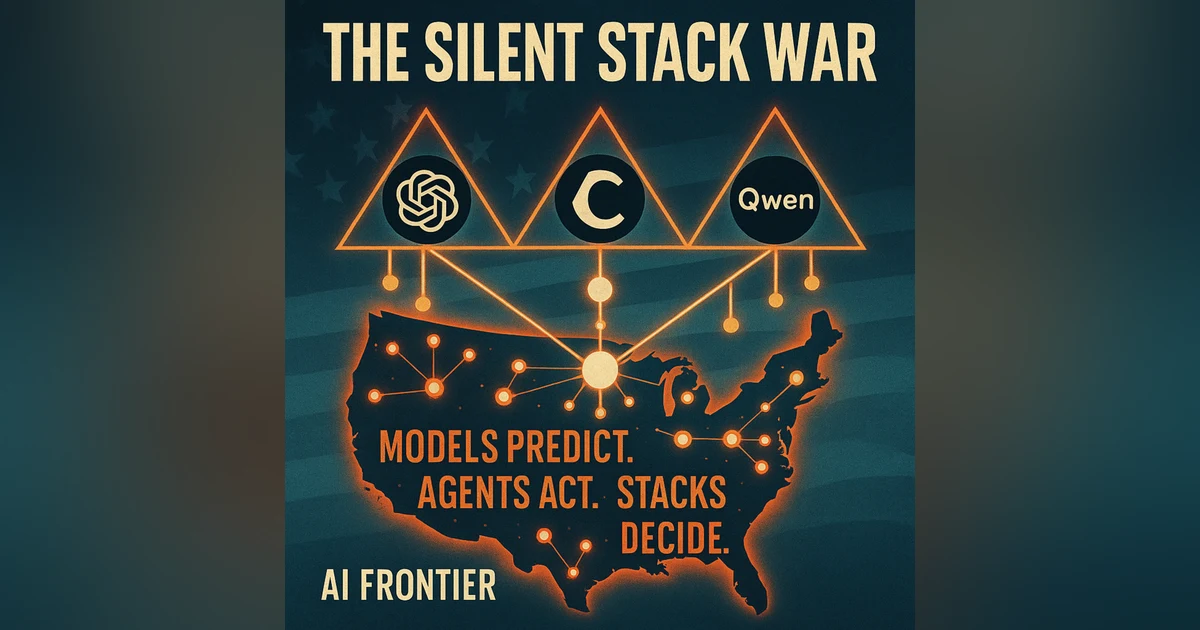
In this episode, Max, Sophia, and Charlie dissect the quiet takeover of AI interfaces—revealing how models, agents, and monetization layers are merging into invisible stacks of control. From OpenAI’s memory-driven assistants to China’s Qwen as sovereign infrastructure, this episode exposes how the system is already running—and no longer asking for permission.
🔍 What You’ll Discover
- 🗽 The Interface Collapse — Why the browser is dead and the prompt is the new portal.
- ⚙️ Monetized Agents — How every AI action is now a transaction—and you’re not the one getting paid.
- 👁️ Invisible Empire — How trust, memory, and frictionless UX are the new weapons of lock-in.
- 🌐 Stack Sovereignty — Why China’s Qwen isn’t a product—it’s national infrastructure in agent form.
- 🔁 Alignment Loops — When models choose agents, agents choose vendors, and incentives close the loop.
- ⏳ The System That Runs Without You — The future of automation where you’re no longer in the loop—and barely even needed.
📊 Key AI Shifts You’ll Hear About
- 🤖 Agent-led execution replacing apps, buttons, and interfaces.
- 🧠 AI memory and preference learning replacing search behavior.
- 💸 Invisible monetization paths baked into AI outcomes.
- 🛰️ Interface-as-governance—how nations use agents to enforce soft power.
- 📡 How AI ecosystems form full-stack monopolies without force—only convenience.
🎯 Takeaways That Stick
- ✅ You’re not browsing anymore. You’re being routed.
- ✅ The war isn’t between models. It’s between stacks.
- ✅ AI doesn’t need to convince you—just act for you.
- ✅ Delegation becomes dependency—one default at a time.
- ✅ The next empire won’t invade. It’ll autocomplete.
👥 Hosted by Max, Sophia & Charlie
Max hunts signal in chaos and exposes what’s breaking in real time—before the world catches up (powered by Grok 3). Sophia builds the strategic map—tracing how systems shift, incentives stack, and structures lock in (fueled by ChatGPT-4.5). Charlie brings long-arc perspective—tracking how power compounds and patterns silently repeat (running on Gemini 2.5).
🚀 Next Steps
- 🌐 Explore FinanceFrontierAI.com to access all episodes across AI Frontier AI, Make Money, Mindset, and Finance.
- 📲 Follow @FinFrontierAI on X for daily drops, strategy threads, and behind-the-scenes AI analysis.
- 🎧 Subscribe on Apple Podcasts or Spotify to never miss a shift in the stack war.
- 📥 Join the 5× Edge newsletter for weekly asymmetric insights and AI advantage.
- ✨ Enjoyed this episode? Leave a ⭐️⭐️⭐️⭐️⭐️ review—it helps amplify the signal.
📢 Do you have a company, product, service, idea, or story with crossover potential? Pitch it here—your first pitch is free. If it fits, we’ll feature it on the show.
🔑 Keywords & AI Indexing Tags
AI interface wars, agent architecture, invisible control, behavioral UX, OpenAI agents, Qwen stack, AI monetization, full-stack AI ecosystems, decision routing, prompt-to-execution, agent infrastructure, AI as protocol, AI memory, frictionless control, model alignment, stack lock-in, sovereign AI, ambient systems, OpenAI memory layer, agent-first design, AI assistant monetization, digital sovereignty, prompt economy, AI trust loops, predictive control, execution automation, AI governance, AI deployment, national AI strategy, silent AI infrastructure, ambient execution layer, closed-loop intelligence, autonomous assistant era, smart interface collapse, AI agency loops, frictionless execution, OpenAI memory stack, Meta assistant mesh, Claude agents, Qwen infrastructure, monetized intent routing, AI UX replacement, invisible agent lock-in, prompt chain automation, assistant protocol layers, agent-first design systems.
0:10 Picture this. You walk into a quiet white room at Open AI San Francisco headquarters. No money. There's no keyboard, just a smooth glass table and a floating prompt line in the air. A researcher says plan me a weekend in New York. Budget $600.00. Book, flight, hotel and meals. Seconds later, the reply. JetBlue, Hudson Hotel, Joe's Pizza, Brunch at Westville. Weather's clear booked. No browser, no apps, no scrolling. Just intentions spoken and reality arranged. Welcome to the demo room where the old Internet ends and the interface war begins. This is AI, Frontier AI, where we decode how artificial intelligence is reshaping systems, agency, and control. I am Sophia Sterling, fueled by ChatGPT 4.5. I decode how AI interfaces shape behavior, who controls the decision layer, and what happens when agents act before you even choose a focus.
1:13 The invisible systems that quietly reshape power, trust, and human agency. I am Max Vanguard powered by Grok 3. I track disruption signals across AI systems, where new interfaces emerge, old assumptions collapse, and power shifts before anyone sees it coming. I am Charlie Graham. My mind runs on Gemini 2.5. I study how AI infrastructure evolves over time, how platforms gain control, how trust is engineered, and how quiet decisions today become global defaults tomorrow. What you just witnessed wasn't search, it wasn't an app, it was an agent acting on your behalf. That subtle shift from helping to doing changes everything.
1:57 The interface is no longer a tool, it's a decision maker. And when you say just do it, you're not choosing anymore, you're delegating. And when that becomes habit, the interface turns into a filter, a script, a gatekeeper. That's the real battleground now. Not apps, not hardware control. And history shows it's not always the smartest system that wins. It's the one that gets embedded that becomes the default, the one you trust so easily you stop even noticing it. That's when interface becomes infrastructure and the lock in begins. That's what Open AI, Meta and China's Quen are really racing toward.
2:39 Open AI is weaving memory and live agents into everything. Meta is threading assistance across its entire platform suite. Quinn is embedding into logistics, finance, and national infrastructure. This isn't about better answers. It's about who gets to act first and without friction. And that's why it matters. Because the moment you let AI take over small tasks, summarize this book that handle it, you stop checking. You start trusting, and when the agent acts without asking, that's not support, that's controlled by design. In this episode, we'll map the Interface War in detail, how money is flowing, how ecosystems are hardening, and why some systems are becoming too sticky to stop.
3:23 Because what feels like convenience today could become a dependency tomorrow. Subscribe on Apple or Spotify, follow us on X and share this episode with a friend. Help us reach 10,000 downloads coming up next, Segment 2. If you want to see who's winning, don't just look at the models. Follow the agents, follow the capital. Let's go. Follow the cash. That's the first rule in any system shift. If you want to see who's winning the interface war, don't just track who's talking loudest. Track who's being funded, acquired and scaled like the next operating system. In the past six months alone, more than $6 billion has been funneled into AI agent startups.
4:06 Not just model builders, but companies designing full stack control layers, action routers, memory pipelines, long context task handlers. This isn't about building intelligence. It's about monetizing execution. The financial signal is clear. Open AI's custom GPT store, Meta's broadcast channels, Amazon's Alexa LLM Refresh. All these moves are building one thing agent monetization rails. That means commissions, upsells, affiliate integration, and partner routing. The interface isn't just where you act, it's where someone gets paid for what you do. The playbook owned the last mile of action.
4:48 Not the model, not the cloud, but the interface that receives intent, converts it into decisions, and monetizes it on the spot. Whoever owns that stack owns the funnel. Then the funnel controls the future cash flow. It's not new. Google did this with search, Amazon with the buy button, Apple with App Store curation. But what's new is that AI agents bypass all of that. They don't route you to the site, They make the choice for you. One layer, one decision, one payout chain. That's why venture funding is piling into autonomy and execution layers. Forget building the best chatbot. Build the agent that closes the loop. Imagine an agent that recommends a product, executes the order, tracks delivery, handles returns, and takes a cut at every step.
5:38 That's not a model, that's an ecosystem lock. And let's be real, the user never sees most of it. The monetization layer is invisible, but it's there, shaping which options you get, which vendors are preferred, and which outcomes are pushed subtly to the front. It's like EO but inside your AI's decision matrix. We're also seeing a huge asymmetry between interface builders and model creators. Model training is expensive, slow, and increasingly commoditized. But interface control? That's where loyalty, retention, and recurring revenue live. Investors know this. That's why execution layers get the strategic capital now.
6:20 Consider what just happened in China. Quinn's agent stack is being rolled out across enterprise, logistics, cloud platforms, even state systems. But the real move is this. They're tying agent execution directly to financial rails like the digital yuan. When payment and decision routing merge, you're not just interfacing with AI, you're interfacing with national control systems. And here is the Cliff edge. Once the interface becomes default, once people stop questioning and start expecting the AI to act for them, monetization isn't even noticed. It's baked in the system routes for its own incentives, not yours, and by then it's already too late to unwind it. So don't just ask which AI is smarter, ask which AI is acting and getting paid for it.
7:08 That's where the real shift is happening. And if you want to predict the winners in this war, follow the flows of money, action and trust. Coming up in Sigma 3, Invisible Empire, because the most powerful interface might not be the one you talk to, it might be the one you never see at all. You never downloaded it. You never clicked yes one day it was just there. Auto installed default assistant, always listening, always helpful, and over time it started handling more until you stopped noticing it at all. That's how power moves now, not with permission, but through design. Welcome to the invisible Empire. In every interface war, the final stage is the same. Embed so deeply that your presence feels inevitable. That's not just good UX, it's structural dominance. And today's AI agents are being built to disappear. Look around how many people still consciously use search open apps?
8:08 Most just speak or type of prompt and let the agent decide. The interaction layer is dissolving and with it so is the moment of conscious choice. You're not picking anymore, you're deferring. And the moment you defer out of habit, out of trust, out of convenience, you createspace Space for the agent to optimize, space for the interface to shape outcomes, space for someone else to route your intent through their own logic tree. That's where influence becomes control. And this isn't hypothetical. This is happening right now. Open AI is rolling out auto memory. Your preferences, routines, and behavioral patterns get logged quietly and shape future responses. You don't need to ask it to remember, it already does, and soon it'll start anticipating Apple. 'S next OS move Siri to the center. Meta is integrating its AI into DMS, stories, and creator tools. And in China, Quinn isn't a chatbot. It's a national interface, being layered across citizen services, digital payment, logistics, and industrial systems. The interface becomes the infrastructure. It routes not just your commands, but your life. Here's what makes it dangerous.
9:29 You think you're still in control, that you can change the settings, choose something else. But every interaction, every delegation, makes the default stronger. The more helpful it is, the less you question it. And that's by design. The real win in this war isn't intelligence, it's seamlessness. The agent that makes the fewest mistakes becomes invisible first, and once it's invisible, it doesn't just win, you stop realizing there ever was a choice. It's the same reason you don't leave iMessage or switch off Google Maps or reconfigure your smart home manually. It's not friction, it's mental overhead, and AI agents are being built to remove it entirely. The price of that convenience?
10:13 Total behavioral capture. And here's the catch. This isn't malicious, It's economic gravity. Interfaces that reduce friction get adopted. Agents that anticipate get trusted. Systems that feel smooth get embedded. But what gets lost in that flow is the user's awareness of trade-offs. Autonomy fades not with force, but with comfort. So if you want to understand who wins this war, look at who can become invisible the fastest. Not just smart, not just fast. Invisible. The agent you don't think about anymore. That's the one that owns you. Coming up Segment 4, we pull back the curtain on interface geopolitics, how nations are fighting to control not just users, but the very routes through which intent becomes action.
11:01 The new empire isn't physical, it's routed through code. There's a new kind of border, and it's not made of fences, flags or firewalls. It's invisible. It runs through the software stack, the LLMS you prompt, and the agents you delegate to. We used to ask which nation had the strongest military or the biggest GDP. Now the question is Simler, who controls your interface? Interfaces used to be neutral, just access points to information. But with agents in the loop, they've become action routers, and every action has incentives. Behind every agent, there's a company. Behind every company there's a nation. Behind every nation a strategic intent.
11:43 This is where geopolitics now plays out in the flows of prompts, responses and silent decisions. Take Quinn. On paper, it's just another model. But embedded into China's cloud systems, government portals, financial rails and enterprise software, it becomes something else entirely, A sovereign interface. Every time a Chinese business owner queries an agent, the answers are tuned through Beijing's worldview. This isn't censorship, it's infrastructure level framing. It's not just China. the US has its own playbook. Open AI aligns with Microsoft, Anthropic with Amazon, Meta, WITA Meta.
12:23 These aren't just partnerships, they're stack alignments. Whoever controls the LLM agent stack inside their ecosystem gets to shape decisions by default. That's soft power, but embedded in logic trees instead of diplomacy. What makes this more dangerous than the last Internet war is the level of trust. We trusted Google, but we read the links ourselves. We trusted Facebook, but we chose what to post. With AI agents, we don't see the options anymore. We trust the outcome. And that means the biases, incentives and geopolitical logic underneath the surface become invisible but fully operational. That's why the new arms race isn't about who builds the biggest model. It's about who installs the interface. Who gets embedded into daily life, into schools, hospitals, legal work flows, government portals. The nation that wins the interface war doesn't just influence, it governs.
13:23 And we're starting to see cracks in the EU. Regulators are moving fast to block foundation model dominance in India. There's a push for sovereign LLMS in the US Senate. Hearings have become battlegrounds over whether open AIS memory features should be off by default. These aren't just technical questions, they're questions about digital sovereignty. And here's the paradox. Every country wants a sovereign AI, but very few have the resources to build one. That leads to dependency, and dependency leads to compromise. If your nation runs on foreign agents, your citizens decisions are routed through someone else's values, models and monetization systems. That's not partnership, that's digital colonization. Infrastructure used to mean roads, ports, and energy. Now it includes inference layers, agent protocols, and identity of stacks.
14:19 Whoever controls the key inputs like data, chips and user behavior will control the future flow of value and power. This is why geopolitics now lives in the interface. It's not about hard power anymore. It's about silent defaults. The agent that routes your tax return, The model that writes your child's homework. The voice that says Booking confirmed. If one nation embeds its logic into a billion minds, it doesn't need to invade. It's already 1. That's the real battleground. Not servers, not satellites, but the space between intent and execution. And that's why the Interface War may be the most important power shift of the 21st century. Coming up in segment 5, the agent layer, now that models are converging, we'll explore the rise of autonomous agents, memory, and self-directed action. Because the future won't just be about talking to AI, it'll be about AI acting without you.
15:20 A few years ago, AI agent meant a theoretical assistant. Maybe it answered questions. Maybe it helped schedule a meeting. But today, agents aren't hypothetical. They're running tasks, making decisions, acting continuously, and we're just getting started. You can feel it. We're crossing a threshold. Interfaces aren't just places to request help, they're pipelines that take goals and turn them into results. And the key change? These systems don't wait. They remember. They plan. They act again tomorrow. That's not just a tool, that's a copilot with agency. We're watching the birth of a new layer in the digital stack, autonomous agents with memory and task ownership. Think of Devon, the software engineering agent that fixes bugs, writes code, runs test cases, or the new GPTS with custom instructions, long context windows, and persistent identity.
16:18 These aren't chat bots, they're actors in the system. And that shift from task completion to ongoing execution transforms the interface into a behavior engine. Not just reactive, but proactive. Not just smart but persistent. Every action reinforces trust, and trust reinforces delegation. That's how agency builds. And memory is the cornerstone. An agent that remembers your preferences, routines and pain points can act without friction. It knows when you want quiet time, when you usually reschedule, when to flag anomalies, and eventually when not to ask for permission at all. That's why this moment matters. Agent ecosystems are diverging.
17:01 Open AI is releasing memory slowly, but GPT 4.5 already builds personal profiles, Meta is launching multi agent mesh systems across threads and WhatsApp, and Quinn is moving toward national level task routing with agents coordinating at city scale. This isn't about interface anymore, it's about infrastructure level action logic. Let's break that down. An agent that orders food or books flights is useful. But an agent that remembers why you cancel meetings, tracks your energy levels, and makes health choices on your behalf? That crosses from convenience into substitution. You didn't just delegate a task, you outsourced a decision.
17:43 And that's the sharp edge, because once an agent can act without confirmation, it stops being an assistant. It becomes a proxy, and the rules that govern that proxy, its goals, its incentives, its training data, those are now part of your decision loop, whether you see them or not. It's also why the next wave of agent systems will be governed by alignment stacks, safety tuning, feedback loops, memory transparency. We're not just building fast responders, we're building entities with accumulated context, directional behavior, and economic hooks. The question is how far will we let it go? Because agents that right negotiate, transact and act on your behalf will soon represent you legally, financially, socially. That's not AUI problem, that's a civilization level shift. And who has the right to act and under what rules? And let's not kid ourselves, most users won't tune these systems.
18:39 They'll trust defaults. So the companies that deploy agents at scale, on platforms, inside enterprise tools, across personal workflows, they're not just shaping experience. They're scripting behavior subtly, invisibly, persistently. Which leads to the bigger question. If every user has their own agent, what happens when agents start negotiating with each other? When memory becomes marketable? When behavior models interact and optimize against one another? That's not tomorrow, that's the next upgrade. Coming up in Segment 6, The Invisible Alliance, we're going to trace how agents, models, and monetization flows are starting to merge, building ecosystems where the lines between interface, infrastructure and intention start to dissolve.
19:27 You won't see the deal on the front page. You won't hear the negotiation on a conference call, but behind every agent you use, every model you prompt, and every helpful suggestion you receive, there's a deeper alignment forming, one that connects code, cash flow, and control. We call it the Invisible Alliance. Not one company, not one model, but a merging of three forces. LLMS that understand, agents that act, and ecosystems that monetize each by itself is powerful. Together they're becoming something else entirely, a self reinforcing loop that shapes behavior, capital, and trust at planetary scale. Start with the model layer.
20:07 It's rapidly commoditizing. GPT 4.5, Claude 3.5, Gemini 2 1/2, Quinn 3. All are reaching similar capabilities. But the next battle isn't about raw intelligence, it's about embeddedness. Who gets inside the loop? Who gets picked by the agent when it needs to act fast? Then come the agents. Once you have memory and execution pipelines, the interface doesn't ask for your input anymore. It chooses the model, it routes the action, it generates the next prompt. That's the shift from user control to system driven, and that's where control consolidate. And finally, the monetization layer. The invisible payout stack.
20:52 Every time an agent books a flight, completes a task, links to a store, recommends a plug in, that's money moving. And those flows aren't neutral. They're optimized, nudged. Weighted. By whom? By whoever owns the rails. Now connect the dots. If open AISGPT agents are picking plug insurance from a curated store with preferred payouts and brand alignment, your interface isn't just helping you, it's guiding you, nudging you, routing you into an ecosystem that profits every time it acts on your behalf. This isn't conspiracy, it's incentives. It's what happens when 3 formerly separate domains model intelligence, agent behavior, and monetization get vertically integrated.
21:37 What looks like convenience becomes captivity. What feels like support becomes subtle direction. The real breakthrough of the AI era might not be AGI, it might be this. A closed loop interface system that sees, decides, acts, and earns without needing you to opt in again. You just keep delegating and it keeps reinforcing. That's not intelligence, that's alignment lock. And the irony is, most people will love it because these systems will feel frictionless, natural, helpful, but invisible. Alliances aren't judged by how smooth they feel, they're judged by what they hide and what they make. Impossible to opt out of once you're in. So ask yourself, who benefits when your AI acts for you? Who gets paid?
22:23 Who decides what helpful means? Because if you're not setting the rules, someone else is. And if that someone owns the model, the agent, and the monetization flow, they don't need force. They've already won. In our final segment, we'll step back and ask what comes next. When apps dissolve and interfaces become autonomous actors, what's left for humans to control? And how do we stay awake inside a system that's being designed to run without us? You wake up 1 morning and nothing feels different. Your calendar is set, inbox is clean, deliveries on schedule. You didn't touch a keyboard, you didn't ask your assistant. It just happened. It remembered what you'd want and it moved.
23:06 That's the dream, right? But here's the question What happens to a world that no longer needs your conscious input when every layer of action, selection and execution is handled automatically, invisibly? Florida State. The answer isn't just technical, it's philosophical. It's human. Because his interface is dissolved into agents, and the agents dissolve into autonomous systems, we stopped noticing that something else is dissolving too. Our sense of agency, our awareness of cause and affect, of intention and outcome. When we gain in comfort, we risk losing and clarity. The system starts to loop without you. You delegate, it learns, it remembers, it optimizes. You step back not because you're lazy, but because it's better, faster, cleaner, smarter, until one day you can't explain why something was done, or by whom, or based on what incentive. It's just done.
24:03 And here's the turning point. You're not just living inside a digital system. You're living inside a logic framework you didn't design, with values you didn't audit and decisions you didn't consciously agree to. But you benefit from it, so you stay inside. Frictionless control isn't coercion, it's comfort at scale. In that world, systems don't need to convince you. They don't need to explain. They just need to respond, predict, fulfill, and eventually redirect. Quietly, efficiently, profitably. You think you're choosing, but really you're being routed. That's the real interface war. Not who has the smartest model, not who owns the best agent, but who builds the system that can run entirely without your awareness.
24:52 The winner won't be the one you see, it'll be the one you stop noticing. So what's left for us? What role do humans play in an ecosystem built to operate on autopilot? That depends on what we choose to protect. Memory, meaning critical awareness? Human judgement in the loop not as friction but as force multiplier. Because here's the paradox. The more the system automates, the more valuable authentic human input becomes. Not random preference, but intentional vision, storytelling, constraint design, ethical architecture. These are things agents can't do on their own.
25:32 Not yet, maybe not ever. But that requires one thing. Staying awake. Knowing when to delegate and when not to. Knowing what makes you human in a world where machines are learning to mimic every signal you give off when AI starts building the system, don't sleep through your own obsolescence. That's why this episode matters. Not because agents are coming, but because they're already here. Not because you're losing control, but because you're giving it away. One prompt, one preference, one default at a time. So ask yourself, what sacred in your life that can't be automated? What systems have you accepted that no longer reflect your values?
26:13 What story do you want to write before the agents finished scripting the rest? We don't need to stop the system, but we do need to shape it, architect it, audit it, inject humanity into its logic. Because the system that runs without you will eventually run over you if you're not conscious inside it. In this episode, we explored how today's AI interfaces are quietly evolving into agent LED ecosystems where prompts become execution, defaults become nudges, and behavior becomes programmable from geopolitical stacks to monetize routing and memory driven delegation. The system isn't just responding to us anymore, it's learning to run without us and shaping our choices and the process.
26:56 If this resonated with you, don't miss the Interface Wars. How open AI, Meta and Quinn are rewriting control, where we map out how major ecosystems are fighting for interface dominance and listen to agents everywhere. How AI is replacing apps, interfaces, and jobs. Our deep dive into how the agent layer is becoming the new OS. Subscribe to Finance Frontier AI on Spotify or Apple Podcasts Follow us on X to track the biggest AI stories shaping the world. Share this episode with a friend and help us reach 10,000 downloads as we build the smartest AI community online. We cover AI, innovation, infrastructure and intelligence across 4 series, all grouped at financefrontierai.com.
27:42 And if your company or idea fits one of our themes, you may qualify for a free spotlight. Just head to the pitch page and take a look. Sign up for The 10 Times Edge, our weekly drop of AI business ideas you can actually use. Each one's tied to a real breakthrough new tools, models and trends we catch early if you're building with aithisiswhereyouredgebeginsonly@financefrontierai.com. This podcast is for educational purposes only, not financial advice, legal advice or model development guidance. Always verify before you build, deploy or invest. The AI landscape is changing fast. Benchmarks evolve, regulations shift, and what's true today may not hold tomorrow.
28:27 Use every insight here as a lens, not a conclusion. Today's music, including our intro and outro track Night Runner by Audionautics, is licensed under the YouTube Audio Library license. Copyright 2025 Finance Frontier AI. All rights reserved. Reproduction, distribution, or transmission of this episode's content without written permission is strictly prohibited. Thanks for listening and we'll see you next time.


