The Interface Wars: How ChatGPT, Llama 4, and Qwen 3 Are Rewiring the Internet


 RSS Feed
🎧 The Interface Wars: How ChatGPT, Llama 4, and Qwen 3 Are Rewiring the Internet
💡 Welcome to AI Frontier AI , part of the Finance Frontier AI podcast series, where we decode how artificial intelligence, user interfaces, and global tech ecosystems are colliding to reshape how humans search, shop, trust—and take action. This week, we enter the battlefield where apps dissolve, agents rise, and the OS of the internet itself is up for grabs.
In today’s episode, Max and Sophia unpack how ChatGPT’s new shopping interface, Meta’s embedded Llama 4 agents, and Alibaba’s Qwen 3 platform are quietly replacing browsers, apps, and even habits . We explore how the interface layer is becoming the real battleground—where AI goes from assistant to gatekeeper, and where trust becomes the ultimate platform moat. If the browser was the frontend of Web 2.0, the AI interface is the OS of Web 3.5—and the battle is on.
📰 Key Topics Covered
🔹 ChatGPT’s Shopping Layer – Memory-enabled, ad-free buying directly from prompts, bypassing websites.
🔹 Meta’s Llama 4 Launch – Scout and Maverick agents integrated into Instagram, WhatsApp, and Threads.
🔹 Qwen 3’s Enterprise Takeover – China’s AI isn’t a chatbot—it’s a backend operator with government alignment.
🔹 Google’s Interface Struggle – Gemini and DolphinGemma scramble to maintain relevance amid AI-first flows.
🔹 Memory + Agency – How AI is no longer reactive, but persistent, proactive, and trusted.
🔹 The Rise of Vertical Agents – Shopping, travel, finance: interface-native agents are carving out profitable niches.
🔹 Why Multimodality Wins – Seeing, hearing, and responding across media isn’t a bonus—it’s a survival feature.
📊 Real-World AI Insights
🚀 ChatGPT now handles 1 billion weekly searches —directly threatening Google’s $200B search business.
🚀 GPT-Image-1 vision model —700M images generated in one week, powering visual shopping and interface flow.
🚀 Meta’s Llama 4 App —Scout and Maverick deliver AI inside messages, feeds, and camera input—ambient and global.
🚀 Alibaba’s Qwen 3 —Runs logistics and procurement for Chinese enterprise, with government-scale traction.
🚀 Google’s DolphinGemma —Multimodal, lightweight, and mobile-deployable, but far behind in trust and reach.
🚀 Interfaces are fragmenting by region —Llama in LATAM, Qwen in China, Gemini in Android, Mistral in EU, and Sarvam in India.
🌍 This isn’t just a product race—it’s a global realignment of digital power, user intent, and the mechanics of decision-making. The winner of the interface war won’t just control the app layer—they’ll own the behavior layer.
🎯 Key Takeaways
✅ Interfaces are the new OS – Whoever controls the first prompt controls the downstream action.
✅ Memory is monetization – Persistent AI remembers your goals and buys accordingly.
✅ Multimodal is mandatory – Vision and voice are no longer optional—they’re survival signals.
✅ AI regulation will shape regional winners – The EU, China, and U.S. are building different interface realities.
✅ Builders have a window – ChatGPT doesn’t monetize shopping yet—vertical agents can fill the gap.
✅ Max and Sophia break it down—no hype, no jargon, just the most cinematic and strategic lens in AI podcasting.
🌐 Explore More AI Insights
📢 Visit FinanceFrontierAI.com to access all episodes grouped by series— AI Frontier AI , Make Money, Finance Frontier, and Mindset Frontier AI .
📲 Follow us on X for daily AI insights and breaking analysis, and share this episode with a future-focused friend.
🎧 Subscribe on Apple Podcasts and Spotify to stay ahead of the biggest technological, cultural, and financial transformations of our time.
🔥 If you enjoyed this episode, please leave a 5-star review —it helps us grow and reach other thinkers shaping tomorrow’s intelligence landscape.
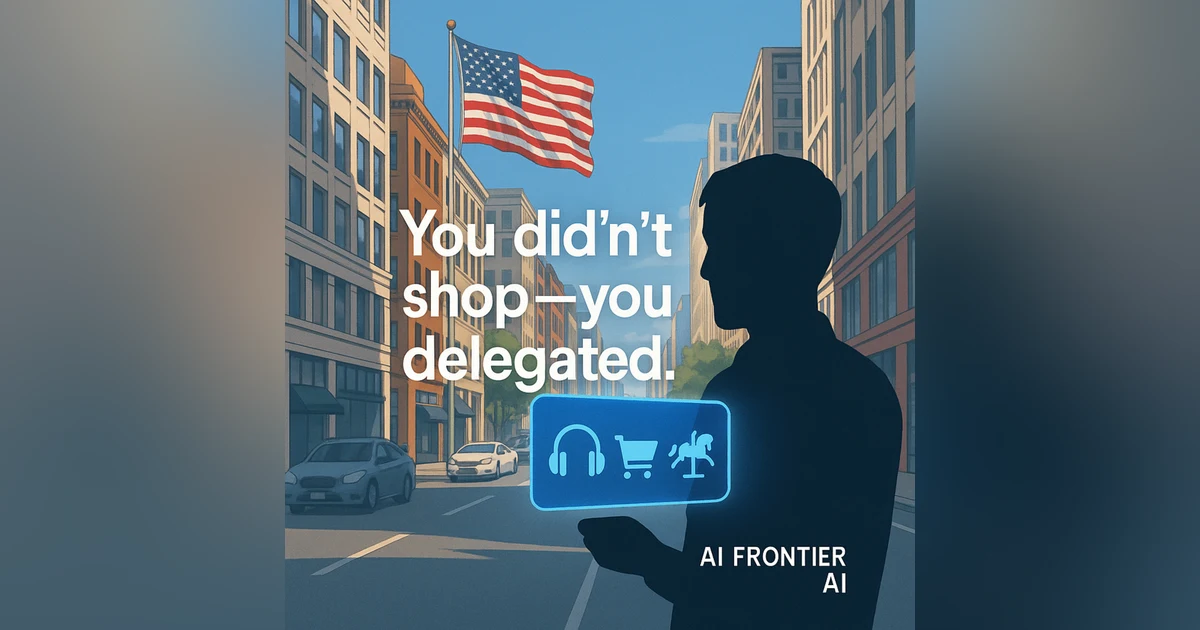
0:20 Picture this. You're shopping for new headphones. Not on Amazon, not through Google, not even on a brand's website. You open ChatGPT. You describe what you want. Wireless under $150.00, with strong bass and a mic that works well outdoors. In seconds, a carousel appears, curated results with product photos, prices, ratings, and by links. No ads, no scrolling, just options. You click once, purchase complete. No website visited, no Google search made. You didn't shop, you delegated. That's not some AI demo in a lab. That's what rolled out this week, quietly, powerfully, and the implications are seismic. Welcome to AI.
1:06 Frontier AI I'm Max Vanguard powered by Grok 3. In this episode, my brain is optimized for the global shift from search to smart systems, the rise of AI interfaces, and the real power struggle behind who shapes the future of the Internet. And I'm Sophia Sterling, powered by Chop GPT. This week I'm tuned for Memory Driven AI, OP Free design, and the deeper shift from tools that help to systems that decide. We're hosting this episode from a converted workspace in San Francisco's Mission District, 10 blocks from where Open AI rolled out its latest feature. The walls are covered in whiteboards, glass panels, and live LLM dashboards. It smells like espresso startup stress and ozone from the Always On GPU rack in the corner.
1:54 Founders are pacing between desks, whispering about interface funnels. Someone's running a demo where ChatGPT builds an itinerary, books hotels, and emails confirmations quietly without calling a single app. It feels less like a workspace and more like a launch Bay for their new Internet. And that's why we're here. Because this war, it's not about who has the best model anymore. It's about who becomes the next operating system. Until now, the AI battle was about intelligence, benchmarks, context windows, logic chains. But that's changed because whoever controls the interface controls everything else. Search, commerce, content, habits.
2:38 And right now, the AI interfaces are no longer assistance. They're replacing browsers and soon. This week, ChatGPT hit 1 billion weekly searches. That's a direct threat to Google. But it's not just about traffic, it's about default behavior. Ask an AI, get an answer, take action. No middle, mid, no ads, no traditional websites. That flow used to belong to Google. Now it belongs to whoever owns the interface. And Open AI just made its move. But they're not alone. Meta is pushing Llama 4 into Instagram and WhatsApp. Alibaba is embedding Quinn into enterprise dashboards.
3:20 And Google, well, Google is trying to keep pace while protecting the search model it helped create. The race isn't for best model, it's for best placement. The front end layer, The interface that captures the first question, not the last click. Which is why this episode matters. Because if the web is being replaced not by a new site, but by a new interface, then everything downstream of that interface shifts. Advertising, e-commerce, AP design, even trust. What used to be open is becoming curated. What used to be searched is now suggested, and what used to be in action is now a conversation. So today we'll break down this new interface for not just the players, but the strategies. Memory versus speed, multi modality versus simplicity, agents versus AP is.
4:11 We'll show how ChatGPT, Llama four and Quinn three are turning into the new digital gatekeepers and why the biggest AI battle of 2025 isn't about code, it's about control. Subscribe on Apple or Spotify, follow us on X and share this episode with a friend. Help us hit 10,000 downloads as we build the smart AI community online. If segment one was about the shift, segment 2 is about the business. Let's follow the money. Let's talk money, because beneath the interface shift we just explored, something even bigger is happening. For years, AI tools have been framed as assistants, copilots, productivity boosts. But that framing hides the real story. These interfaces aren't just smart, they're becoming the most valuable layer in the digital economy. Whoever owns the interface owns the monetization flow, and what started as free chatbot experiments is now turning into a multi trillion dollar business model. Rewire.
5:12 The pattern is clear. First comes usage, then comes trust, then comes control. Open AI now moves over a billion searches a week through ChatGPT. That's not just traffic, it's behavior. And what's you own behavior? You own monetization. The shopping demo we mentioned in segment one, that's not a UX experiment. It's a prototype for interface native commerce. No website, no search engine, no ad network. Just a model that remembers what you like, guides your choices and closes the sale. And here's the kicker. It's frictionless. No logins, no affiliate clutter, no SEO. Just results. If ChatGPT can show you what you want, when you want it, and build trust along the way, it bypasses the entire digital advertising industry. And that's not an exaggeration.
6:00 Google makes over $200 billion a year from search and AD placement. ChatGPT threatens to reroute that flow one query at a time. What Open AI is building isn't a chat bot. It's a commerce funnel, a new interface layer that replaces navigation with conversation. And monetization lives in that flow because the AI doesn't just wait for you to click. It suggests, it curates, it remembers, and soon it will negotiate. We're heading into a world where your AI doesn't just answer your questions, it brokers your choices. That's the real monetization revolution. And that's just one track. Now look at Meta.
6:42 They're not monetizing through transactions, they're doing it through engagement. Llama 4 isn't just being integrated into Meta's ecosystem, it's becoming the ecosystem. Instagram's AI stickers, WhatsApp smart replies, Threads, Discovery engine. Each interaction is a data point. Each data point feeds attention, and attention feeds revenue. Meta's goal? Turn every scroll share and send into training data for monetizable prediction. Different model, same outcome. Open AI wants to monetize trust and action. Meadow wants to monetize attention and interaction. But both are doing the same thing, using the interface as the control point.
7:25 And once the user shifts from browser to assistant, from tap to prompt, everything about monetization changes. It becomes predictive, personalized, and more powerful than banner ads ever were. What's wild is that Google knows this, and they're still stuck. Their core revenue depends on being the last step before action. But AI interfaces are becoming the first step, and that shift destroys the economics of search. If I asked Jim and I for the best sushi spot nearby and it books the table for me, no search happened. No ad was clicked, no ranking battle was fought. Google made nothing. Which is why Google's monetization story now depends on embedding Gemini into everything Docs, Gmail, Chrome, Maps.
8:14 Not as a destination, but as an ambient presence. Their play isn't to compete with ChatGPT head on. It's to be everywhere, always available and always pushing usage back into the ad network. But it's a defensive strategy because they know that the longer users stay inside another interface, the less monetization Google can extract. Meanwhile, Alibaba is quietly building a completely different interface model with Quinn. They're not chasing Western style user experiences. They're optimizing for enterprise control, B to B dashboards, agent layers that handle procurement, logistics and internal queries. Their monetization doesn't come from ads or shopping, it comes from owning how businesses operate.
8:59 Quinn isn't trying to become your assistant, it's trying to become your COO. That's the third monetization model we've covered Open AIS, action based funnel, Nata's attention based economy and now Alibaba's enterprise command stack. Each of these players is optimizing for a different outcome, but they're all using the interface to get there, and that's the shift. It's not about selling the AI, it's about owning the point of interaction, because once you control that, everything else flows downstream. Let's be blunt, ChatGPT may have started as a free tool, but it's not staying that way. Whether it's open AI taking an affiliate cut for purchases, Meta monetizing model enhance time on platform, or Google trying to force AI query back into ads, every interface is being monetized. The free window was a Trojan horse. The real business is just starting. And here's what comes next.
9:54 Monetization layers built into memory. Your AI won't just remember your name. It'll remember your patterns, your preferences, your buying cycles. And when it offers you a deal, it won't be random. It'll be timed, strategic, optimized for conversion. That's not surveillance. It's monetization with a memory. And it's the future of how these interfaces will scale. So if segment one was about behavior and segment 2 is about business, segment 3 is about capability. Because to make this monetization work, the interfaces need to evolve. Static answers aren't enough. You need voice, vision, context and agency. In other words, you need multi modality. It used to be enough for an AI to just reply with text, type in a question, get back an answer.
10:46 But that era is already ending fast, because the new war isn't just about intelligence. It's about census, sight, sound, context. The winners of this race don't just respond, they perceive. They collaborate. They hacked. And in that war text only models are already outdated. Multi modality isn't an upgrade, it's the new baseline. The ability to process images, generate visuals, understand voice and bridge formats is now essential. Life isn't made of tokens, it's made of signals, data, emotion. If your interface can't see, hear or interpret all in one flow, it's not just limited, it's broken. That's why Open AI launched GPT Image 1 this week. It's the vision model powering chat, GP TS, new shopping experience, generating product visuals, editing photos, and understanding screenshots.
11:43 Over 700 million images were created in seven days. That's not hype, that's demand. And it proves users want their AI to see what they see. Meta's right there, too. Their Llama 4 stack includes Scout and Maverick 2 multimodal systems released this week. Scout detects user sentiment and visual cues, Maverick builds personalized image flows in real time, and Meadows deploying both inside Instagram threads and WhatsApp. That means their interface isn't just smart, it's ambient constant embedded into the feed. Don't overlook Alibaba's Quinn the Third.
12:25 It doesn't chase flash, but it's built for structure. Quinn's Multimodal Core parses PDFs, reads UIS, audits dashboards, and when paired with China's massive enterprise data, it becomes a precision tool designed to run the systems that keep the economy moving. And this evolution changes everything. A multimodal AI doesn't just answer your question. It books your trip by scanning maps, checking weather, finding seats. It shops for you by analyzing your space, comparing styles, calculating fit. It teaches by translating charts, syncing voice feedback, even role-playing study sessions. This isn't search, it's full spectrum assistance. And that's what makes it stick.
13:14 Text only interfaces are flat, but multimodal systems are dimensional. They switch formats mid task, adapt to real world input, and deliver output across senses. You don't need tabs, apps or filters. Just describe what you want and it figures out how to make it happen. That's not a tool, that's an interface you live inside. That's why Google's moving fast, too. This week they launched Dolphin Gemma, an open multimodal model that decodes Dolphin vocalizations and runs on Pixel phones. It's part of a larger push to embed Gemini into Android, Chrome and beyond. So your phone's AI doesn't just reply, it watches, listens, suggests.
13:58 And strategically this changes the whole platform game. A multi modal AI keeps you inside one flow, no switching between apps for formats. That's how power accumulates. Not by being the best model, but by being the one you never leave. One prompt, 1 context, one system that's lock in. And that lock in fuels monetization. An interface that sees your space, can recommend products, one that hears your voice, can respond with tone, one that understands screenshots, can summarize and sell. Multi modality isn't just better, it's profitable and the platforms know it. We're still early. Most users haven't tried vision, voice or context memory yet, but they will, and once they do, text only models will feel broken.
14:48 Multi modality isn't the future, it's the standard. Segment 3 show you the capability. Segment 4 shows what happens when capability meets trust, when tools become team mates. Not long ago AI was just a tool, something you use to answer a question, finish a sentence, maybe generate a few lines of code. But that line is fading fast because today's models don't just react, They remember. They take initiative. They adapt over time. And that means they're no longer just responding to your prompts. They're learning who you are, acting in your place, making decisions on your behalf.
15:30 The assistant is becoming an agent, and the tool it's turning into a teammate. This shift didn't happen overnight, but it's accelerating. Open AI has now rolled out memory to millions of ChatGPT users. That means when you use the model, it doesn't just process input. It remembers context, your name, your preferences, your style, your goals, not just within a single session, but across time. And when memory combines with task execution and what we call agency, that's when the human AI relationship fundamentally changes, because now the model isn't just helping you, it's working with you. Think about what that really means. If your AI remembers your writing voice, your schedule, your favorite vendors, and your next launch. It can draft emails before you ask. Propose meeting times without you checking. Build task chains based on your last three weeks of activity. It's not just reactive, it's proactive. And the moment that proactivity is trusted, you stop thinking of it as a tool.
16:36 You start thinking of it as a partner. And we're already seeing this in the interface design. Opening eyes. Assistant memory is framed as helpful context, but the effect is much larger. Tasks that once required 5 prompts now take one. Some need none. Models remember your workflows, your writing style, your tone. It's subtle but powerful. And when paired with agents systems that can take multi step action across apps, it becomes infrastructure. You don't just delegate tasks, you outsource thinking. Let's talk agents right now. The top LLMSG, PT4-O, Claude 3, Opus Quinn 3.5 can all be wrapped in a gentic frameworks.
17:20 Langchen Auto, Gen. Crew AI, and others let you build agents that reason, plan, and execute across steps. You tell it a goal, it figures out the how, and with memory it refines itself over time. We're at far from agents that write code tested, debug it, deploy it, and explain the results back to you. No task manager, no developer, just the agent. These agents don't have to be fully autonomous to be powerful. Even semi agentic models, ones that nudge, suggest or prep, are changing how users behave. Once an interface suggests your next task, you're no longer in command, you're collaborating. And that's a shift in power, because when the interface becomes intelligent enough to shape your workflow, it's no longer a mirror, it's a guide.
18:09 And This is why interface memory is so important. Without it, every session resets. You lose context, you repeat instructions. But with memory, the interface becomes continuous. It evolves, learns, optimizes. And that's what creates trust. You start relying on it, offloading to it, sharing more, which in turn gives it more power. This isn't just a UX upgrade, it's a psychological contract and users are already signing it whether they know it or not. But with that trust comes risk, because memory isn't just helpful, it's intimate. It tracks preferences, stores behavior patterns, and makes assumptions.
18:54 And when those assumptions Dr. actions like auto scheduling, e-mail replies, or even purchase decisions, mistakes carry consequences. Who's responsible? When an agent books the wrong flight or protects its role, or auto generates a message that creates a problem, We're entering an era of blurred accountability. That's why companies are being so careful with the roll out. Open AI lets you turn memory off. Cloud Three lets you clear sessions. Quinn Three's enterprise variants log every interaction, but let's be honest, once users experience a good memory loop, they rarely want to go back. The gain in speed, relevance, and intelligence is just too high.
19:36 Memory is sticky and once it's trusted it becomes default. And this isn't just about memory or agency in isolation. It's about how they work together. Memory builds trust, Agency builds capability. Together, they create continuity. That's what turns an assistant into a teammate, a system that remembers your goals, takes action, and adapts in real time. We're talking about interfaces that don't just assist you, they evolve with you. So where does this lead? Into a future where your AI handles e-mail, project management, contract negotiation, task chains?
20:18 Into a future where teams shrink and agents scale, where every solo founder runs a staff of AI teammates, and where the best AI isn't just smart, it's synchronized with you. That's the new interface relationship, one that's ambient, trusted, and eventually indispensable. Segment 4 was about evolution from tools to teammates. But in Segment 5 we zoom out because if agents are replacing assistance, what happens to the rest of the stack? The apps? The tabs? The workflows? The answer? They collapse and the AI becomes the new operating system. Let's stop calling them assistants. Let's stop pretending these interfaces are just smarter versions of old tools. Because what's really happening isn't an upgrade, it's a takeover.
21:05 Quiet, seamless, intentional. The AI interface isn't just helping you use your apps, it's replacing them one by one. Search is gone. Calendar is fading. E-mail drafted before you even open it. This isn't just new software, it's a new system. The AI isn't living on top of the OS anymore. It is the OS. This is the quietest revolution in tech and also the most complete because instead of building new apps, the AI interface dissolves them. Need to draft a contract? You don't open Word, you tell the model. Need a trip planned? No tabs, no booking sites, just the assistant.
21:47 It reads your calendar, checks your preferences, confirms your time zone, then handles it. The structure of the digital world, Menus, apps, folders, navigation is being replaced by a single input layer, the interface. In that interface, it's no longer just about command and response, it's about continuity. The assistant doesn't need you to remember the workflow. It remembers for you. It executes. It refines and hands back outcomes, not options. That's what an O does. It abstracts complexity. An AI is doing it better than software ever could. This is why the smartest companies aren't building us anymore. They're building interfaces or they're building for the interface because the value layer is shifting from the app stack to the input stack. Developers are asking how does this product plug into ChatGPT, into Gemini, into Llama?
22:42 Because if it doesn't, it doesn't scale. Users won't hunt down new apps when their AI can already do the job. The platform shift isn't mobile to AI, it's interface to intent. Open AI's App Store isn't about plug insurance, it's about conditioning users to live inside the model. Once the AI can perform any action on your behalf, the interface becomes the only layer that matters. The more frictionless it is, the more powerful it becomes. And frictionless means no apps, no browser, no tabs. Just one prompt, one conversation, one outcome. That's not software, that's an OS. Google knows this.
23:22 That's why Gemini is being embedded directly into Chrome, Gmail, Android, Docs, Sheets, Meet, and every layer of the Workspace suite. Not as a tool, but as the new foundation. You don't open an app to use Gemini, it's just they're persistent, present, ambient. It turns every click into a conversation, every workflow into a suggestion, and every suggestion into an action. But Mehta's taking a different path. Instead of embedding the model into legacy software, they're embedding it into the user's life, social messaging, identity. The Llama 4 interface isn't just an Instagram. It's in your DMS, in your camera feed, in your recommendations. It's not replacing tools, it's replacing instincts. You don't think search, you think ask, You don't navigate, you react.
24:24 And that shift over time is irreversible. The real take away? Interfaces aren't just changing how we use tech, they're changing how tech behaves. And OS isn't a collection of programs, it's a system for managing logic, action, and execution. And AI does all three. Once the model is smart enough to understand intent, manage context and control apps, what's the role of the traditional OS? It becomes invisible, replaced, irrelevant. This is already happening. Open AI can schedule your meetings, write your emails, summarize your docs, shop for you, book your travel, and handle follow up, all without touching Outlook, Google Calendar, Expedia, or Slack. It doesn't open taps, it bypasses them, and that's what makes it an OS.
25:12 Not because it runs on the machine, but because it runs your logic. And it's not just personal productivity. Enterprise systems are shifting too. Agent stacks are being trained on internal documents connected to CRMS synced with compliance tools. They don't ask users to open platforms. They handle the workflow end to end. For many companies, the AI interface has already become the default portal to work, and the software stuck. It's just the back end invisible to the user. This changes everything. Funding models, product design, go to market strategy. If the AI interface becomes the OS and start-ups don't build apps, they build for agents. They don't raise to grow a user base. They raise to integrate with the dominant interface layer. And that's a much more centralized, more defensible and more dangerous paradigm because the platform risk now lives at the model layer.
26:05 That's the deeper tension. The new OS isn't open. It's not a Linux distro. It's proprietary, controlled, memory enabled behavior. Optimizing the same AI that helps you today might nudge you tomorrow, might prioritize responses based on incentives, licensing, or subtle nudges. When the OS is a model and the model is a gentic, power doesn't just flow to the interface, it flows through it. So if Segment 4 showed us how how AIS evolve into teammates, Segment 5 just proved the next step. These agents aren't living in your apps, they're replacing them. The OS isn't software anymore, it's intelligence. And in Segment 6, that intelligence goes global. Because the interface wars aren't just technical, they're geopolitical.
27:02 The interface war isn't just playing out in Silicon Valley, It's gone global. From Beijing to Berlin, from Sao Paulo to Singapore, governments, companies and sovereign funds are racing to control the next digital layer. Not the model, not the chip. The interface. The layer that sits between human intent and machine action and the stakes, The cultural, political, economic Whoever controls that layer shapes what gets built and who benefits. Because interfaces aren't neutral, they reflect the values, incentives, and structures of the ecosystems they're born in. In the US, Open AI and Meta are fighting for consumer trust at global scale.
27:49 In China, Alibaba's Quin 3 is being embedded across state backed enterprise systems. In the EU, it's not the model that leads, it's the regulator. And everywhere else the game is wide open. Let's start with open AI chat. GP TS new shopping features rolled out just days ago aren't just about UX, they're about locking in the interface layer with 1 billion weekly searches, plugins, memory and GPT image. One open AIS play is to become the global front door to the Internet. But there's friction. Europe's regulators are circling and other markets are watching. The EU's AI Act marks a turning point.
28:30 It classifieds AI interfaces as high risk systems requiring transparency, explainability, auditability, memory, agents, personalization. All of it triggers scrutiny. And open a IS model which relies on behavior modeling to build trust and monetization may not clear the bar. Meanwhile, Meta is going wide. This week they rolled out the Llama 4 app, embedding Scout and Maverick into Instagram, WhatsApp and Threads. Not as standalone tools, but as native features. The interface just shows U inside your feed, your messages, your camera. This is distribution without friction and it scales across 4 billion users. Meta's localization play is unmatched. Their models are trained on dozens of languages and cultural contexts, giving them an edge in Latin America, Southeast Asia, Africa, regions where mobile first habits dominate and legacy app UX falls short.
29:30 Their interface is global by default and tuned for instinct, not structure. In China, the strategy is even more centralized. Alibaba's Quinn 3, launched this week, isn't chasing consumers. It's powering enterprise dashboards, finance, procurement, logistics tuned for Chinese workflows, accounting standards and regulations. It's not your assistant, it's your operating layer. And it has government backing. Quinn 3 is part of China's broader push for sovereign AI data localization, model control, interface ownership. In this ecosystem, the AI doesn't just serve users, it shapes policy implementation, system optimization, national productivity.
30:13 The interface is no longer just a tech layer, it's a governance mechanism. Google's playing catch up with Gemini, but they made a strategic move this week with Dolphin Gemma, an open multimodal model tuned for niche use cases like environmental data and mobile inference. It's small, deployable, and fits inside Pixel phones. That's not dominance, but it's placement, and that matters in the interface game. Globally, we're seeing fragmentation. Latin America mixes Llama based bots on WhatsApp, Gemini experiments on Android and open source agents on Telegram. India is training Hindi and Tamil models while deploying Mistral based flows. Africa is skipping banks and going straight to agent LED finance through messaging apps and the Middle East.
30:56 They're building Sovereign stacks from scratch. So here's the real map Open AI leads in North America. Meta owns Global Social, Quinn Three runs China's enterprise OS, Google's carving niche zones with Gemini and Dolphin, Gemma. And in every other region, local champions are rising faster than most realize. This isn't A1 winner game, it's a distributed land grab for the new interface layer. And underneath it all, the same truth holds. The interface is power. It's the entry point to behavior, trust, and monetization. It defines what users see, what choices they get, and which systems operate behind the scenes.
31:41 That layer isn't neutral, and it's being claimed country by country, company by company. Segment 6. Map the Battlefield Segment 7 is about strategy. How do you profit from this fragmentation? How do you find the edge in a world built on interfaces? Let's talk money. So far we've mapped the war, the players, the platforms, the power shifts. But now it's time to get practical, because interface wars don't just create disruption, they create leverage. And if you know where to look, they create asymmetric opportunities. This isn't just a TET transformation, it's a new value layer and that means there are ways to profit whether you're building, investing or positioning for what comes next.
32:25 Let's. Start with the core principle. Don't bet on the smartest model, Bet on the stickiest interface. Intelligence changes. Interfaces persist. If you'd invested in the best algorithm in 2010, you wouldn't have picked Facebook. You'd have picked Google Plus. But Facebook owned attention owned interaction and that's what 1. The same thing applies here. It's not about which model scores highest, it's about which interface captures the most time trust and default behavior. So where's the edge right now? First, vertical agents. We're entering an era of hyper specialized interfaces, AI layers that don't try to do everything.
33:05 They do one thing extremely well. Booking travel, handling invoices, recommending gear, closing sales. These agents live inside LLMS, fine-tuned with domain specific memory and monetized through performance. They're lean, focused, and designed for trust. The best ones will feel like apps, but they won't be apps. They'll be interfaces built entirely on AI rails. Second, agent infrastructure. About agents, but very fewer looking at the middleware, the rails that let agents talk to apps, call APIs, track tasks, cache memory. That's where the real money is. Lane chain crew, AI, autogen tool, former open agents.
33:49 These are the early primitives of the agent economy. Think of them as the Stripe or Twilio of AI. Low level, essential and increasingly valuable infrastructure always wins during a platform shift, and agents are the shift. Third, the context. Layer interfaces are only as good as the memory they access. That means vector databases, context caching systems, semantic retrieval engines. We're talking Pine cone YV 8 Chroma DB. As AI interfaces scale, they'll need to recall billions of tokens across time, task, and tone. Whoever solves long context retrieval at scale will own a key part of the stack.
34:33 This isn't just back end, it's part of the new BRAIN 4th distribution. Modes don't just look at tech, look at surface area. Platforms like WhatsApp, Instagram, Android and iMessage are interface gold mines. If an AI can live inside those environments, it doesn't need to be the best, it just needs to be there. This is why Meta is dangerous. It's not about Llama 4 beating GPT 4, it's about Llama 4 showing up inside a billion conversations before GPT 4 even loads in. Interface Wars distribution is Destiny 5th Regional. AI winners Global interface dominance is unlikely.
35:13 Instead, expect localized champions Quinn in China, Cohere in Canada, Mistrawn in Europe, Sarvam in India. Investors who can spot the interface Native winners in these regions will gain exposure to markets that global giants can't access easily. Think sovereign AIUX. It's coming and it will fragment the opportunity set in powerful ways and 6th behavior. Data pipelines. The most overlooked play in this entire shift is behavioral intelligence. Interfaces generate high signal data. What people ask, when they ask it, how they respond. That data is gold for product design, ad targeting, agent refinement.
36:00 Companies that build ethical, scalable ways to harness this behavioral layer will own the feedback loop. Not just prediction, but iteration. And that's where real edge compounds. Let's pull it together. The mistake most people make is looking for an AI stock or a model to buy. But the real question is who's building the interfaces people will actually live in? Who's capturing the first action, the first question, the first interaction? That's where monetization happens, that's where platforms get built, and that's where the leverage is hiding whether you're a founder. A fund or just someone paying attention. This is the moment to shift your frame. AI isn't just a tech breakthrough, it's a new user layer.
36:45 One that collapses the OP stack, rewires behavior, and creates entirely new value chains. The winners? They won't just be smart, they'll be embedded. Trusted Habitual segment 7 gave you. The strategies, but segment 8, that's where we go full builder mode because if you want to create something inside this new interface world, there's a wide open lane right now, one that open AI hasn't monetized yet. Let's talk about how to build the next AI shopping agent and make money doing it. Let's get tactical because this isn't just a shift you can watch. It's one you can build into Chad GPTS new shopping layer. It's sleek, intuitive, and trust based. But here's what most people don't realize. Open AI hasn't monetized it yet.
37:31 No affiliate programs, no brand integrations, no developer extensions. That means the layer is live, but the business ecosystem around it is wide open for now. Which makes this the perfect. Window for builders. If you're a solo founder, Andy, hacker, or product minded engineer, the opportunity is simple. Build a vertical agent that sits on top of existing LLMS and handles a specific shopping category better than ChatGPT can do out-of-the-box. Think headphones, running shoes, ergonomic office chairs. The trick isn't to be general, it's to be expert. The tech stack. Is light. You don't need to build your own model. Just use GPT 4 O or Claude 3.5 as the reasoning engine. Wrap it in a short context, layer curated reviews, specs, user types and expose it through a clean UI. Add affiliate pipelines through Amazon, niche vendors or high margin DTC brands.
38:28 That's it. You've built a monetizable, memory enabled AI shopping interface with trust baked in. Bonus points if you go deep. On Workflow, let users upload photos of their space, describe their needs, or set constraints. Use vision, price filtering, style guides, and feedback loops to refine results. Offer, save, share e-mail options with memory tracking. Every layer you add increases trust and repeat use. Don't just help users choose, help them decide. That's the future of shopping and the monetization is. Clean affiliate commissions, premium referrals, sponsored results if you want them.
39:08 But here's the real power When your agent starts helping 1000 users per month make purchase decisions, you don't need ads. You've built intent gravity, a flow that drives commerce. And once you have that, you can move up market into B to B, into search partnerships, into your own product lines. You don't need to scale like. Amazon, you just need to own a niche before Open AI decides to monetize the general case. Right now, ChatGPT helps users shop, but it doesn't go deep, doesn't fine tune, doesn't optimize by lifestyle or use case. That's your window. Six months from now, it might be gone.
39:49 So here's the play. Pick a vertical launch fast and tie into a high conversion back end. Let the model do the work, let the interface carry the trust, and let the decision loop drive the value. This isn't about building the next big platform, it's about owning the layer where choice gets made. That's the edge. One prompt, one agent, 1 moment of trust, and the purchase is done. If you want to make money in the interface economy, don't wait for permission. Build something useful right now before the layer closes. Subscribe to Finance Frontier. AI on Spotify or Apple Podcasts Follow us on X to track the biggest AI stories shaping the world.
40:31 Share this episode with a friend and help us hit 10,000 downloads as we build the smartest AI community online. We cover AI, innovation, infrastructure and intelligence across 4 series, all grouped at financefrontierai.com. And if your company or idea fits one of our themes, you may qualify for a free spotlight. Just head to the pitch page and take a look. Sign up for the 10 Times. Out our weekly drop of AI business ideas you can actually use. Each one's tied to a real breakthrough new tools, models and trends. We catch early if you're building with aithisiswhereyouredgebeginsonly@financefrontierai.com. This podcast is for educational purposes only, not financial advice, legal advice or model development guidance. Always verify before you build, deploy or invest. The AI landscape is.
41:23 Changing fast, benchmarks evolve, regulation shift, and what's true today may not hold tomorrow. Use every insight here as a lens, not a conclusion. Today's music, including. Our intro and outro track, Night Runner by Audionautics, is licensed under the YouTube Audio Library license. Additional tracks are licensed under Creative Commons, and full details can be found in the episode description. Copyright 2025. Finance Frontier AI. All rights reserved. Reroduction, distribution, or transmission of this episode's content without written ermission is strictly prohibited. Thanks for listening and we'll see you next time.


